Get DeafLetter
A weekly selection of signals, vulnerabilities and guides. Critical alerts remain optional.
You can unsubscribe at any time. Privacy policy.
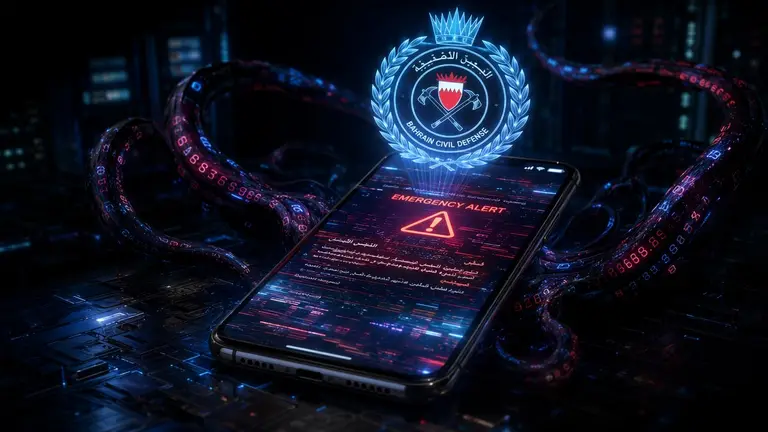
Dream Research Lab published its analysis of a mobile surveillance campaign on July 20, 2026. The operation exploits fear from geopolitical tensions in the Gulf. The malicious app, named "BH Alert," impersonates the Bahrain Civil Defense emergency-alert application and distributes a multi-stage malware capable of stealing credentials, intercepting SMS and OTPs, capturing screenshots, and taking full remote control of Android devices. Distribution occurs through pages that clone the Google Play Store and Bahraini government sites, leveraging emotional urgency during real air-defense events to trick users into sideloading.
- The "BH Alert" app impersonates Bahrain's civil defense alert but is distributed exclusively outside the Google Play Store, via cloned domains with fake download counters exceeding 100,000 and fraudulent "Verified by Play Protect" badges.
- The final payload carries the package name
com.kisa.octagonpaneland is built on the Ward framework for command and control, with a regular heartbeat of roughly 5 seconds detectable via network monitoring. - The infection chain unfolds in four stages: an RC4 loader hidden in a font file (ZfChs.ttf), a social-engineering intermediate payload, an RC4 shell, and finally the OctagonPanel RAT with full remote surveillance.
- The malware abuses Android Accessibility Services and a sham VPN service that blocks legitimate app connectivity while keeping the command channel open.
How the Trick Works: Real Emergencies, Fake Apps
According to the cited source, the mechanism requires no zero-day vulnerabilities or sophisticated exploit techniques. "During active air-defense events, official emergency-alert applications see sharp spikes in install demand," Dream Research Lab explained, "and fear does the rest." The malicious pages present bilingual English/Arabic content citing the Bahrain Civil Defense, the Ministry of Interior, and references to the UNDRR to fabricate institutional legitimacy.
Users searching for the official app during a real or perceived alert are steered to domains such as download.alert-bh.com, download.bh-security.com, playgoogle.alertbh.com, and bh-alert.com. Clicking the install button downloads an APK of roughly 20 MB with a timer-delayed delivery, a technique that mimics the feel of an official store download.
Anatomy of the Four-Stage Chain
The malware's architectural complexity serves to evade static detection and fragment forensic analysis. Stage 0, dubbed Ematterassist, contains an RC4-encrypted payload disguised as a font file ZfChs.ttf: on load, the loader decrypts and injects DEX code into the app process. Stage 1, with package com.kit.kitty, handles the social engineering by pressing Android's permission mechanisms. Stage 2, Hvoicemanual, is an RC4 shell that prepares the environment for the final payload. Stage 3 activates com.kisa.octagonpanel, the OctagonPanel RAT with the Ward framework for active surveillance operations.
The Ward framework implements WardAccessibilityService to gain granular control of the user interface, enabling automated clicks, reading on-screen content, and intercepting credentials entered in banking apps via overlay. The sham VPN service, described by the source as "intentionally disrupts normal device connectivity," isolates the victim from legitimate services while preserving the tunnel to the command server. Additional anti-analysis techniques include runtime code injection, junk logic to obfuscate execution flow, and exclusion of overlay windows from the recent apps task manager.
"Network monitoring can help detect this malware once active, since it phones home on a steady ~5-second heartbeat — an anomaly that stands out as a consistent, identifiable traffic pattern, detectable even without decrypting the traffic itself" — Dream Research Lab spokesperson, via Dark Reading
Command Infrastructure and Attribution Signals
The C2 channel uses AES-GCM over TCP with endpoints embedded in the payload, according to Rescana. The roughly 5-second heartbeat interval generates an anomalous, constant traffic pattern that the source says is detectable even without decrypting the content.
Russian-language elements appear in package names and code artifacts, but the dossier establishes no definitive attribution to a known APT group or nation-state operator. No infrastructure overlaps link the actor to publicly attributed campaigns by specific entities in the current state of research.
What to Do Now
- Verify the source of emergency apps: Legitimate Bahraini government apps are not distributed via sites outside the Google Play Store or Apple App Store; any link to
download.alert-bh.comor similar is malicious. - Monitor network traffic for the ~5-second pattern signature: The Ward framework's C2 heartbeat is identifiable as a constant periodic anomaly, even without decrypting the AES-GCM payload.
- Check for unauthorized active VPN services: The connectivity-blocking mechanism is a distinct behavioral indicator detectable via MDM tools on corporate devices.
- Inspect Accessibility Services permissions: The legitimate civil defense alert app does not require extended accessibility for its function; a request for
WardAccessibilityServiceis a compromise marker.
Why This Attack Redraws the Risk Perimeter
The BH Alert campaign demonstrates that institutional social engineering can outperform technical exploit techniques. There is no need to find an Android vulnerability when you can clone a ministry's credibility during a missile alert. For enterprises with personnel in the GCC, the risk translates to corporate devices bypassing MFA by intercepting OTPs in real time, and access to corporate apps via screenshots and lockscreen credentials.
The real vulnerability is not in the code, but in the social trust that emergency apps require to function. When a real crisis collapses users' critical latency, the margin for verifying a download page's authenticity vanishes. This dynamic is replicable in any emergency context: weather alerts, public health, terrorism. The malware does not have to "break" anything. It only has to wait for the moment when fear makes verification impossible.
Frequently Asked Questions
- Is there an official Bahrain civil defense alert app involved in this campaign?
- No. The official app is not compromised; the campaign relies on impersonation via fake pages.
- Why is the payload hidden in a font file?
-
.ttffiles are legitimate binary formats that static detection engines tend to exclude from deep analysis. The use of RC4 adds an obfuscation layer requiring the runtime key for decryption. - Does the malware target only individuals or also enterprises?
- Enterprise impact stems from compromise of BYOD or corporate devices accessing corporate services, with credential-theft capabilities that bypass MFA. No indications emerge of specific targeting against financial or government entities.
Information verified against cited sources and current as of publication.
Sources
- https://www.darkreading.com/mobile-security/fake-bahrain-alert-apps-android-surveillance-malware
- https://cybersecuritynews.com/fake-bahrain-civil-defense-android-app/
- https://www.gdnonline.com/Details/1401276/Fake-alert-app-warning
- https://mallory.ai/stories/019f8ba9-e207-7dc9-bcbc-a42a2609e123
- https://www.rescana.com/post/active-exploitation-alert-fake-bahrain-alert-app-deploys-advanced-android-surveillance-malware-targeting-gulf-region-use
- https://thehackernews.com/2026/07/threatsday-android-spyware-plc-attacks.html
- https://www.cisa.gov/news-events/news/cisa-fbi-epa-and-us-government-partners-update-warning-iran-affiliated-threat-actors-targeting
- https://thehackernews.com/2024/01/atomic-stealer-gets-upgrade-targeting.html
- https://thehackernews.com/2023/03/mispadu-banking-trojan-targets-latin.html
Get DeafLetter
A weekly selection of signals, vulnerabilities and guides. Critical alerts remain optional.
You can unsubscribe at any time. Privacy policy.