Get DeafLetter
A weekly selection of signals, vulnerabilities and guides. Critical alerts remain optional.
You can unsubscribe at any time. Privacy policy.
The DOUBLECUP criminal framework sells its operators a concealment technique described as "steganographic" in the service's control panel. According to technical analysis from the SANS Internet Storm Center, the mechanism uses no real steganography: the PowerShell payload is visible in plaintext, appended after the end of the PNG file, extractable with Windows' standard FINDSTR command. The mismatch between criminal marketing and technical implementation makes the first stage detectable with elementary integrity checks, lowering the detection threshold compared to legitimate LSB techniques.
- The DOUBLECUP payload does not encode PowerShell code in the PNG image's pixels or metadata but appends it in plaintext after the end of the file, separated by CR+LF [SOURCE 1]
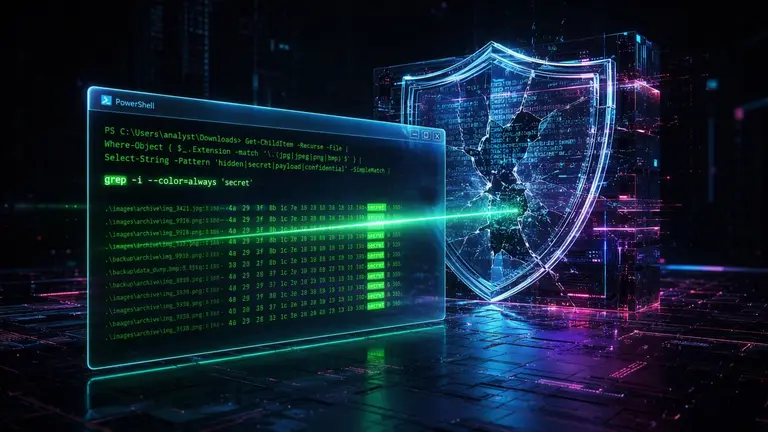
- Extraction requires only FINDSTR, Windows' native grep, with a unique identifier: no specialized tools needed [SOURCE 1]
- The LaaS service panel lists "findsrt" as a steganographic method, confirming the mismatch between operational description and technical reality [SOURCE 2]
- The second stage implements environmental keying with the victim's public IP for PBKDF2 and a SHA-256 stream cipher in CTR mode [SOURCE 2]
How DOUBLECUP's "Fake Steganography" Works
The first-stage mechanism exploits the PNG format's tolerance for trailing content. The image file ends with its structural signature; immediately after, with a 0x0D 0x0A separator (CR+LF, Windows line terminator), the PowerShell script begins in plaintext. There is no encoding, no concealment in pixels, no injection into IHDR, IDAT chunks, or EXIF metadata.
The SANS ISC analyst verified directly: "You can see the PowerShell payload as cleartext." Anyone opening the file with a hex editor or text viewer will see the PowerShell code after the image's binary content. The PNG parser ignores everything after the end of the file, but the content remains accessible to any static analysis tool.
Extraction requires a single command line: FINDSTR with a unique identifier present in the script, followed by a direct pipe into PowerShell. No decoders, no LSB algorithms, no image processing libraries are needed. The technical barrier for forensic analysis is practically non-existent, whereas genuine LSB steganography would require bit-plane scanning of pixels with payload reconstruction.
The LaaS Architecture: Real Sophistication and Inflated Marketing
DOUBLECUP is a Russian-origin Loader-as-a-Service designed for ClickFix campaigns with a client-server architecture. The service offers a management panel with configurable payload options, including an entry for "steganographic" methods that lists "findsrt" — almost certainly a typo for "findstr," confirmed by SANS ISC analysis.
The framework is not without sophistication. The second stage implements environmental keying: the cryptographic key derives from the victim's public IP address, applied in PBKDF2 with a stream cipher based on SHA-256 in CTR mode. Polling to the C2 server occurs at 1.2-3 second intervals on the /session/check?sid=[SessionID] endpoint with 16-character identifiers generated at page load.
Documented final payloads are CountLoader, for Windows and macOS, and the DeviceManager RAT with C2 communication via EtherHiding. Active campaigns impersonate CRM systems — NetSuite, Odoo, HubSpot, Salesforce — using embedded iframes for the clipboard hijacking mechanism with fake captchas.
What to Do Now
The first stage of DOUBLECUP is detectable with elementary integrity checks. Security teams can implement three concrete actions:
1. Flag PNG files with suspicious trailing content. A legitimate PNG file contains no executable data after the end-of-file signature. Detection solutions can automatically flag images with appended PowerShell payloads, identifiable via cleartext string patterns or entropy anomalies in the trailing segment.
2. Extract and analyze the code with standard tools. FINDSTR is sufficient to isolate the script: no dedicated decoder is required. Analysts can replicate the extraction documented by SANS ISC using the unique identifier present in the payload, reducing analysis time from hours to minutes.
3. Correlate the source IP for targeted sandboxes. The second stage's environmental keying requires the victim's specific public IP for decryption. Capturing this data during network analysis allows sandboxes to replicate decryption conditions and extract the final CountLoader or DeviceManager payload.
Why False Criminal Marketing Helps Defenders
The mismatch between the DOUBLECUP panel's operational description and the actual technical implementation constitutes a recurring pattern in malware-as-a-service. Operators sell sophistication to other criminals, exaggerating technical quality to justify higher license prices.
For defenders, this dynamic creates an advantage. A payload believed to be steganographic when it is merely a simple file concatenation with a CRLF separator exposes itself to checks that a genuine LSB technique would evade. Sandboxes automatically extract appended scripts; analysts identify the code with standard tools.
The presence of environmental keying in the second stage partially offsets this advantage: static analysis of the encrypted payload does not reveal the final content without the correct IP. However, the first stage remains interceptable with network analysis that captures the source IP.
"New malware that uses steganography always gets my attention, but I was disappointed when I looked at the latest DOUBLECUP write-up. It doesn't use real steganography" — SANS ISC Analyst
What the Source Does Not Specify
The dossier does not document whether DOUBLECUP variants exist that actually implement LSB steganography in parallel campaigns. The "findsrt" method in the panel could be an internal typo or a proprietary service name; the source does not clarify whether other operators use different options. No data emerges on license volumes sold, number of active operators, or specific victim geography.
The brief does not list CVEs or official vendor advisories for the final CountLoader and DeviceManager payloads. The exact publication date of the SANS ISC analysis is not reported in the available material.
The Pattern of the Criminal Service That Overrates Itself
The DOUBLECUP case confirms that the malware-as-a-service ecosystem differs little from other illicit markets: perceived quality often matters as much as real quality. The declared "steganography" becomes a sales label, not an engineering property, with side effects that favor defenders.
The operational lesson is twofold: security teams can lower the alert threshold for payloads that declare advanced techniques without implementing them, focusing resources on genuinely sophisticated mechanisms like environmental keying. Analysis of terminology in criminal administration panels provides useful indicators for profiling a service's real technical level.
For the threat intelligence sector, the mismatch between description and implementation represents a signal of criminal market maturity: the standardization of LaaS services produces friction between innovation promises and codebases developed under time constraints, generating detectable gaps that defenses can exploit.
Information is based on cited sources and current as of publication.
Information is based on the cited source and current as of publication.
Sources
- https://isc.sans.edu/diary/rss/33274
- https://socradar.io/blog/doublecup-clickfix-loader-devicemanager-rats/
Get DeafLetter
A weekly selection of signals, vulnerabilities and guides. Critical alerts remain optional.
You can unsubscribe at any time. Privacy policy.