Get DeafLetter
A weekly selection of signals, vulnerabilities and guides. Critical alerts remain optional.
You can unsubscribe at any time. Privacy policy.
Check Point Research published the full description of a static deobfuscation pipeline for JSCeal on August 31, 2026. JSCeal is a JavaScript stealer distributed as compiled V8 bytecode. The research, presented at Black Hat USA 2026, demonstrates that it is possible to recover the malware's structure and semantics without sandbox execution, bypassing an anti-analysis barrier that has long slowed the threat intelligence ecosystem. The toolkit is publicly available on GitHub.
- JSCeal is an active stealer since March 2024 that arrives as a .jsc file compiled for V8, executed by a bundled Node.js runtime, with multiple layers of obfuscation applied before compilation.
- Check Point Research's pipeline operates on View8 pseudocode: value propagation, string reconstruction, control-flow unflattening, and proxy resolution reverse javascript-obfuscator transformations without executing the payload.
- The methodology was validated on 23 JSCeal samples collected over several months, producing analyzable output in all cases according to the source.
- Deobfuscated capabilities include keylogging, browser credential theft, cryptocurrency wallet theft, screenshot capture, and a local HTTPS MITM proxy for traffic interception.
The Double Layer Hiding the Stealer
JSCeal does not arrive as readable JavaScript source. The payload is distributed as compiled V8 bytecode in .jsc files, executed by a Node.js runtime bundled in the distribution package. This architectural choice represents a qualitative leap over traditional JavaScript infostealers: V8 compilation is inherently lossy, stripping original variable names, flattening control structures, and rendering conventional source-level deobfuscation tools inapplicable.
On top of that comes intense pre-compilation obfuscation. According to Check Point Research's analysis, operators use javascript-obfuscator with four main techniques: RC4-encrypted strings, control-flow flattening that disperses logical flow into a state machine, proxy functions that mask function calls, and operation wrappers that obscure arithmetic and logical operations. The result is a "double transformation problem": the code is obfuscated as source, then compiled to bytecode, losing further semantic information.
The generation analyzed in greatest depth used a Node.js build based on V8 10.2.154.26-node.25. The app.jsc file was compressed with Brotli and decompressed by a preflight.js before loading into the runtime. This transformation chain makes dynamic sandbox analysis insufficient for recovering the original logical structure: the malware runs, but its internal organization remains opaque to analysts.
How CPR's Static Pipeline Works
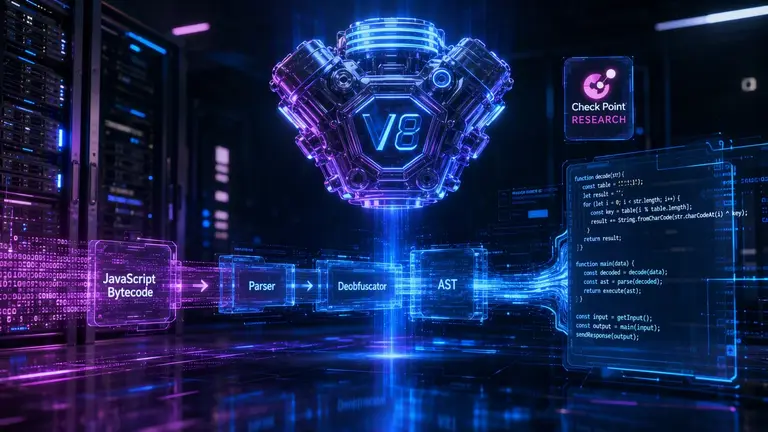
Check Point Research's answer is a fully static approach that inverts the transformations without ever executing the malicious payload. The starting point is View8, the V8 decompiler developed by Moshe Marelus (also CPR), which converts bytecode into pseudocode. From this intermediate stage, the pipeline applies a series of dedicated semantic-structural transformations.
The documented steps are four. First is value propagation: constant values are traced through the data-flow graph to reconstruct simplified expressions. Second is string reconstruction: RC4-encrypted strings are decrypted by reconstructing the key and algorithm from patterns in the decompiled bytecode. Third is control-flow unflattening: the control graph is restored from the state-machine flattening. Fourth is proxy/wrapper resolution: interposed functions between caller and callee are inlined to restore original semantic links.
Check Point Research extended View8 with three specific improvements: pickle serialization for handling intermediate data structures, deterministically normalized function identifiers to enable cross-sample comparison, and function-level visibility checks to manage scope in the presence of obfuscation. A bug in View8's original string printing, related to treating 16-bit code units as byte-oriented sequences, was also identified and fixed.
"The goal is not perfect source recovery — V8 compilation is lossy, and the output of decompilation remains pseudocode. Instead, we aimed to recover enough structure and semantics to read the malware as code again." — Check Point Research
What Emerged from the 23 Analyzed Samples
Systematic application of the pipeline to 23 JSCeal payloads collected over several months produced analyzable output in all cases, according to Check Point Research's documentation. This consistency is significant because it indicates that JSCeal's obfuscation techniques, while multi-layered, follow sufficiently regular patterns to be algorithmically inverted once the generator's structure is understood.
The recovered code allowed mapping the malware's operational capabilities in technical detail. JSCeal implements keylogging by capturing input events at the application level. It performs browser credential theft by locating specific SQLite database paths for Chrome, Firefox, and variants. It targets cryptocurrency applications through recognizable APIs and paths. It captures screenshots. Finally, it activates a local HTTPS MITM proxy to intercept traffic from the compromised machine.
Cross-sample comparison also enabled tracking the malware's evolution. Newer generations include the use of V8 code cache for more recent Node.js/V8 versions, an additional payload encryption layer, and macOS targeting. The malware is also known as WEEVILPROXY or MeadowLocust by other security vendors, indicating a fragmentation in nomenclature that systematic deobfuscation could help reduce.
What to Do Now
For threat intelligence analysts encountering JSCeal payloads or similar V8 bytecode-based samples, the hasherezade/jsc_deobfuscator toolkit provides an immediate operational starting point. The pipeline takes the .jsc file as input and produces deobfuscated View8 pseudocode, enabling structural comparison across samples collected in different periods.
The 23 documented applications by Check Point Research indicate the methodology is stable for JSCeal generations analyzed through Q1 2025. Analysts should verify the sample's Node.js/V8 runtime version: the generation studied in detail used V8 10.2.154.26-node.25, while evolutions with V8 code cache for newer versions may require adaptations to the decompilation flow.
For enterprise security teams, the research signals that detection based on JavaScript source signatures is inadequate for this class of payload. JSCeal never exists as readable source at distribution time: the compiled .jsc file and bundled Node.js runtime require binary artifact-level checks, not source-code pattern matching.
Frequently Asked Questions
Does the pipeline recover the original JavaScript source?
No. The process generates View8 pseudocode: V8 compilation is lossy and original variable names are irretrievably lost. The goal is to recover enough structure and semantics for analysis, not faithful source reconstruction.
Does the toolkit work on any compiled JavaScript malware?
The toolkit is specific to JSCeal's obfuscation patterns on View8 pseudocode. The implemented transformations (control-flow unflattening, proxy resolution, RC4 string reconstruction) are tuned to the documented javascript-obfuscator techniques as applied by this specific malware.
Why is static analysis preferable to sandboxing for this case?
According to Check Point Research, sandbox execution allows observing the malware's behavior but not recovering its internal organization. V8 compilation eliminates the high-level structures needed for code comprehension: the static pipeline inverts transformations before this information loss makes analysis impossible with conventional tools.
Sources
Get DeafLetter
A weekly selection of signals, vulnerabilities and guides. Critical alerts remain optional.
You can unsubscribe at any time. Privacy policy.