Get DeafLetter
A weekly selection of signals, vulnerabilities and guides. Critical alerts remain optional.
You can unsubscribe at any time. Privacy policy.
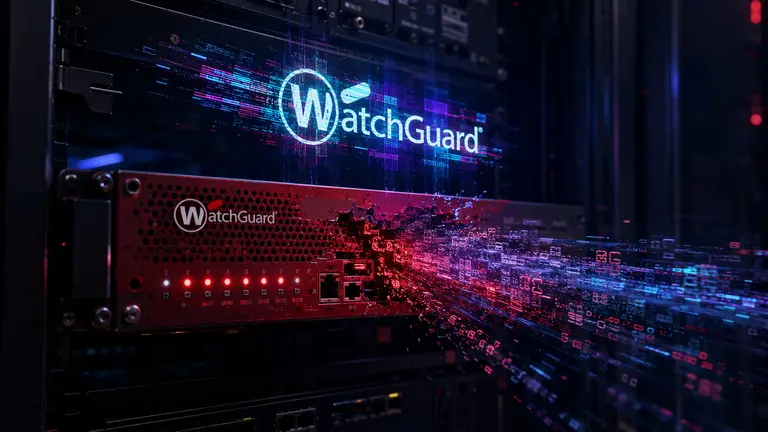
On July 29, 2026, Trend Micro's Zero Day Initiative published advisory ZDI-26-500, documenting a vulnerability in the networkd process of WatchGuard FireWare OS. The flaw allows an authenticated remote attacker to execute arbitrary code with root privileges on the device, compromising the perimeter security appliance from the inside. The severity is confirmed by a CVSS 4.0 score of 8.6, classified as HIGH in the CVE-2026-13050 record.
- The vulnerability resides in the
network_wireless_kick_off_user_cbfunction of the networkd process, where a lack of user-supplied data length validation causes a stack-based buffer overflow. - Exploitation requires authentication, but once that requirement is met it enables remote code execution in the context of root on the firewall.
- Affected versions include Fireware OS 11.8 through 11.12.4_Update1, 12.0 through 12.12, and 2025.1 through 2026.2.
- The vulnerability was reported to the vendor on May 22, 2026; coordinated public disclosure followed on July 29, 2026, after approximately 68 days.
The Mechanism: From a Wireless Client Management Function to Total Device Control
The specific vulnerability lies in the handling of wireless client management requests within the networkd process. According to the ZDI advisory, the network_wireless_kick_off_user_cb function fails to properly validate the length of user-supplied data before copying it into a fixed-length buffer allocated on the stack.
This classic programming flaw — a stack-based buffer overflow — allows controlled overwriting of return addresses and adjacent stack structures. The impact is radical: the attacker gains code execution in the context of the networkd process, which, per the ZDI advisory, operates with root privileges. This is not a subsequent local privilege escalation; the malicious code runs directly with the highest operating system privileges.
The authentication requirement narrows the attack surface but does not mitigate the severity of the impact. On a network device like a firewall, compromised credentials — via phishing, brute force, or password reuse — open a direct path to the internal infrastructure. The device meant to filter and control traffic becomes the bridge for bypassing the perimeter.
"An attacker can leverage this vulnerability to execute code in the context of root."
— Trend Micro Zero Day Initiative, Advisory ZDI-26-500
The Perimeter Paradox: When the Guardian Becomes the Breakpoint
The most unsettling aspect of this vulnerability is not technical but architectural. WatchGuard Firebox firewalls are designed to serve as the first and last bastion between internal and external networks. When an appliance of this type hosts a root-privileged RCE flaw, the paradox is clear: the device that inspects, filters, and blocks traffic can be weaponized to bypass itself.
A firewall compromised with root can be reconfigured to selectively forward traffic, exfiltrate data without triggering internal detection systems, or operate as a passive listening post with total visibility into network flows. The integrity of logs themselves becomes suspect, since an attacker with system privileges can manipulate activity records.
The CVE-2026-13050 record assigns the vulnerability a complete impact on confidentiality, integrity, and availability — all three dimensions of the CIA triad. The CVSS 4.0 vector AV:N/AC:L/AT:N/PR:H/UI:N/VC:H/VI:H/VA:H/SC:N/SI:N/SA:N reflects this completeness: the attack is remote, requires low complexity, needs no user interaction, but assumes the attacker possesses high privileges.
Disclosure Timeline: From Report to Patch
The timeline documented in the ZDI advisory is linear. Nicholas Zubrisky, a researcher with Trend Micro Research, reported the vulnerability to WatchGuard on May 22, 2026. The vendor subsequently released a corrective update, the availability of which is confirmed in the advisory, though no direct URL to the patch package is provided. Coordinated public disclosure followed on July 29, 2026, approximately 68 days after the initial report.
This interval aligns with standard coordinated disclosure practice, balancing the need for remediation with transparency to users. The official CVE record, published by cve.org, corroborates the ZDI advisory's technical data with the quantitative score and specific affected versions, providing a second independent verification point on the same fundamental facts.
Immediate Actions
- Verify the FireWare OS version running on Firebox devices: affected releases span 11.8 through 11.12.4_Update1, 12.0 through 12.12, and 2025.1 through 2026.2.
- Consult the WatchGuard support portal for the corrective update referenced in advisory ZDI-26-500, which the vendor issued prior to public disclosure.
- Review authentication logs on affected devices for anomalous access or recurring patterns that may indicate exploitation attempts prior to patching.
- Inspect wireless policy configuration on WatchGuard firewalls, as the vulnerable function is tied to wireless client management.
Operator Identity and Dossier Limits
The ZDI advisory does not specify whether the vulnerability was actively exploited in the wild prior to the patch release. It also does not detail whether the required authentication equates to full administrative access or a lower privilege tier, nor whether the network_wireless_kick_off_user_cb function is exposed exclusively via the web management interface or through other remote administration channels.
These gaps do not undermine the solidity of the verified facts — the mechanism, impact, score, and versions — but they define the perimeter of uncertainty within which organizations must operate. Absence of evidence of in-the-wild exploitation does not equal absence of risk, especially for a flaw with a CVSS 8.6 score and complete impact across all three security axes.
The very nature of the vulnerability — a buffer overflow in C code on a networked embedded system — recalls recurring historical patterns in the security appliance ecosystem. The impossibility of delegating perimeter security to a single technological layer remains, in this case as well, the implicit lesson beneath the technical details.
Sources
- http://www.zerodayinitiative.com/advisories/ZDI-26-500/
- http://www.zerodayinitiative.com/advisories/published/
- https://www.cve.org/CVERecord?id=CVE-2026-13050
- http://www.zerodayinitiative.com/advisories/upcoming/
- https://www.trendmicro.com/
- https://www.trendmicro.com/en_us/business/products/one-platform.html
Information verified against cited sources and current as of publication.
Sources
Get DeafLetter
A weekly selection of signals, vulnerabilities and guides. Critical alerts remain optional.
You can unsubscribe at any time. Privacy policy.