Get DeafLetter
A weekly selection of signals, vulnerabilities and guides. Critical alerts remain optional.
You can unsubscribe at any time. Privacy policy.
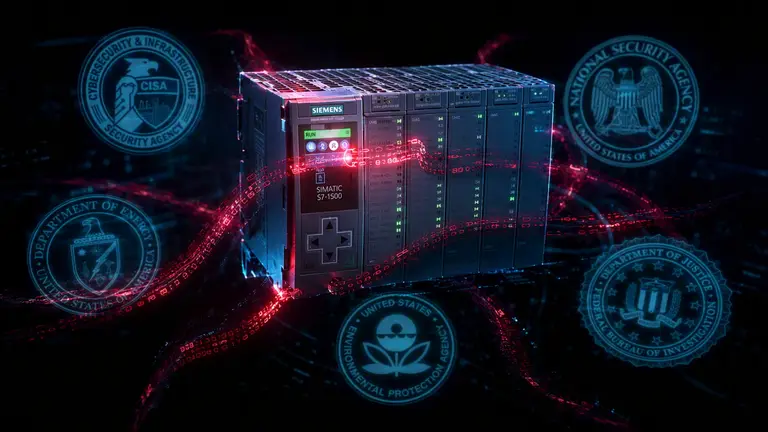
On August 19, 2026, CISA, NSA, FBI, DOE, and EPA issued advisory AA26-231A with a clear message: active threat actors are using AI-assisted exploit scripts against internet-exposed Siemens S7 Series PLCs. This is not a new zero-day vulnerability, but a technical democratization: tools that drastically lower the skill threshold for interacting with industrial control systems previously protected by decades of specialized know-how.
- The scripts use open-source libraries snap7.dll and python-snap7 to communicate via the S7comm protocol on TCP port 102, with read/write access to PLC memory, configuration data, and ladder logic
- Target models are S7-300 (CPU 314/315/317), S7-1200 (CPU 1211C-1217C), and S7-1500 including F-series safety controllers, deployed across six U.S. critical sectors
- Malicious tools are disguised as legitimate OT monitoring utilities to evade security teams, a technique cataloged as MITRE ATT&CK ICS T0849
- Siemens has explicitly stated there are no new vulnerabilities in its ICS products: the techniques exploit known misconfigurations
"This is not a theoretical risk—it is an active threat"
How the Attack Works: Open-Source Libraries and the S7comm Protocol
The CISA advisory documents that threat actors combine AI assistance with publicly available industrial libraries. The technical core consists of snap7.dll and python-snap7, Python bindings for the open-source Snap7 project that implements Siemens' S7comm protocol. These libraries enable read/write operations on PLC memory, extraction of configuration data, and manipulation of ladder logic programs via TCP port 102.
The AI-generated component does not replace attacker intelligence but amplifies productivity. As the advisory states: "Using AI to generate exploitation scripts represents an evolution in threat actor capabilities, dramatically reducing the technical expertise and time required to develop working ICS exploitation scripts and malicious tools." The reduction specifically concerns the learning curve of the S7comm protocol and Siemens memory structure—skills that traditionally required years of OT experience.
Six Sectors in the Crosshairs and Persistent Reconnaissance
Reconnaissance activity is concentrated on six critical infrastructure sectors: Critical Manufacturing, Energy, Water and Wastewater, Chemical, Food and Agriculture, and Commercial Facilities. The five co-signing agencies assess this pattern as "persistent reconnaissance" with intent of "pre-positioning for operational effects": advance positioning to cause operational effects, not necessarily immediate execution.
Documented internet scanning tools are Censys and ZoomEye. The combination of mass scanning and working exploit scripts creates an expanded attack surface: no longer just APTs with dedicated resources, but a broader pool of actors able to identify targets and interact with them in reduced timeframes. Disguise as legitimate monitoring tools adds an evasion layer against defenses based on process whitelisting.
Attribution Remains Unconfirmed: Hypotheses Without Documented Overlaps
On attribution, the five-agency advisory contains no official identification of the actors. No documented infrastructure overlaps link this specific campaign to groups attributed with certainty. Cynthia Kaiser of the Halcyon Ransomware Research Center proposed a possible link to previous activity suspected of Iranian origin, stating that "this appears to be a continuation of the same suite of activity we suspect is affiliated with Iran targeting PLCs": this is an analyst hypothesis, not an official agency confirmation.
The dossier does not specify which generative AI model is employed, nor does it provide a precise timeline for the campaign's start. Also missing is the exact number of compromised or targeted installations. It is not documented whether damaging write operations have already occurred or if activity is limited to reconnaissance and pre-positioning.
What to Do Now
The five co-signing agencies indicate specific actions for this threat. Monitoring TCP port 102 traffic for anomalies in the S7comm protocol is the first documented measure, since malicious scripts use this port to communicate with PLCs.
Verify that Siemens S7-300, S7-1200, and S7-1500 PLCs are not directly exposed to the internet using Censys, ZoomEye, or equivalent scanning tools. The advisory identifies this exposure as a necessary condition for the observed activity.
Inspect processes loading snap7.dll or python-snap7: malicious tools masquerade as legitimate OT monitoring utilities. Recognition of these libraries in anomalous contexts relative to the authorized inventory is indicated as a relevant indicator.
Review asset inventory to identify F-series safety controller variants among S7-1500 models: these units, present in the six critical sectors listed, are explicitly named among the campaign's targets.
The Takeaway: A Worsening Defense-Offense Asymmetry
The real paradigm shift is not technological but economic. The cost of developing OT capabilities has compressed from months to days, while the cost of defense remains structurally high: asset inventory, network segmentation, removal of internet exposure for devices never designed for it. This divergence is the core problem the agencies are signaling.
Siemens has clarified there are no new vulnerabilities to patch. The logical consequence is that the attack surface is configurational, not coded. But secure configuration of a heterogeneous PLC fleet, often installed years ago by third-party vendors, does not scale at the speed a Python script can be generated and distributed. The barrier separating those who could cause damage from those who could not has measurably thinned.
Information is based on the cited source and current as of publication.
Sources
- https://www.cisa.gov/news-events/cybersecurity-advisories/aa26-231a
- https://www.bleepingcomputer.com/news/security/us-warns-of-ai-powered-attacks-on-siemens-plcs-in-critical-infrastructure/
- https://gbhackers.com/cisa-nsa-and-fbi-warn-hackers/amp/
- https://www.cybersecuritydive.com/news/ai-hackers-siemens-s7-devices-cisa-fbi/828321/
- https://www.theregister.com/security/2026/08/19/not-a-theoretical-risk-feds-warn-as-attackers-use-ai-made-code-to-hack-critical-infrastructure-controllers/5289960
- https://www.smartindustry.com/benefits-of-transformation/cybersecurity/blog/55399650/us-agencies-report-cybercriminals-used-ai-generated-code-to-crack-siemens-plcs
- https://www.cisa.gov/topics/critical-infrastructure-security-and-resilience/critical-infrastructure-sectors/energy-sector
- https://www.cisa.gov/topics/critical-infrastructure-security-and-resilience/critical-infrastructure-sectors/water-and-wastewater-sector
- https://www.cisa.gov/topics/critical-infrastructure-security-and-resilience/critical-infrastructure-sectors/chemical-sector
- https://www.cisa.gov/topics/critical-infrastructure-security-and-resilience/critical-infrastructure-sectors/food-and-agriculture-sector
Get DeafLetter
A weekly selection of signals, vulnerabilities and guides. Critical alerts remain optional.
You can unsubscribe at any time. Privacy policy.