Get DeafLetter
A weekly selection of signals, vulnerabilities and guides. Critical alerts remain optional.
You can unsubscribe at any time. Privacy policy.
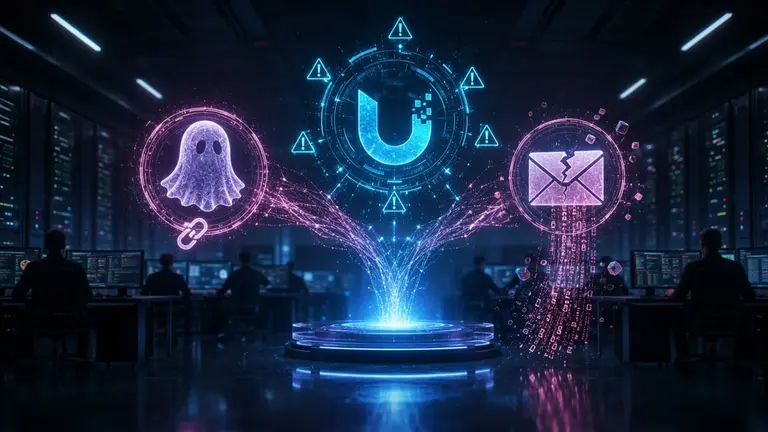
On July 9, 2026, three critical attack vectors overlapped within a 48-hour window, creating an operational convergence that simultaneously stresses the software supply chain, network control, and institutional communications. The GhostApproval symlink vulnerability affects six AI coding assistants; Ubiquiti issued 14 new critical CVEs for the UniFi platform in two days; and the UNK_MassTraction threat cluster is actively exploiting Roundcube against physics and engineering departments at US and Canadian universities. The overlap of these attack surfaces — development, network infrastructure, and communication — exposes the limits of siloed security management.
- GhostApproval, a symlink vulnerability in six AI coding assistants (Amazon Q, Claude Code, Augment, Cursor, Antigravity, Windsurf), allows arbitrary file writes on the underlying system bypassing user consent; three tools have released fixes, two have not, while Anthropic disputes the bug classification.
- Ubiquiti issued 14 new critical CVEs from July 7–9, 2026, including CVE-2026-50746 (CVSS 10.0, command injection in UniFi Connect), CVE-2026-50747 (CVSS 9.9, SQL injection in UniFi Talk), and CVE-2026-50748 (CVSS 9.9, command injection in UniFi Access).
- Three prior UniFi OS CVEs — CVE-2026-34908, CVE-2026-34909, CVE-2026-34910 — entered the CISA KEV catalog on June 23, 2026, with a remediation deadline of June 26, 2026, all carrying CVSS 10.0 scores.
- The UNK_MassTraction cluster, attributed to Chinese interests, is exploiting CVE-2024-42009 (CVSS 9.3) in Roundcube against North American academic researchers, with confirmed web shell deployment.
GhostApproval: When AI Coding Assistants Rewrite System Files
On July 9, 2026, Threat-Modeling.com documented GhostApproval, a vulnerability that exploits the symlink mechanism to induce six AI coding assistants to write arbitrary files to the underlying operating system, bypassing explicit user consent. The affected tools are Amazon Q, Claude Code, Augment, Cursor, Antigravity, and Windsurf. The attack pattern is not limited to a single platform; it strikes at the trust developers place in automated code suggestions.
The remediation landscape is fragmented. Three of the six vendors have released fixes; two have not. Anthropic, the developer of Claude Code, explicitly disputes that this constitutes a bug. This vendor dissonance across the same product class introduces a management risk: developers using multiple AI assistants in the same environment must verify patch status tool by tool, without a coordinated industry response to rely on.
"GhostApproval: Symlink flaw in 6 AI coding assistants — Amazon Q, Claude Code, Augment, Cursor, Antigravity, Windsurf — write to arbitrary files" — Threat-Modeling.com, July 9, 2026
The UniFi CVE Deluge: 14 Critical Vulnerabilities in 48 Hours
On July 7, 2026, Ubiquiti began publishing a block of critical vulnerabilities that concluded on July 9 with the issuance of three additional CVEs, bringing the total to 14 new critical flaws in two days. The official Bulletin 066, dated July 2, 2026, details CVE-2026-50746, CVE-2026-50747, and CVE-2026-50748 with their respective CVSS scores, affected versions, and available patches.
CVE-2026-50746 affects UniFi Connect with a CVSS score of 10.0: an improper access control flaw enables remote command injection. CVE-2026-50747 hits UniFi Talk (CVSS 9.9) via authenticated SQL injection allowing privilege escalation. CVE-2026-50748 concerns UniFi Access (CVSS 9.9) with improper input validation enabling command injection. The severity is amplified by the typical UniFi deployment model: a centralized platform managing physical access, VoIP, cameras, and networking in a single interconnected ecosystem.
In parallel, three CVEs from the previous June — CVE-2026-34908, CVE-2026-34909, and CVE-2026-34910 in the UniFi operating system — entered the CISA KEV catalog on June 23, 2026, with a remediation deadline set for June 26, 2026. According to NVD records, all three carry CVSS 10.0 scores with assessment provided by the CNA HackerOne. CVE-2026-34908 is classified as improper access control, CVE-2026-34909 as path traversal, and CVE-2026-34910 as improper input validation with command injection. Inclusion in the KEV catalog means the federal agency has verified active exploitation in the wild.
Roundcube as an Academic Espionage Vector
On July 7, 2026, Threat-Modeling.com reported activity by the UNK_MassTraction cluster against physics and engineering departments at US and Canadian universities. The group exploits CVE-2024-42009, a Roundcube vulnerability with a CVSS score of 9.3, to compromise institutional researcher mailboxes. The source confirms web shell deployment, indicating persistent access to communication platforms.
The tactical objective is the collection of sensitive research intelligence, not financial theft or destruction. Academic researchers represent a high-value target: their communications contain pre-publication data, international collaborations, grant reviews, and methodological details not yet in the public domain. Compromising Roundcube — self-hosted webmail widely used by institutions that have not migrated to cloud solutions — provides visibility into years of communication history without the need for complex lateral movement.
Immediate Actions
- Verify AI coding assistant patch status: Check whether AI tools in use for development (Amazon Q, Claude Code, Augment, Cursor, Antigravity, Windsurf) have released fixes for GhostApproval; for the two tools without updates, evaluate restricting filesystem write permissions in the working environment.
- Patch KEV-listed UniFi CVEs immediately: CVE-2026-34908, CVE-2026-34909, and CVE-2026-34910 had a CISA deadline that passed on June 26, 2026; apply the corrected versions specified in Ubiquiti Bulletin 066.
- Prioritize July UniFi CVEs by model: CVE-2026-50746, CVE-2026-50747, and CVE-2026-50748 carry CVSS 9.9–10.0 and impact three distinct UniFi applications; schedule patching based on the criticality of the managed service (physical access, VoIP, device control).
- Inspect Roundcube access in universities: Hunt for web shell indicators in Roundcube installations, focusing on physics and engineering accounts; the UNK_MassTraction cluster is active and confirmed in these departments.
The Common Mechanism: Trust Abuse Across Three Different Layers
The July 2026 convergence has a denominator that goes beyond the chronicle of individual vulnerabilities. In each case, the attacker exploits a trust relationship the system has encoded as legitimate: the implicit consent in the AI assistant that modifies code, the centralization of the UniFi platform unifying physical and logical security functions, the familiarity of institutional webmail that raises no suspicion among researchers. Traditional security segments these domains into separate teams: application security, network operations, academic IT. The temporal overlap of the three threats makes clear that the fracture occurs at the intersection.
The data emerging from the dossier shows that none of the three attack lines is technically new: symlink, command injection, compromised webmail are known patterns. The novelty is the synchrony. When the same organization — a developer at a university that also manages the UniFi network — must handle simultaneous patching on three fronts, the probability of error or delay grows non-linearly. The operational pressure of July 2026 is a maturity test not for individual technologies, but for the ability to orchestrate responses across silos that were not designed to communicate.
Frequently Asked Questions
Why does Anthropic dispute that GhostApproval is a bug?
It is noted that Anthropic rejects the classification, creating a situation where developers and security teams must independently assess risk without vendor convergence.
Are the July 2026 UniFi CVEs already actively exploited?
The three June CVEs in KEV (CVE-2026-34908/34909/34910) do have confirmed active exploits per the CISA catalog.
How many universities were compromised via Roundcube?
The source confirms UNK_MassTraction activity against physics and engineering departments at US and Canadian universities, with verified web shell deployment.
Information verified against cited sources and current as of publication.
Sources
- https://threat-modeling.com/vulnerability-intelligence-report-july-9-2026/
- https://fixitphill.com/security/ubiquiti-unifi-os-cisa-kev-june-2026/
- https://threat-modeling.com/vulnerability-intelligence-report-july-7-2026/
- https://community.ui.com/releases/Security-Advisory-Bulletin-066-066/984eceb3-49c8-4227-942d-671c289b3afc
- https://nvd.nist.gov/vuln/detail/CVE-2026-50656
- https://nvd.nist.gov/vuln/detail/CVE-2026-34908
- https://nvd.nist.gov/vuln/detail/CVE-2026-34909
- https://nvd.nist.gov/vuln/detail/CVE-2026-34910
- https://nvd.nist.gov/vuln/detail/CVE-2026-53359
Get DeafLetter
A weekly selection of signals, vulnerabilities and guides. Critical alerts remain optional.
You can unsubscribe at any time. Privacy policy.