Get DeafLetter
A weekly selection of signals, vulnerabilities and guides. Critical alerts remain optional.
You can unsubscribe at any time. Privacy policy.
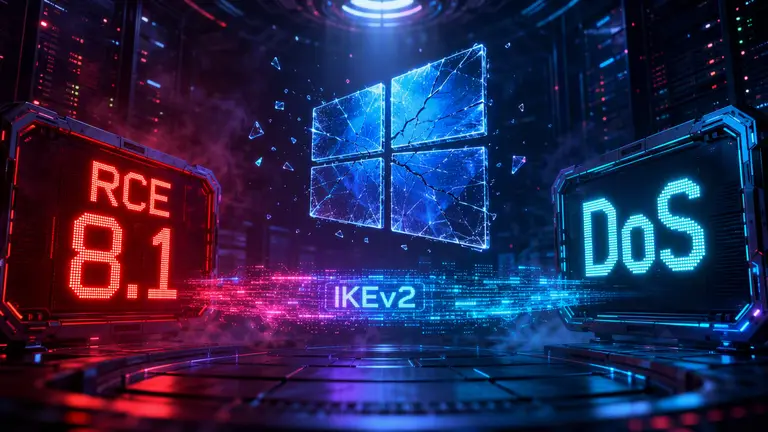
The coordinated disclosure on September 8, 2026 revealed a vulnerability in Microsoft Windows' IKEv2 implementation that exposes systems to unauthenticated remote attack. Trend Micro's Zero Day Initiative describes CVE-2026-50696 as remote code execution in SYSTEM context, CVSS 8.1. Microsoft classifies it as Denial of Service, severity Important, CVSS 7.5. For enterprise security leads, the stakes aren't just technical — they're about deciding what to patch first.
- CVE-2026-50696 affects the Windows IKEEXT service and enables unauthenticated remote attack, but only on systems with specific IPsec configurations.
- ZDI rates impact as Remote Code Execution with SYSTEM-context execution; Microsoft rates it Denial of Service, severity Important. \li>The official Microsoft CVSS is 7.5 (HIGH), with a vector indicating availability impact only; the ZDI table shows 8.1 without vector explanation.
- Microsoft assesses exploitability as "Unlikely" and confirms no in-the-wild exploitation; the patch has been available since the September 2026 Patch Tuesday.
- The RCE/DoS discrepancy shifts the risk profile and remediation priority for security teams.
The Mechanism: Integer Underflow in the IKEEXT Service
The flaw resides in the IKEEXT service, which handles the Internet Key Exchange protocol in Windows. According to advisory ZDI-26-622, the issue stems from a lack of validation of attacker-supplied data, triggering an integer underflow before a memory write. This sequence — arithmetic underflow followed by heap write — is typically associated with buffer overwrite.
Microsoft describes the same causal chain as a "heap-based buffer overflow" resulting in "deny service over a network." The divergence isn't about the trigger mechanism: both sources converge on the integer underflow and memory corruption. They differ on whether that corruption translates into attacker-controlled code execution.
"This vulnerability allows remote attackers to execute arbitrary code on affected installations of Microsoft Windows. Authentication is not required to exploit this vulnerability, but only systems with specific IPsec configurations are vulnerable." — Advisory ZDI-26-622
Analysis — The Assessment Fracture: Why RCE and DoS Coexist on the Same Advisory
In DeafNews' interpretation, the discrepancy between ZDI and Microsoft reflects different approaches to coordinated disclosure. Independent researchers classify the maximum technically plausible impact. Vendors run conservative assessments based on factors often not made public.
Microsoft assigns CVE-2026-50696 the CVSS vector 3.1/AV:N/AC:L/PR:N/UI:N/S:U/C:N/I:N/A:H — network attack, low complexity, no privileges, no user interaction, zero impact on confidentiality and integrity, maximum on availability. This vector, which yields the 7.5 score, is formally incompatible with an RCE classification: code execution would imply at least integrity or confidentiality impact.
The ZDI score of 8.1, reported in the table without an explicit vector, remains unexplained in the primary source. The difference may stem from preliminary metrics or a calculation with different parameters. Microsoft has not published clarifications on this numerical divergence.
Microsoft's exploitability assessment, marked "Exploitation Unlikely," rests on the absence of known public exploits at the time of publication. ZDI has not released a proof-of-concept. Neither source documents in-the-wild exploitation.
Attack Surface: Who Is Exposed
The vulnerability does not affect all Windows systems. The ZDI advisory specifies that "only systems with specific IPsec configurations are vulnerable." Microsoft does not detail exactly which configurations expose the IKEEXT service to attack.
Typical enterprise IPsec configurations include site-to-site VPN tunnels, IKEv2 remote-access connections, and host-to-host encryption policies. Without an official list of vulnerable configurations, security teams must assume any system with active IKEv2 could be at risk until patch verification.
The IKEEXT service runs with system privileges, motivating ZDI's SYSTEM-context execution classification. Even under Microsoft's pure DoS reading, the availability impact on VPN or network infrastructure can be critical for organizations dependent on remote connectivity.
What to Do Now
Apply the Microsoft patch released in the September 2026 Patch Tuesday. The fix is confirmed as complete by both the ZDI advisory and the MSRC page.
For systems where immediate patching isn't feasible, verify whether IKEv2/IPsec is actually in use. Disabling the IKEEXT service on systems that don't require IPsec connectivity reduces the attack surface.
Monitor IKEEXT service logs for anomalies in IKEv2 negotiations. Microsoft has not released specific indicators of compromise, but repeated service crash patterns may signal exploitation attempts.
Assess patching priority based on risk profile: organizations with Internet-exposed IKEv2 VPNs should treat the vulnerability with high urgency regardless of the RCE/DoS classification, given the unauthenticated remote attack vector and availability impact.
Disclosure Timeline
The vulnerability was reported to Microsoft on May 11, 2026. Coordinated publication occurred on September 8, 2026, after roughly 120 days of patch development.
During this interval, Microsoft developed and released the fix. Advisory ZDI-26-622 and the MSRC page for CVE-2026-50696 were published simultaneously. Neither source indicates a public exploit was available before or during disclosure.
The primary structured source is advisory ZDI-26-622; Microsoft MSRC details converge on mechanism and patch but diverge on impact classification. Information is current as of publication.
Information verified against cited sources and current as of publication.
Sources
Get DeafLetter
A weekly selection of signals, vulnerabilities and guides. Critical alerts remain optional.
You can unsubscribe at any time. Privacy policy.