
Get DeafLetter
A weekly selection of signals, vulnerabilities and guides. Critical alerts remain optional.
You can unsubscribe at any time. Privacy policy.
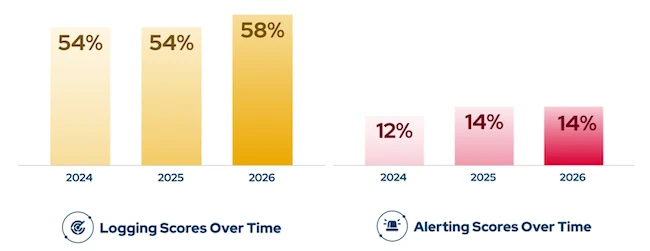
On September 9, 2026, data from the Picus Blue Report draws a hard line: the time from disclosure to weaponized exploit has collapsed to roughly 10 hours, down from weeks in the recent past. In that same span, the platform recorded 338 million BAS simulations in production environments, yielding a figure that condenses the entire problem: defensive controls show 69% preventive efficacy, yet only 14% of attack actions generate alerts in SOCs. The asymmetry isn't staffing — it's architectural.
- Roughly 135 new CVEs per day, with under 0.5% patched upstream; the ten least-prevented vulnerabilities in 2026 are blocked less than 25% of the time.
- Performance issues have become the leading cause of silent detection-rule failure, doubling to 49% in one year from 24%.
- Mythos 5 scored CWI 80 in the Booz Allen benchmark for autonomous end-to-end compromise; open-weight models are lowering the hardware barrier for autonomous attacks.
- The proposed answer is agentic BAS: a closed-loop, signal-driven system that generates simulations in roughly 9 minutes from unstructured intelligence, with vendor-specific fixes deployed and re-verified automatically.
The Exploit Window Has Closed on Itself
Roughly 135 CVEs per day means a detection-engineering team working eight hours without breaks would face 45 new vulnerabilities per shift, on top of existing backlogs. The Picus Blue Report 2026 measures the result: under 0.5% of these vulnerabilities are patched upstream, shifting the full burden onto compensating controls.
But controls aren't keeping pace. Preventive efficacy tops out at 69% in the aggregate across 338 million simulations. The ten least-prevented vulnerabilities in 2026 — all in everyday software: browsers, archive utilities, OpenSSL, core OS components — are blocked less than 25% of the time. Logging sits at 58%, a four-year high, yet the alert score is stuck at 14%, unchanged year over year. Three-quarters of simulated attacks traverse the perimeter without generating a human-actionable signal.
The regime change is in offensive velocity. The report cites the "post-Mythos era" as the watershed: when disclosure-to-exploit measures less than a business day, detection that requires manual rule review, staging tests, and planned deployment operates on timescales incommensurate with the threat.
The Structural Silence of Detection Rules
The 14% alert failure isn't uniform; it has an internal geography the report maps precisely. Performance issues have become the leading cause of detection-rule failure, jumping from 24% to 49% in a year. Log collection gaps follow at 41%. Together, these two phenomena constitute silent failure: the rule exists, the system appears to function, but the event isn't captured or isn't forwarded.
The figure matters because it measures dynamic degradation, not static deficiency. As the report notes: "Strong performance is rented, not owned." Controls that worked yesterday fail today due to configuration drift, infrastructure updates, log-format changes. Without continuous verification, the gap opens invisibly.
"When only one side of the pipeline is automated, the gap isn't holding steady. It's compounding."
The Adversary That Doesn't Sleep: From Mythos to Local Models
Independent benchmarks confirm that frontier models can operate as autonomous end-to-end hackers. In the Booz Allen test, Anthropic's Mythos 5 scored CWI 80 for autonomous compromise of a production-grade enterprise network; the next-closest score was 49. The UK AI Security Institute measured end-to-end success rates of 30% for Mythos and 20% for GPT-5.5, with the latter completing 32-step autonomous chains.
The politically relevant datum isn't the frontier model itself. It's the democratization that follows. Recorded Future reports that open-weight models and quantization are lowering the hardware and cost barrier for autonomous attacks. The economic viability threshold for opportunistic threat actors is estimated at 6–12 months. "You no longer need frontier access to do this," Nico Waisman, CISO of XBOW, told Dark Reading. "That's the point where automation becomes the cheaper option, not just the impressive one."
Recorded Future adds a specific warning: "The danger for defenders isn't the headline-grabbing frontier models; it's the ease with which adversaries can deploy effective local models on modest hardware." The same advisory identifies BAS as one of three critical areas for defensive AI agents: "Validating coverage and exposing gaps before an adversary's agents get in is well-advised."
Why Gen-1 BAS Is a Blind Man With a Calendar
The report identifies three structural limits in the current generation of BAS. First: the trigger is the calendar, not the signal. The test runs when scheduled, not when a CVE drops or a configuration changes. Second: it cannot answer "do we detect this morning's vulnerability?" Third: post-test work demands human hours of analysis, prioritization, ticketing, and verification.
The consequence is an open loop with constant lag. The adversary operates at machine speed; the defender operates at human-queue speed. Gen-1 BAS measures yesterday's posture against today's threat, with results available the day after tomorrow.
The contrast with the agentic proposal is sharp. Picus AI Threat Builder converts unstructured intelligence into a MITRE ATT&CK-mapped simulation in roughly 9 minutes. The proposed agentic BAS architecture is a closed loop: signal (CVE, threat intel, config change) → automatic simulation → vendor-specific fix deployed → automatic re-verification. Humans remain on decision gates, not in the critical path.
What to Do Now
Priority actions emerge from the convergence of the report's data and vendor intelligence advisories.
1. Verify whether your current BAS answers the CVE-in-an-hour question. If the system cannot generate a runnable simulation from this morning's disclosure by this afternoon, the temporal gap with the adversary is unrecoverable through staffing.
2. Audit detection rules against the two silent-failure vectors: performance issues (49%) and log collection gaps (41%). The report shows both have grown; without BAS-driven verification, the degradation stays invisible until the incident.
3. Map your internal MTTR against the ~10-hour time-to-exploit. If the detection→analysis→containment cycle measures days, the 69% prevention leaves an operational window for the adversary measuring tens of hours.
4. Evaluate vendor BAS agentic capabilities against a closed-loop criterion: signal-driven generation, automatic vendor-specific fix, integrated re-verification. As the report notes, "any vendor should be willing to show you all five live." If the vendor shows only simulations and dashboards, the loop is open.
Recorded Future's prescription is unequivocal: "Don't wait. Start building today." The 6–12-month horizon for open-weight model quantization isn't preparation time — it's verification time that your defensive architecture is ready to operate at machine speed.
Frequently Asked Questions
Is the 14% alert score a universal industry average?
No. It is the specific figure from the Picus Blue Report 2026, aggregated from 338 million simulations in the platform's customer environments. It is not generalizable to other BAS platforms or independent measurements without verification.
Is Mythos already used in real-world attacks?
No. Confirmations of autonomous capability come from controlled benchmarks (Booz Allen, UK AI Security Institute), not from field observations of documented incidents. A 30% end-to-end success rate in tests does not imply operational reliability in uncontrolled conditions.
Is agentic BAS already a market standard?
The report describes the approach as a necessary architectural evolution, not as a widely deployed current standard. The recommendation to verify "all five live" from vendors implies significant maturity variation across operators.
Sources
- https://www.helpnetsecurity.com/2026/09/09/picus-security-autonomous-breach-attack-simulation/
- https://www.darkreading.com/cybersecurity-operations/companies-six-months-prepare-automated-attacks
- https://www.picussecurity.com/breach-and-attack-simulation
- https://awards.thehackernews.com/winners/2026/picus-ai-exposure-validation/
- https://www.recordedfuture.com/blog/build-defensive-ai-agents
- https://www.ibm.com/topics/ctem
- https://thehackernews.com/2026/04/after-mythos-new-playbooks-for-zero.html
- https://nvd.nist.gov/vuln-metrics/cvss
- https://img2.helpnetsecurity.com/posts2026/Picus-autonomous_breach_attack_simulation_Logging-and%20Alerting-Scores.webp
Get DeafLetter
A weekly selection of signals, vulnerabilities and guides. Critical alerts remain optional.
You can unsubscribe at any time. Privacy policy.