Get DeafLetter
A weekly selection of signals, vulnerabilities and guides. Critical alerts remain optional.
You can unsubscribe at any time. Privacy policy.
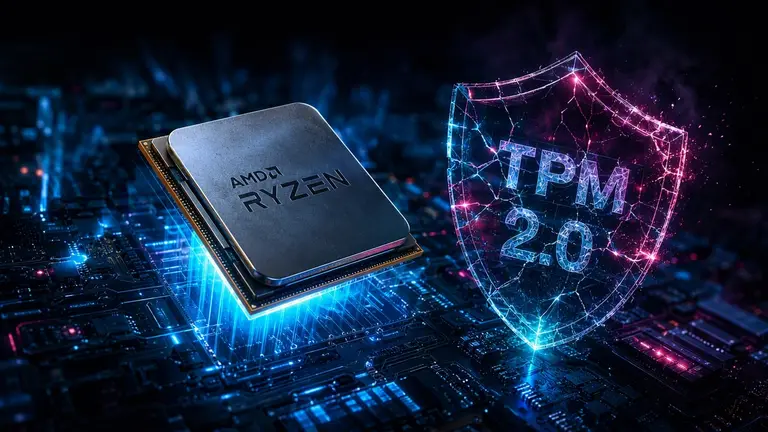
AMD published advisory AMD-SB-7064 on August 11, 2026, confirming two TPM 2.0 vulnerabilities rated CVSS 8.5 and 8.3 that affect Ryzen, Threadripper, and EPYC processors. Corrected firmware had already been distributed to motherboard vendors starting May 18, 2026. The public disclosure arrives nearly three months after patches were available, creating a security paradox: systems could be updated, but no one knew the danger they needed to defend against.
- Vulnerabilities CVE-2026-6726 and CVE-2026-6727 carry CVSS 8.5 and 8.3, both classified High
- Both require local access with elevated privileges to exploit
- Corrected firmware was distributed to vendors starting May 2026, before public disclosure
- The flaws reside in the TPM 2.0 reference code from the Trusted Computing Group, not exclusive to AMD
The Technical Mechanism: Use-After-Free and Timing Side-Channel
CVE-2026-6726 is a use-after-free bug in the TPM 2.0 implementation. According to Igor's Lab, "A use-after-free condition can cause information from a previously used TPM object to remain available even though the same memory area is subsequently used for another purpose." This condition affects the TPM2_Certify function, used to generate cryptographic attestations of platform integrity.
CVE-2026-6727 is a timing side-channel vulnerability affecting RSA-OAEP decryption operations. As TechSpot reports, "AMD describes the second flaw (CVE-2026-6727) as a timing side-channel vulnerability affecting decryption workloads using the RSA cryptosystem." Differences in padding-check processing times open the door to a Manger attack, which can enable decryption of sensitive data and generation of false attestation keys.
Both vulnerabilities undermine the chain of trust that the TPM guarantees for measured boot, conditional access, and disk encryption. Their presence in the TCG reference code makes them potentially relevant to other implementers, though the dossier does not specify which.
The Silence Timeline: Fixes in May, Disclosure in August
Distribution of corrected firmware began May 18, 2026 with the release of ComboAM4PI 1.0.0.11 for Ryzen 3000 platforms, according to VideoCardz. For AM5 platforms, ComboAM5PI 1.3.0.1b was distributed on May 21 and version 1.2.0.3k on May 31.
Major motherboard vendors had already integrated these updates into their BIOS before AMD publicly disclosed the vulnerabilities. VideoCardz documents that ASUS already had ComboAM5 PI 1.3.0.1b circulating in June, MSI released updates in early July, ASRock in late July, and GIGABYTE in June. As TechSpot observes: "The fixed TPM code had already been available for months. Meanwhile, AMD has only just released its AMD-SB-7064 bulletin detailing the issue."
For platforms with AMD Pluton — Ryzen AI 300/400 and Ryzen AI Max 300 — updates are instead slated for August 2026, with a potentially longer exposure window.
The Firmware Supply-Chain Paradox
The gap between silent distribution to vendors and public disclosure raises a structural issue in semiconductor security governance. Motherboard vendors pushed updates without being able to communicate the critical nature of the changes to their customers. IT administrators and power users, accustomed to prioritizing BIOS updates based on changelogs, lacked the information needed to accelerate deployment.
"AMD itself explicitly classifies the two CVEs as 'non-AMD' because the errors originate in the TPM 2.0 reference code of the Trusted Computing Group" Igor's Lab
AMD's classification of the vulnerabilities as "non-AMD" adds a layer of complexity: responsibility lies in the TCG reference code, but implementation and fix distribution fall on the vendor supply chain. This misalignment between code ownership, patch responsibility, and public communication is emblematic of firmware supply-chain risks.
What to Do Now
- Verify the installed BIOS/UEFI version and compare it against the firmware versions cited in advisory AMD-SB-7064 for your platform
- Check your motherboard vendor's site (ASUS, MSI, GIGABYTE, ASRock, or others) for any updates released after August 2026 that complete coverage
- Assess impact on BitLocker and disk encryption: a TPM firmware update can trigger a recovery key prompt; plan the recovery process before installation
- Await specific guidance for Pluton platforms (Ryzen AI 300/400, Ryzen AI Max 300) where updates are still rolling out
Who Discovered the Issue and Why It Matters
The vulnerabilities were reported to the TCG Vulnerability Response Team by Intel security researchers, according to TechSpot and Morethantech. This detail is not marginal: cross-vendor reporting in the semiconductor industry remains the exception rather than the norm, and its absence could have delayed remediation indefinitely.
The role of Intel researchers also highlights the shared nature of the TCG reference code: a flaw in reference code is not proprietary to a single vendor but propagates through the ecosystem of implementations. The dossier does not specify whether other vendors (Intel itself, or other TPM implementers) were involved in the same report or have distributed parallel fixes.
The Dossier's Limits
The brief contains no evidence of in-the-wild exploitation or actual abuse of the vulnerabilities during the pre-disclosure period. The source does not specify whether existing TPM keys on already-updated systems require regeneration or if the firmware update alone is technically sufficient to restore security. The complete reporting timeline is also undocumented: exactly when Intel researchers contacted the TCG, and how much time elapsed between that report and the start of corrected firmware distribution.
The dossier also does not list all affected OEM vendors and motherboards, limiting itself to the four major manufacturers cited by VideoCardz. Systems from smaller vendors or custom integrators may have a different exposure window.
Frequently Asked Questions
- Are the vulnerabilities remotely exploitable?
- No. Both require local access with elevated privileges, per advisory AMD-SB-7064.
- Can I still be vulnerable if I updated my BIOS in June?
- Depends on the TPM firmware version included in the update. If the BIOS contains ComboAM4PI 1.0.0.11 or later, or ComboAM5PI 1.2.0.3k/1.3.0.1b or later, the fix is present even though the patch's nature was not declared.
- Do the vulnerabilities affect only AMD?
- No. According to Igor's Lab, AMD explicitly classifies the CVEs as "non-AMD" because they reside in the Trusted Computing Group's TPM 2.0 reference code. The dossier does not specify whether other implementers are affected.
The AMD-SB-7064 case offers a broader reading on the tension between responsible disclosure and supply-chain velocity: accelerating patch distribution without communicating the risk does not protect those who don't know they need it. For enterprise environments that base device onboarding on TPM attestation, the disclosure delay was a period of unquantifiable exposure — not for lack of a fix, but for lack of awareness.
Sources
- https://morethantech.it/pubblicazioni/4988_amd-conferma-due-falle-tpm-su-ryzen-firmware-corretto-da-maggio-2026
- https://www.techspot.com/news/113448-amd-tpm-implementation-includes-two-high-severity-flaws.html
- https://www.igorslab.de/en/amd-confirms-two-tpm-2-0-vulnerabilities-ryzen-3000-to-ryzen-ai-require-updated-firmware/
- https://videocardz.com/newz/amd-confirms-ryzen-tpm-vulnerabilities-asus-msi-and-gigabyte-already-have-fixes
- https://morethantech.it/images/publications/4988/d425e37f-d099-4876-8387-19f2a5bab8d1.jpeg
- https://www.guru3d.com/story/amd-publishes-fixes-for-two-highseverity-tpm-vulnerabilities/
- https://www.techspot.com/ethics.html
Information verified against cited sources and current as of publication.
Sources
Get DeafLetter
A weekly selection of signals, vulnerabilities and guides. Critical alerts remain optional.
You can unsubscribe at any time. Privacy policy.