Get DeafLetter
A weekly selection of signals, vulnerabilities and guides. Critical alerts remain optional.
You can unsubscribe at any time. Privacy policy.
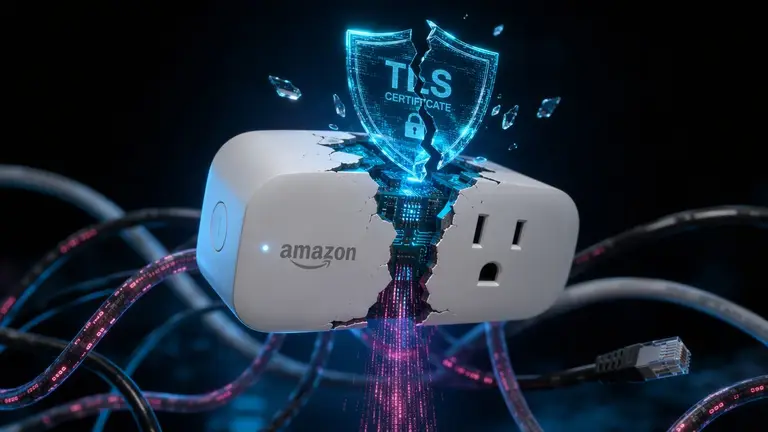
On August 12, 2026, Trend Micro published advisory ZDI-26-558 detailing a vulnerability in the Over-The-Air update process of the Amazon Smart Plug. The flaw allows a network-adjacent attacker to bypass TLS certificate validation during firmware download, with potential code execution if chained with other vulnerabilities. The device, deployed at mass scale in homes, received a fix in firmware version 3.1.212 after 281 days of coordinated disclosure.
- The ZDI-26-558 vulnerability enables certificate validation bypass for OTA updates on Amazon Smart Plug without requiring authentication
- The specific flaw resides in the lack of certificate validation when downloading firmware updates
- Code execution requires chaining with additional vulnerabilities; it is not standalone
- The fix is available in firmware version 3.1.212; the CVSS is 6.8 per the ZDI advisory list
The Mechanism: When TLS Becomes Toilet Paper
The Amazon Smart Plug downloads firmware updates over the local network. The cited advisory documents that "the specific flaw exists within the processing of OTA updates. The issue results from the lack of certificate validation when downloading updates. An attacker can leverage this in conjunction with other vulnerabilities to execute code in the context of the device."
The failure chain is precise: the plug does not validate the certificate of the server serving the firmware. An attacker on the same network — via ARP spoofing, DNS hijacking, or positioning as a rogue access point — intercepts or redirects the update traffic to a controlled server. The device accepts the malicious firmware as authentic because the cryptographic check is missing.
"The specific flaw exists within the processing of OTA updates. The issue results from the lack of certificate validation when downloading updates. An attacker can leverage this in conjunction with other vulnerabilities to execute code in the context of the device." — Advisory ZDI-26-558
From Disclosure to Patch: 281 Days of Exposure Window
The vulnerability was reported to the vendor on November 5, 2025. Coordinated publication occurred on August 12, 2026. The responsible disclosure period — 281 days — falls within the typical range for the Zero Day Initiative program for vulnerabilities requiring infrastructure changes or complex firmware modifications.
The timeline takes on significance given the nature of the device: the Amazon Smart Plug is a low-cost IoT endpoint often overlooked in home patch management programs. During the interval between reporting and publication, unpatched devices remained exposed to anyone who gained a network-adjacent position.
The source does not specify whether Amazon deployed automatic OTA patches during the embargo period or if the fix requires manual user action.
Pwn2Own: The Context That Elevates Real-World Risk
The advisory is labeled (Pwn2Own) in the ZDI advisory list. This context indicates the vulnerability was demonstrated in competition, not discovered in an abstract lab. Pwn2Own participants must demonstrate working exploits against real targets, with time and legal constraints that filter out impractical theories.
This provenance qualifies the risk: the OTA certificate bypass is not hypothetical. It was executed on consumer hardware under competitive conditions. The fact that the advisory specifies "in conjunction with other vulnerabilities" for code execution does not diminish the severity of the first link — loading unauthenticated firmware opens attack surfaces the device is not designed to contain.
The dossier does not identify which complementary vulnerabilities are needed to complete the RCE chain. The source documents neither the estimated number of affected devices nor exact technical details of the bypass mechanism (which certificate, which chain of trust).
Why It Matters
The ZDI-26-558 case intersects three depressing IoT security trends: OTA updates implemented with nominal but unvalidated TLS, mass-market devices with an attack surface invisible to the user, and exposure windows measured in months even for publicly demonstrated vulnerabilities.
The affected device is a smart plug — a peripheral that controls household electrical loads. Its compromise is not limited to turning lights off: malicious firmware can turn it into a network pivot, a Wi-Fi traffic sniffer, or a bot for coordinated DDoS attacks. The network-adjacent requirement, seemingly limiting, is actually accessible via router compromise, malware on devices on the same network, or simple physical proximity in multi-unit buildings.
The CVSS 6.8 reported by the ZDI advisory list classifies the vulnerability as medium-high. The score reflects the combination of low attack complexity with a network-adjacent requirement and the need for chaining to achieve maximum impact.
The dossier does not document specific remedial measures beyond the firmware update. The source does not specify whether version 3.1.212 was distributed automatically or if users must manually verify the installed version. No CVE is assigned or reported in the advisory.
For users managing home or small office networks, the case raises a visibility problem: most patch management programs do not catalog smart plug firmware, and OTA updates are designed to be invisible. Verifying version 3.1.212 requires access to the Amazon management app or the device's diagnostic interface — an operation the source does not explicitly describe.
FAQ
- Does the vulnerability allow automatic remote code execution?
- No. The advisory specifies that code execution requires chaining with "other vulnerabilities" — the OTA certificate bypass is the first link, not the complete chain.
- How serious is CVSS 6.8 in a home IoT context?
- The score, drawn from the ZDI advisory list and not the main advisory, indicates a medium-high vulnerability. For mass-market IoT devices with a permanent attack surface and non-technical users, operational severity tends to exceed theoretical severity.
- Is a CVE necessary for risk management?
- No: ZDI-26-558 is a structured and traceable identifier. The absence of a CVE in the dossier does not prevent cataloging in vulnerability management programs, though it may slow automatic integration in some patch management tools.
The Amazon Smart Plug case fits into a sequence of OTA failures on mass-market IoT devices where TLS is present but not validated — a configuration that appears secure to surface audits and proves neutral under structured attack. The difference between "uses HTTPS" and "verifies who is on the other end" remains the boundary between nominal security and actual security.
Sources
- http://www.zerodayinitiative.com/advisories/ZDI-26-558/
- http://www.zerodayinitiative.com/advisories/published/
- https://www.trendmicro.com/
- https://www.trendmicro.com/en_us/business/products/one-platform.html
Information is based on the cited source and current as of publication.
Fonti
Get DeafLetter
A weekly selection of signals, vulnerabilities and guides. Critical alerts remain optional.
You can unsubscribe at any time. Privacy policy.