Get DeafLetter
A weekly selection of signals, vulnerabilities and guides. Critical alerts remain optional.
You can unsubscribe at any time. Privacy policy.
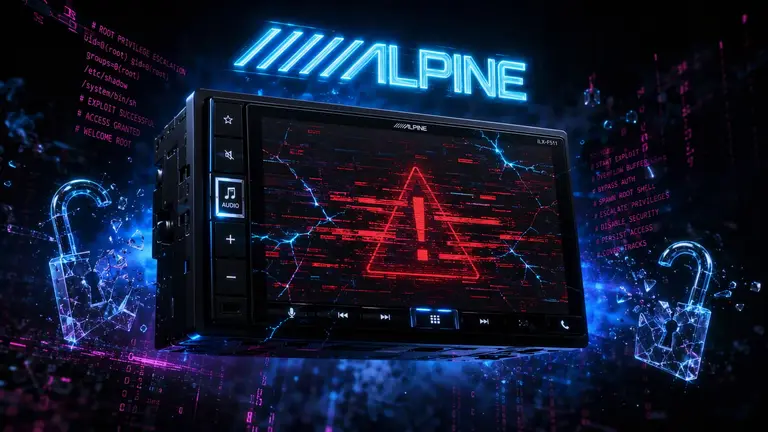
On October 28, 2026, the Zero Day Initiative published advisory ZDI-26-824, disclosing a zero-day vulnerability in the Alpine iLX-F511 infotainment system. The flaw allows a network-adjacent attacker to execute arbitrary code with root privileges without any authentication. The disclosure closes a window of roughly eight and a half months, from the initial report on February 4, 2026, to Alpine's failure to deliver a fix.
- CVE-2026-118606 (CVSS 8.8) enables unauthenticated RCE on Alpine iLX-F511 by network-adjacent attackers
- The vulnerability resides in the framework service due to an "exposed dangerous function"
- Discovered by the Compass Security team and demonstrated at Pwn2Own Automotive 2026
- Alpine acknowledged the report and requested an extension on June 7, 2026, but released no patch by the disclosure date
"This vulnerability allows network-adjacent attackers to execute arbitrary code on affected installations of Alpine iLX-F511 devices. Authentication is not required to exploit this vulnerability." — ZDI Advisory ZDI-26-824
How the Vulnerability Works
According to the ZDI advisory, the specific flaw exists within the device's framework service: "The specific flaw exists within the framework service. The issue results from an exposed dangerous function." The term describes a programmatic function accessible from the outside without the necessary security controls to limit its use.
This is not a buffer overflow or a parsing error, but an interface designed to be invoked by other processes that ends up reachable without authentication. The consequence is documented in the same source: "An attacker can leverage this vulnerability to execute code in the context of root."
Network-Adjacent: The Vector and Its Boundaries
The advisory specifies that the attacker must be "network-adjacent," encoded in CVSS as AV:A (Attack Vector: Adjacent). The attacker must be on the same physical or logical network as the device: the same local Wi-Fi network, the same subnet, or in physical proximity with data-link-layer interaction capabilities.
For an automotive infotainment system, this condition has concrete implications. The iLX-F511 integrates Wi-Fi and Bluetooth connectivity for smartphone mirroring, updates, and streaming. A vehicle parked in areas with shared networks, a fleet with corporate hotspots, or a compromised access point can constitute the shared network that makes the device reachable. The source does not specify which interface serves as the primary attack vector.
Pwn2Own Automotive: The Exploit as Proof
The vulnerability is cataloged as ZDI-CAN-29006 in the ZDI list with an explicit "(Pwn2Own)" annotation. Pwn2Own Automotive is the vehicle-targeted hacking contest organized by Trend Micro. Participation requires a practical demonstration of working exploits on real hardware.
The fact that the flaw was demonstrated in this context means the exploit was successfully executed on real hardware before independent observers. The researchers — Cyrill Bannwart, Emanuele Barbeno, Yves Bieri, Lukasz D., and Urs Mueller of Compass Security — demonstrated the full chain from network-adjacent access to root code execution.
The CVSS 8.8 score and HIGH severity rating derive from the aggregated ZDI list (source 2), not from the primary ZDI-26-824 advisory. The primary advisory does not explicitly report a CVE or CVSS score in its text.
Timeline of a Failed Disclosure
The documented chronology is linear. On February 4, 2026, researchers submitted the report. On June 7, 2026, Alpine acknowledged receipt and requested an extension. On October 15, 2026, ZDI notified its intention to publish as a zero-day. On October 28, 2026, public disclosure occurred.
In this window of roughly eight and a half months, no patch was released. The advisory states verbatim: "Given the nature of the vulnerability, the only salient mitigation strategy is to restrict interaction with the product." This formulation, rare in ZDI output, indicates the disclosure program identified no effective countermeasures beyond isolating the device.
Mitigation Steps
Since the primary source lists no specific corrective actions beyond restricting interaction, guidance is limited to what is documented:
- Restrict the Alpine iLX-F511's network connectivity to trusted, isolated networks
- Avoid public or shared Wi-Fi networks with unverified devices
- Monitor Alpine communications for future firmware patches: no update is available as of the disclosure date
Why This Matters
The ZDI-26-824 vulnerability sits at a critical point in the automotive ecosystem. Aftermarket infotainment systems like the iLX-F511 are installed on vehicles already on the road, often lacking the automatic update processes typical of OEM platforms. This architecture creates a class of devices that remain exposed for extended periods when the vendor fails to release timely patches.
Alpine's silence after eight months of coordinated disclosure raises questions about the vendor's response capabilities in the aftermarket sector. Unlike OEMs bound by regulations such as UN R155/R156 on vehicle cybersecurity, aftermarket component manufacturers operate in a fragmented regulatory context. For the Italian public, this means compliance with active security standards depends on individual vendor policies, not a uniform regulatory framework.
The single ZDI source limits real-world risk assessment. The following are unavailable: the number of exposed devices, the specific affected firmware version, technical details of the vulnerable function, the presence of public exploits outside the Pwn2Own context, or a patch release plan from Alpine. These gaps make it impossible to estimate the likelihood of real-world attacks, even though the exploit's technical feasibility is documented.
The case fits a recurring pattern in the infotainment sector: the demonstration of critical vulnerabilities at Pwn2Own, followed by 0-day disclosure due to vendor non-response. The gap between automotive product security rhetoric and the reality of public demonstrations remains unbridged, with concrete consequences for users and fleets integrating these devices.
Note on source limitations. This article relies exclusively on the ZDI-26-824 advisory and the aggregated ZDI list confirming CVE-2026-118606, CVSS 8.8, and the Pwn2Own context. No independent primary source, Alpine statement, or real-world incident report is available at the time of publication. Risk assessment for Italian users is therefore conditioned by this documented limitation.
Sources
Get DeafLetter
A weekly selection of signals, vulnerabilities and guides. Critical alerts remain optional.
You can unsubscribe at any time. Privacy policy.