Get DeafLetter
A weekly selection of signals, vulnerabilities and guides. Critical alerts remain optional.
You can unsubscribe at any time. Privacy policy.
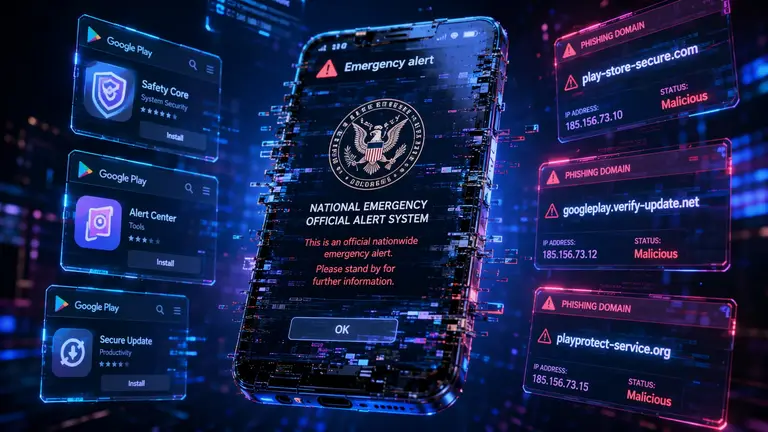
On July 20, 2026, Dream Research Lab researchers published an analysis of an active Android campaign in the Gulf that impersonates Bahrain's civil alert application. The "BH Alert" app — distributed via pages cloning the Google Play Store and domains bearing government labels — installs a four-stage surveillance platform, exploiting the legitimate demand spike for emergency apps during civil defense protocols activated after Iranian missile strikes. The timing is no accident: real geopolitical tensions generate a digital "fear tax" in which trust in institutions becomes an attack vector.
- The "BH Alert" app impersonates Bahrain's civil defense with bilingual English/Arabic content and UNDRR references to fabricate legitimacy.
- The four-stage infection chain uses an RC4 loader disguised as a font file (ZfChs.ttf), a fake VPN that blocks legitimate apps, and the OctagonPanel RAT with a persistent accessibility service.
- C2 traffic exhibits a roughly five-second heartbeat detectable via network monitoring without payload decryption.
- Four distribution domains identified: download.alert-bh.com, download.bh-security.com, playgoogle.alertbh.com, bh-alert.com.
When Real Emergency Becomes Digital Bait
Researchers identified the campaign on July 17, 2026, with the report published three days later. The context is immediate: Bahrain, Kuwait, and other Gulf states had activated civil defense protocols in response to missile attacks. According to Dream researchers, cited by Dark Reading, "during active air defense events, official emergency alert applications see marked spikes in installation demand." The fake app exploits exactly this window.
The distribution page replicates the Google Play Store with "safe and secure" badges, fake download counters showing over 100,000 installs, and fabricated reviews. The publisher adopts government labels. Content is bilingual English/Arabic with references to the UNDRR (United Nations Office for Disaster Risk Reduction) to anchor false institutional authority. The initial vector is not determined with certainty: the source hypothesizes smishing and links on social media or messaging platforms.
The Four Stages of Compromise
The technical analysis documents a chain structured in four phases. Stage 0, dubbed Ematterassist, consists of an RC4-encrypted loader camouflaged as the ZfChs.ttf font file. This file injects hidden DEX code that initiates the sequence. Stage 1 presents the package com.kit.kitty, a social engineering interface that demands VPN permissions and installation from unknown sources from the user.
Stage 2, identified by the package biz.rely.melt.Hvoicemanual, serves as an RC4 shell that decrypts the final payload. Stage 3 is the RAT proper: the package com.kisa.octagonpanel, also known as OctagonPanel/Ward, which includes the WardAccessibilityService for persistence. According to the primary source, "the four-stage surveillance platform is capable of collecting lock screen credentials, SMS and one-time codes, contacts and screenshots, executing overlays on banking apps, and assuming full remote control of the device."
A particularly aggressive mechanism is the fake VPN service: the app activates a VPN that intentionally disrupts the device's normal connectivity. Legitimate applications lose internet access, while attacker-controlled components remain functional. This forces the user to complete the setup to restore connectivity, bypassing resistance to permissions.
The C2 Heartbeat: A Detectable Network Pattern
Communication with the command-and-control server presents an anomalous characteristic that makes it identifiable. The Dream Research Lab spokesperson, cited by Dark Reading, specified that "the malware contacts home on a constant heartbeat of roughly five seconds — an anomaly that stands out as a consistent and identifiable traffic pattern, detectable even without decrypting the traffic itself." The C2 uses AES-GCM encryption over TCP with embedded endpoints. The identified distribution and C2 domains are download.alert-bh.com, download.bh-security.com, playgoogle.alertbh.com, and bh-alert.com, according to Rescana's analysis.
"and fear does the rest"
Limits of Available Intelligence
The dossier presents significant gaps. The exact number of victims or compromised devices is not quantified. Attribution to a specific threat actor group is unconfirmed: Rescana hypothesizes targeting of activists and journalists, but this is an assessment unverified by the primary source. The initial distribution vector remains hypothesized, not determined. It is unclear whether iOS versions of the malware exist, nor is actual economic damage mentioned. The app does not appear to be distributed on the official Google Play Store, but exclusively via sideload from cloned sites.
The CISA source cited in the dossier concerns Iranian-affiliated threat actor activity in the period, but is not directly correlated to the BH Alert malware: any link between the OctagonPanel campaign and specific state actors remains undocumented.
Immediate Actions
- Verify the provenance of emergency apps: official government publications do not distribute software via cloned third-party store pages.
- Monitor network traffic for regular roughly five-second heartbeat patterns toward unrecognized domains, a behavioral indicator detectable even without decryption.
- Audit and control active VPN permissions and accessibility services on corporate and personal Android devices, particularly those of employees in the Gulf region.
- Segment corporate access from unmanaged mobile devices: compromised smartphones with overlay and SMS interception capabilities can bypass SMS-based MFA.
The Second Case of 2026 and the Return of a Tactic
This is not an isolated operation. Dream Group researchers report this is the second case in 2026: in March, an analogous campaign was documented with the trojanized Israeli "Red Alert" app. The recurrence of the tactic — impersonation of government emergency apps during real crises — indicates a reproducible model that does not depend on a specific technical vulnerability, but on the psychology of emergency. When fear compresses the decision cycle, security controls become friction to be eliminated quickly.
For organizations with employees or operations in the Gulf, the risk is not only individual: a compromised mobile device with access to corporate apps, even protected by MFA, represents a bridge to enterprise networks. The detectability of C2 traffic offers a concrete opportunity, provided network monitoring is active before the emergency incident generates the installation spike.
Sources
- https://www.darkreading.com/mobile-security/fake-bahrain-alert-apps-android-surveillance-malware
- https://teamwin.in/fake-bahrain-civil-defense-app-deploys-android-rat-to-steal-pins-otps-and-banking-credentials/
- https://cybersecuritynews.com/fake-bahrain-civil-defense-android-app/
- https://www.rescana.com/post/active-exploitation-alert-fake-bahrain-alert-app-deploys-advanced-android-surveillance-malware-targeting-gulf-region-use
- https://thehackernews.com/2026/07/threatsday-android-spyware-plc-attacks.html
- https://www.cisa.gov/news-events/news/cisa-fbi-epa-and-us-government-partners-update-warning-iran-affiliated-threat-actors-targeting
- https://securelist.com/mobile-apt-middle-east/
Get DeafLetter
A weekly selection of signals, vulnerabilities and guides. Critical alerts remain optional.
You can unsubscribe at any time. Privacy policy.