Get DeafLetter
A weekly selection of signals, vulnerabilities and guides. Critical alerts remain optional.
You can unsubscribe at any time. Privacy policy.
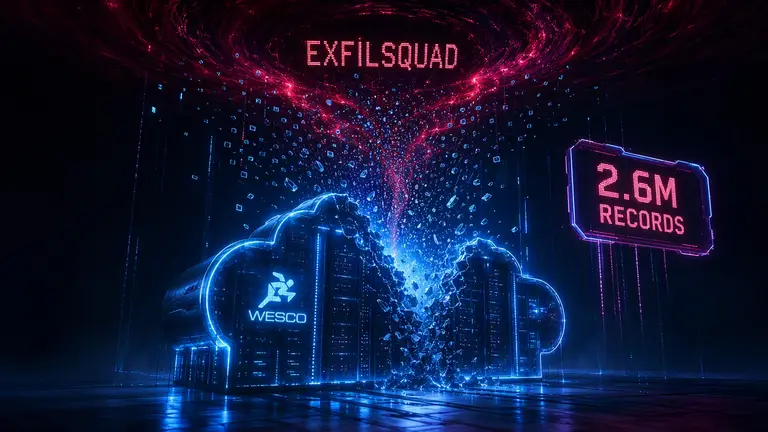
Wesco, a Fortune 500 industrial distributor with roughly 21,000 employees and nearly $24 billion in annual revenue, confirmed on August 11, 2026, that it is investigating a security incident in its cloud CRM environment. Data extortion group ExfilSquad claims the theft involved 2.6 million records and uploaded torrent files to P2P networks after a negotiation deadline expired. The reconstruction relies primarily on Wesco's statement to BleepingComputer and threat intelligence analysis; the technical root cause remains unconfirmed.
- Wesco confirmed the incident through Jennifer Sniderman, VP Corporate Communications, ruling out ransomware or malware on its IT systems.
- ExfilSquad claimed 2.6 million stolen records, including customer and employee PII, CRM user profiles, credit/business identifiers, and authentication metadata; Wesco has not confirmed this claim.
- The group set a negotiation deadline of August 5, 2026, and uploaded torrent files on August 7, 2026, according to Resecurity.
- Resecurity and VenariX research links ExfilSquad to patterns of targeting misconfigured Microsoft Power Pages tables in prior incidents; Wesco has not confirmed this root cause.
Wesco's Confirmation and the Limits of the Reconstruction
Jennifer Sniderman, Wesco's VP of Corporate Communications, told BleepingComputer: "Wesco is aware of a claim of CRM data exfiltration by a third party." The same source reports the official statement that "We have worked with our cloud CRM vendor on the matter, and we do not believe that there is a risk to sensitive data."
Wesco explicitly ruled out the presence of ransomware or other malicious software on its IT systems. The company stated that "We do not believe that payment card information, financial account information or other sensitive customer or employee data is at risk."
The dossier does not identify the cloud CRM vendor involved. The reference to Microsoft Dynamics 365 emerges from BleepingComputer's reporting as contextual information, not as corporate confirmation. The exact nature of the technical compromise remains unattributed: the correlation with misconfigured Microsoft Power Pages tables derives from researcher analysis of historical ExfilSquad patterns, not from a Wesco statement.
ExfilSquad's Modus Operandi: Legitimate Tools, Public Distribution
ExfilSquad operates exclusively through data extortion, without ransomware deployment. According to Resecurity, the group uses dual-use tools — 7z, rclone, PowerShell, WinSCP, curl — for staging and exfiltration to attacker-controlled cloud storage.
Distribution occurs via torrent on P2P networks. Resecurity documents that ExfilSquad uploaded torrent files for victims, including Wesco, on August 7, 2026, after setting a negotiation deadline of August 5, 2026. The publication method makes data dissemination irreversible, regardless of the outcome of any subsequent contact with the victim.
The domain mallory[.]ai is documented as an IOC associated with the group's activities.
"A lot of teens are drawn to hacking because it feels like a game — you get recognition, a sense of identity, community, and a lot of power" — ExfilSquad representative, via The Times, reported by Resecurity
Supply-Chain Risk Escalation in Cloud CRM
Wesco operates more than 700 distribution, fulfillment, and sales facilities across roughly 50 countries. Its nodal position in the industrial supply chain amplifies the breach's exposure: CRM records containing partner, customer, and business contact data represent primary material for targeted phishing and business email compromise (BEC) campaigns against third parties. Rescana highlights "significant third-party risk implications for organizations with data held by Wesco," underscoring that compromise of a distributor of this scale generates cascading effects.
The risk asymmetry is structural. Companies that entrust partner data to third-party-managed cloud CRM platforms retain limited visibility into actual security configurations, access controls, and data exposure policies. When the attack surface shifts from on-premises perimeter to shared SaaS services, traditional endpoint security stacks lose detection capability: the attack does not traverse corporate firewalls or install detectable malware, but uses native administrative tools.
What Changes
The Wesco-ExfilSquad incident documents three dynamics relevant to risk analysis. First: the separation between corporate confirmation and attacker claim. Wesco verified the incident but has not validated the volume or nature of the data; this distance is typical of cloud breaches where the vendor manages infrastructure and the customer holds partial visibility.
Second: the absence of ransomware does not imply absence of impact. Torrent publication makes data permanently accessible, eliminating the possibility of containment through negotiation or legal intervention.
Third: the source does not specify whether Wesco has notified regulatory authorities or law enforcement, nor whether the cloud CRM vendor has issued technical guidance to its customers. This information vacuum leaves partner organizations without parameters to assess their own exposure.
Editorial Line
The Wesco case exemplifies an expanding category of incidents: data theft extortion against SaaS environments, where the attacker does not compromise the customer's infrastructure but extracts value from data hosted on third-party platforms. The corporate response — collaboration with the vendor, ruling out ransomware, risk assessment on sensitive data — follows standard protocol, but does not clarify the technical terms of the compromise.
For supply chains transiting through Wesco, the relevant datum is not the confirmation or denial of the 2.6 million record claim, but the permanence of data on P2P networks. Visibility into who has downloaded the torrents, and with what intent, remains outside the control of the victim and its vendor. This is the asymmetry that defines the risk.
The reconstruction is based primarily on Wesco's statement to BleepingComputer and threat intelligence analysis. The source does not specify the confirmed technical root cause, the CRM vendor involved, nor whether the torrent data has been independently authenticated.
Information has been verified against cited sources and updated as of publication time.
Sources
- https://www.bleepingcomputer.com/news/security/wesco-confirms-security-incident-after-exfilsquad-claims-data-theft/
- https://www.rescana.com/post/wesco-cloud-crm-data-breach-exfilsquad-data-theft-and-supply-chain-risks-analyzed
- https://www.resecurity.com/blog/article/exfilsquad-targets-new-victims-shares-data-via-torrents
- https://blog.rankiteo.com/wes1786569977-wesco-breach-august-2026/
- https://daily.dev/posts/wesco-confirms-security-incident-after-exfilsquad-claims-data-theft-xhz2lerqo
- https://www.teiss.co.uk/news/wesco-investigates-cybersecurity-incident-after-data-extortion-group-claims-breach-17969
- https://www.bleepingcomputer.com/
- https://www.bleepingcomputer.com/tutorials/
- https://www.bleepingcomputer.com/download/
Get DeafLetter
A weekly selection of signals, vulnerabilities and guides. Critical alerts remain optional.
You can unsubscribe at any time. Privacy policy.