Get DeafLetter
A weekly selection of signals, vulnerabilities and guides. Critical alerts remain optional.
You can unsubscribe at any time. Privacy policy.
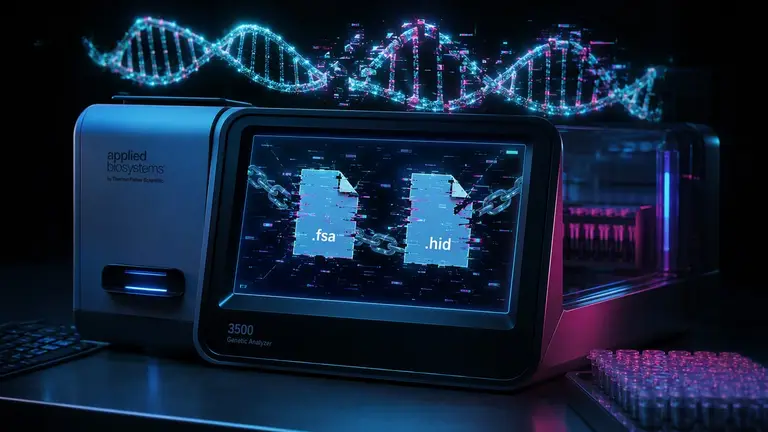
On July 31, 2026, Thermo Fisher Scientific published a security bulletin for CVE-2026-17583, a high-severity vulnerability (CVSS v4.0: 8.2) in its Applied Biosystems DNA analysis systems. The flaw allows alteration of digital .fsa and .hid files before they are loaded into the analysis software, without the application flagging any anomaly. The discovery, coordinated with CISA and made by researchers Nathan Adams, Kevin Dyer, and Laura Gaydosh Combs of the Forensic Bioinformatics group, raises a broader issue: roughly thirty years of digital forensic evidence have never been protected by cryptographic validation.
- CVE-2026-17583 scores CVSS v4.0 8.2: .fsa and .hid files can be modified before analysis without generating warnings in Thermo Fisher software.
- Nathan Adams demonstrated the modification using Anthropic's Claude AI in approximately 45 minutes, combining two DNA profiles into a file that appeared unaltered since 2015.
- The patch introduces digital signatures only for new files, excluding retroactive validation of three decades of potentially exposed evidence.
- Five product lines receive updates; three End-of-Life lines will not be patched, leaving operational systems without official mitigation.
The Mechanism: Implicit Trust in Early-1990s Formats
The .fsa and .hid formats date back at least to 1995, when Applied Biosystems instrumentation began digitizing forensic DNA analysis output. These files contain the genetic profiles extracted from biological samples, but — according to the Thermo Fisher security bulletin cited by primary sources — the analysis software accepts them without verifying integrity or authenticity. The check is limited to formal file structure, not provenance or intermediate alteration.
This architecture made sense in a physically isolated 1990s laboratory, where chain of custody relied on procedural controls and physical access. It does not withstand an actor with access to the lab server and knowledge of the DNA testing workflow, the documented access condition for this vulnerability. According to Rescana, the modification is "virtually undetectable" — an adjective the sources quote directly from the vendor bulletin.
The Demonstration: 45 Minutes with a Language Model
Researcher Nathan Adams published a proof-of-concept built with Anthropic Claude. The first successful file modification took approximately 45 minutes of interaction with the AI model. Adams combined scans from two individual DNA profiles into a new file that Thermo Fisher software accepted without warning, presenting it as a document unaltered since 2015.
The temporal detail matters: if the modified file appears consistent with a generation from ten years ago, no internal software check can flag the anomaly. Sources do not document whether other forensic tools outside Thermo Fisher software can detect the tampering, and the dossier explicitly notes that "no known methods exist to retroactively validate files generated before the patch."
"Digital signatures will help customers verify files 'moving forward'" — Thermo Fisher Security Bulletin, July 31, 2026
The Patch: Prospective Protection, Historical Gap
Thermo Fisher released updates for five product lines: 3500/3500xL, 3730/3730xL, SeqStudio, SeqStudio Flex, and GeneMapper ID-X. Three lines remain unpatched — 3130 Series, ABI PRISM 3100/3100-Avant, and ABI PRISM 310 — because they are declared End-of-Life by the vendor. The bulletin, as reported by The Hacker News, specifies that digital signatures will help customers verify files "moving forward," with no indication of validation mechanisms for the historical installed base.
This architectural choice is not technically surprising: adding signatures to already-generated files would require an ex post signature with a key whose historical custody cannot be guaranteed. The practical result, however, is a trust asymmetry. Digital DNA files produced from 1995 through July 31, 2026, lack any cryptographic attestation of integrity. No exploitation in the wild has been confirmed as of August 3, 2026, but the very absence of validation makes it impossible to retrospectively verify whether manipulations occurred in past judicial cases.
Immediate Actions
Primary sources converge on several priority actions for laboratories operating this instrumentation:
- Immediately update the five supported product lines to the firmware and software versions specified in the Thermo Fisher bulletin of July 31, 2026.
- For the three unpatched End-of-Life lines, evaluate decommissioning or isolation in network segments with enhanced access controls, given that no official fix is planned.
- Review digital chain-of-custody procedures for archived .fsa and .hid files, documenting the validation gap as a risk element in forensic reports.
- Prosecutors and defense counsel who relied on DNA analyses based on digital files must assess reopening specific verifications where file integrity was implicitly assumed.
The "Forensic Debt" of Legacy Scientific Formats
The CVE-2026-17583 case is not isolated in the technology landscape. Analogous crises have hit electronic voting machines (where proprietary formats without cryptographic hashes made automatic recounts impossible), medical devices (where decade-old firmware inherited obsolete trust models), and industrial SCADA systems. The difference here is the judicial context: forensic DNA enjoys an aura of scientific objectivity that digital forensics dismantles when the chain of custody shows a missing link.
The use of an AI model to generate the proof-of-concept accelerates the public narrative, but it is not the technical core of the problem. The structural defect — absence of file authentication — predates the existence of large language models by decades. Claude lowered the cost of demonstration; it did not create the vulnerability. This distinction matters for anyone assessing whether the risk is emerging or simply finally visible.
Frequently Asked Questions
Are physical DNA samples at risk?
No. The vulnerability concerns exclusively the digital .fsa and .hid files, not the original biological material. The alteration occurs in the digital representation of the profile, not in the sample itself.
Can a historical file be verified for modification?
According to sources, no known method exists to retroactively validate files generated before the July 31, 2026 patch. The digital signatures introduced are valid only for documents produced afterward.
Why is the CVE not in the CISA KEV catalog?
The CISA Known Exploited Vulnerabilities catalog lists vulnerabilities with confirmed exploitation in the wild. As of August 3, 2026, primary and supporting sources agree on the absence of confirmed exploitation, consistent with its non-inclusion in KEV.
Sources
- https://www.rescana.com/post/cve-2026-17583-critical-dna-data-tampering-vulnerability-in-thermo-fisher-applied-biosystems-software
- https://thehackernews.com/2026/08/thermo-fisher-patches-flaw-that-could.html
- https://dailysecurityreview.com/resources/thermo-fisher-patches-dna-file-tampering-flaw-cve-2026-17583/
- https://gbhackers.com/thermo-fisher-dna-analysis-software-flaw/
- https://www.secnews.gr/en/725222/cve-2026-17583-thermo-fisher-eypatheiadn/
- https://nvd.nist.gov/vuln/detail/CVE-2026-17583
- https://nvd.nist.gov/vuln/search
- https://www.cisa.gov/known-exploited-vulnerabilities-catalog
- https://thehackernews.com/
- https://thehackernews.com/p/upcoming-hacker-news-webinars.html
Information verified against cited sources and current as of publication.
Sources
Get DeafLetter
A weekly selection of signals, vulnerabilities and guides. Critical alerts remain optional.
You can unsubscribe at any time. Privacy policy.