Get DeafLetter
A weekly selection of signals, vulnerabilities and guides. Critical alerts remain optional.
You can unsubscribe at any time. Privacy policy.
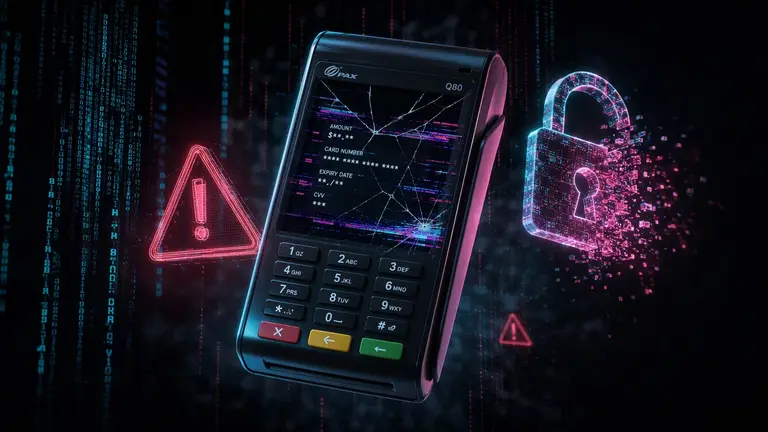
On August 5, 2026, Trend Micro disclosed vulnerability ZDI-26-525 in the PAX Technology Q80 payment terminal. The flaw allows an unauthenticated, network-adjacent attacker to achieve arbitrary code execution. PAX Technology confirmed on April 23, 2026 that the affected firmware is end-of-life and no longer supported, leaving devices exposed with no remediation path.
- ZDI-26-525 is a zero-day RCE vulnerability in the PAX Technology Q80 POS terminal, disclosed without an available patch
- The attack exploits AIP file parsing via symbolic links to achieve arbitrary file write, which can be chained with other vulnerabilities for root code execution
- PAX Technology declared the firmware end-of-life on April 23, 2026 and requested a disclosure extension to April 2027, which ZDI denied
- The only documented mitigation in the source is limiting interaction with the product
The Mechanism: How an AIP File Becomes an Entry Point
The flaw resides in the PAX Q80's AIP file parser. According to the ZDI advisory, the installation routine follows symbolic links without validating the real filesystem path. An attacker with access to the same local network can create a symbolic link that redirects the installer process's write operation to an arbitrary destination.
This technique falls under the CWE-59 (Link Following) and CWE-61 (Symbolic Link Following) weakness families, both documented in the MITRE catalog. Arbitrary file write alone does not guarantee code execution with maximum privileges: the advisory specifies that the attacker must combine this vulnerability with "other vulnerabilities" to reach a root context. The dossier does not identify these complementary vulnerabilities.
"The specific flaw exists within the parsing of AIP files. By creating a symbolic link, an attacker can abuse the installer process to write arbitrary files."
The network-adjacent condition narrows the attack radius compared to a fully remote exploit, but remains critically relevant for POS terminals: these devices typically sit on local networks in retail stores, restaurants, and small businesses, often with weak or absent segmentation, where an initial compromise on another network node can pivot laterally to the payment terminal.
The Timeline That Pins the Vendor: April to August Without a Fix
The coordination timeline documented in the ZDI advisory traces a path with no positive outcome. On April 22, 2026, the vulnerability was reported to PAX Technology. On April 23, the vendor confirmed the reported firmware was end-of-life and no longer supported. This declaration, ostensibly closing the matter, instead opened a graver scenario: the absence of any remediation path for users who continue to operate the hardware.
On July 13, 2026, PAX Technology disputed the impact on still-supported releases, a move implying the existence of newer firmware for the same Q80 model. On July 27, the vendor requested a disclosure deadline extension to April 2027. ZDI refused and notified its intention to proceed with a 0-day classification. Coordinated publication occurred on August 5, 2026.
The dossier does not clarify whether the end-of-life firmware is the only one existing for the Q80 or if later versions address the issue. The vendor's reference to "supported releases" in the plural suggests the former, but the ZDI advisory neither confirms nor denies this interpretation. This remains a significant area of uncertainty for operators assessing their risk.
Why It Matters
Case ZDI-26-525 exposes a systemic fracture in the security model of industrial IoT devices and embedded payment systems. When a vendor declares firmware end-of-life while the hardware remains in active production, it creates a security technical debt that falls entirely on the end user, often without the expertise or resources to manage it.
The PAX Q80 is a widely deployed POS terminal in commercial environments with tight operating margins, where hardware replacement represents a non-trivial investment. ZDI's zero-day classification, applied when no patch or official mitigation exists, makes explicit that the risk is not theoretical: it is a present, unresolvable risk using standard tools.
The advisory documents no specific corrective measures or technical alternatives for legacy users. The dossier does not specify whether subsequent non-end-of-life firmware for the same hardware is actually available or presents the same attack surface. The linked ZDI catalog, which assigns a score of 7.5 to entry ZDI-CAN-30583 for the same vulnerability, provides no additional details on exploit conditions or prevalence.
The absence of an assigned CVE and official CVSS in the primary advisory — with only the 7.5 score present in the separate catalog listing — reduces standard traceability of the vulnerability in patch management systems and threat intelligence databases. Security operators must explicitly reference the ZDI-26-525 identifier, which is less integrated into automated workflows than a canonical CVE identifier.
The Line Between Adjacent and Remote: A POS Never Truly Isolated
ZDI's network-adjacent classification technically distinguishes the attack from a fully remote one, but this distinction has limited operational value in real enterprise networks. POS terminals connect to payment gateways, local servers, cashier workstations, and increasingly to cloud services for inventory management and reporting.
An attacker who has compromised another node on the local network — via phishing, malware, or secondary vulnerability — is positioned to exploit ZDI-26-525 without further barriers. The dossier documents no in-the-wild exploits or active campaigns, but the described attack mechanism requires no complex conditions: creating a symbolic link and placing a manipulated AIP file are technically trivial operations once network access is obtained.
The concrete impact for the merchant or restaurateur using a PAX Q80 is not immediately quantifiable from the advisory. The dossier does not specify the nature of exposed data or whether POS compromise allows direct access to payment card data or requires further steps. The terminal's PCI-DSS certification, if present, could be compromised by an unpatchable vulnerability, with contractual and regulatory consequences extending beyond the purely technical.
The absence of a dedicated security advisory from PAX Technology constitutes a further information void. Users who do not actively monitor ZDI publications may remain completely unaware of their device's risk condition, receiving no official vendor notifications or replacement guidance.
What Remains in the Dark: The Dossier's Limits
The ZDI-26-525 advisory provides a solid but circumscribed technical map. The following remain documented as unknown: the identity of the "other vulnerabilities" required to complete the exploit chain to root; the specific vulnerable firmware version; the number of deployed PAX Q80 devices potentially exposed; the existence of subsequent non-end-of-life firmware for the same hardware; and any evidence of active exploitation.
The dossier also does not specify whether the AIP format is proprietary to PAX Technology or derives from the Android Application Package (APK) format, an ambiguity bearing on the potential attack surface: if the parser is shared with other models or firmware generations, the vulnerability's radius could extend beyond the Q80. The advisory does not address this possibility.
For security operators and IT managers at points of sale using PAX hardware, the single source and absence of independent corroboration demand caution in interpretation. The ZDI advisory is authoritative in its domain, but the lack of an official vendor response leaves unresolved questions of scope and lifecycle management that cannot be deduced from the available text.
Information is based on the cited advisory and current as of publication.
Sources
- http://www.zerodayinitiative.com/advisories/ZDI-26-525/
- http://www.zerodayinitiative.com/advisories/published/
Information is based on the cited source and current as of publication.
Sources
Get DeafLetter
A weekly selection of signals, vulnerabilities and guides. Critical alerts remain optional.
You can unsubscribe at any time. Privacy policy.