Get DeafLetter
A weekly selection of signals, vulnerabilities and guides. Critical alerts remain optional.
You can unsubscribe at any time. Privacy policy.
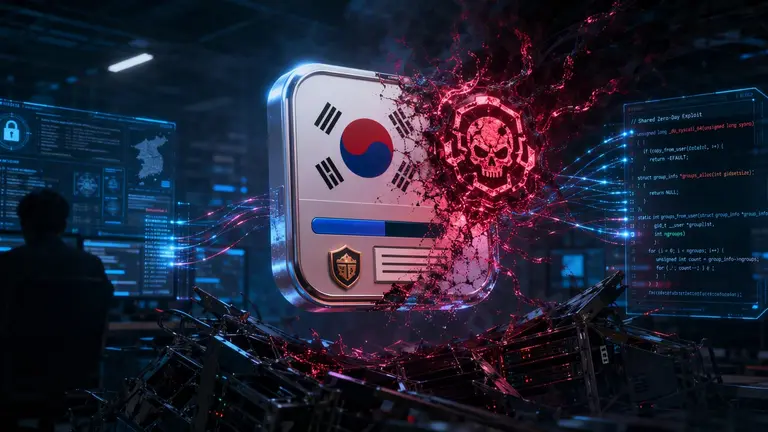
On July 30, 2026, four South Korean agencies — the NIS, National Police Agency, KISA, and the Financial Security Institute — issued a joint advisory documenting unprecedented sharing between state espionage and cybercrime. The North Korean Lazarus Group operated for months through the same technical access used by the Gunra ransomware, with identical infrastructure, tools, and vulnerabilities converging in a campaign AhnLab dubbed "Operation Double Barrel." The novelty lies not only in the damage but in the model: a nation-state functioning as an exploit provider for an emerging criminal crew.
- Lazarus and Gunra shared identical filenames, C2 servers, SSH key fingerprints, and privilege-escalation tools, according to AhnLab analysis.
- The attack vector is a mandatory client-side component, AnySign4PC, used by South Korean banks and government services; vulnerable versions 1.1.4.4–1.1.4.6 allowed buffer-overflow RCE.
- Fifteen legitimate South Korean websites were compromised in watering-hole attacks, likely via a shared hosting provider.
- AhnLab stopped short of definitive single-actor attribution, classifying the Lazarus–Gunra link as a "high likelihood of technical linkage."
The Software You Cannot Avoid
AnySign4PC is a mandatory financial security component for accessing banking and government services in South Korea. According to AhnLab, cited by The Record, "the Korean financial security software currently being abused… is used not only in various enterprise environments but also on many personal PCs." This mandatory distribution turns every vulnerability into a massive attack surface: no target selection is required, just compromise a legitimate site the user visits routinely.
TechTimes identified the vulnerable versions 1.1.4.4–1.1.4.6 and the patch 1.1.5.0 released on June 1, 2026, by KISA. Active exploitation dates back to the second half of 2025, per ENKI WhiteHat — a window of at least six months during which millions of systems ran code with no individual defense. As of July 30, 2026, no CVE had been assigned to the vulnerability.
AhnLab emphasized that "because the vulnerabilities can be triggered simply when a user accesses a specific page, not only explicitly targeted organizations but also general user environments running vulnerable software may be exposed to risk." The mechanism is technically a drive-by compromise: no attachment to open, no credentials to steal beforehand.
Technical Overlap Between Espionage and Ransomware
AhnLab's analysis, reported by The Record, documents overlaps that go beyond mere reuse of a public vulnerability. Both groups used identical payload filenames, matching execution arguments, equivalent privilege-escalation tools, overlapping C2 servers, and the same SSH key fingerprint. Malware cleanup used the same technique: renaming to random four-character strings before removal.
Lazarus installed espionage backdoors in at least 72 organizations in 2026, including government agencies, cryptocurrency exchanges, and IT service providers. Gunra used the same access for file encryption, data theft, and extortion. The detail that upends traditional intelligence models is the direction of flow: while previous years showed North Koreans infiltrating as affiliates in existing RaaS programs — documented by Unit 42 for Jumpy Pisces/Andariel with Play ransomware and by Symantec for Lazarus with Medusa — here the evidence suggests the reverse path.
The Record spelled out this reading: "here, the evidence suggests the relationship may run the other direction — with state hackers supplying tools, exploits, and access to a smaller, newer group." Gunra emerged in April 2025 with five South Korean companies as initial victims, built its ransomware on leaked Conti v2 source code, and transitioned to a RaaS model in January 2026. As of March 9, 2026, according to TechTimes, the group had claimed 32 global victims.
The Attack Chain: Watering-Hole, Spearphishing, and AI
Fifteen legitimate South Korean websites, managed by the same web development firm, were compromised for watering-hole attacks. AhnLab assesses that attackers likely first breached the shared hosting provider, gaining a multi-site distribution portal without having to hit each final destination individually.
In parallel, a spearphishing campaign targeted a South Korean defense contractor with emails disguised as a survey on GaN semiconductors. AhnLab noted probable use of artificial intelligence in generating the lure pages, signaling a level of personalization that accelerates scale without requiring dedicated linguistic operators for every sector.
Plainbit technically reconstructed the exploit chain via WebSocket and PNG files, according to TechTimes. The choice of image format is deliberate: it bypasses filters that actively inspect executables and scripts, while the payload activates in the context of the client-side software already present on the machine.
"a high likelihood of technical linkage" — AhnLab, official classification of the Lazarus–Gunra relationship
Why It Matters
The dossier does not document the volume of data exfiltrated from the 72 Lazarus-targeted organizations nor specify whether espionage and ransomware victims overlap. It does not show that Lazarus directly monetized the accesses passed to Gunra, nor that infrastructure sharing equals a unified command structure. The geographic origin of Gunra operators remains unattributed: the previous hypothesis of Eastern European operators, tied to the Conti code heritage, has been neither confirmed nor refuted by available material.
The brief also does not document specific remedial measures beyond the KISA patch release, nor provide exact values for technical indicators — SSH fingerprint, C2 domains, specific filenames — which remain unpublished in accessible reports. The source does not specify the nature of data exposed during Gunra operations.
A Boundary Dissolves: Analysis
The July 30, 2026 joint advisory is not an isolated exception but the acceleration of a trend already mapped. What changes is the direction of flow: not criminals buying access from states, but states feeding criminals with zero-days and mature infrastructure. For organizations with operations in South Korea or dependencies on Korean financial software, this means compromise of a legitimate site can now trigger two distinct but overlapping damage chains — espionage and ransomware — with different timelines and objectives.
For the global financial sector, the distinction between APT and cybercrime erodes where it matters most: in the ability to model risk. If state zero-days become commodities available to groups with six months of history, threat intelligence frameworks must rebuild propagation speeds they have never measured. The open question is who protects users forced to run vulnerable software by law, when the patch arrives after months of active exploitation.
Sources
- https://therecord.media/north-korea-hackers-ransomware
- https://databreaches.net/2026/07/31/north-koreas-lazarus-group-sharing-tools-with-ransomware-hackers-south-korean-agencies-warn/
- https://ground.news/article/north-koreas-lazarus-group-sharing-tools-with-ransomware-hackers-south-korean-agencies-warn
- https://f4n6.co.uk/security-feed/north-koreas-lazarus-group-sharing-tools-with-ransomware-hackers-south-korean-agencies-warn/
- https://www.techtimes.com/articles/322157/20260730/state-hackers-made-south-koreas-mandatory-banking-software-zero-day-weapon.htm
- https://finance.biggo.com/news/88c65712-0379-4902-a1c6-84d52503a358
- https://therecord.media/north-korean-hackers-collaborate-with-play-ransomware
- https://therecord.media/north-korean-hackers-using-medusa-ransomware
- https://therecord.media/us-indicts-north-korean-hacker-ransomware
Information verified against cited sources and current as of publication.
Sources
Get DeafLetter
A weekly selection of signals, vulnerabilities and guides. Critical alerts remain optional.
You can unsubscribe at any time. Privacy policy.