Get DeafLetter
A weekly selection of signals, vulnerabilities and guides. Critical alerts remain optional.
You can unsubscribe at any time. Privacy policy.
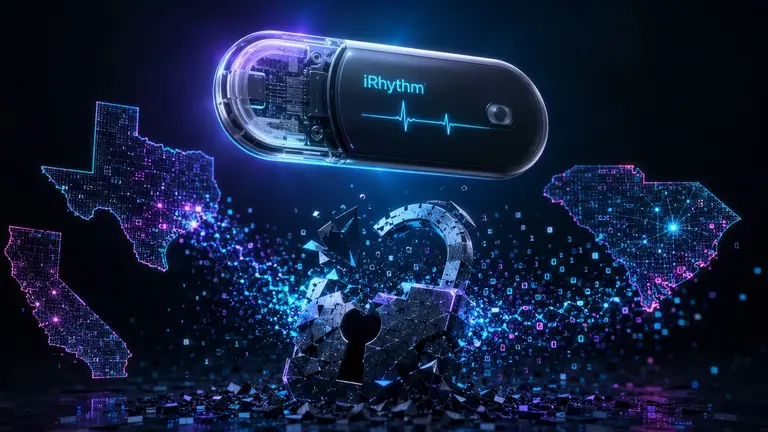
iRhythm Technologies disclosed a data breach that began on June 3, 2026, and was discovered on June 8, with more than 360,000 individuals already notified in Texas, South Carolina, and California. The day after discovery, June 9, a threat actor issued a ransom demand. As of the sources' publication, no public leak had been documented.
- Over 360,000 people were affected: 298,647 in Texas and 69,526 in South Carolina, with additional notifications in California per SecurityWeek.
- Unauthorized access occurred via social engineering on third-party hosted business applications, not on iRhythm's clinical systems or medical devices.
- On June 9, 2026, iRhythm received a ransom demand; sources document no subsequent public leak.
- Exfiltrated data includes names, addresses, emails, dates of birth, phone numbers, patient account numbers, device serial numbers, insurance numbers, and service dates.
The Attack Window: Five Days of Unauthorized Access
According to SecurityWeek, iRhythm identified the unauthorized access on June 8, 2026. The compromise window spans June 3 to June 8 — five days during which the threat actor had access to data stored in business applications hosted on third-party infrastructure.
HIPAA Journal, a healthcare compliance specialist, confirms the vector was a social engineering attack, citing information derived from iRhythm's SEC filing. The sources did not consult the SEC filing directly; they report it based on company statements.
The compromised applications were not part of the company's clinical infrastructure. iRhythm explicitly stated there was no impact on products, clinical or medical device systems, customer connections, manufacturing and distribution operations, patient safety, or the ability to meet patient needs.
"the company has not identified any impact to our products, our clinical or medical device systems, our connections to customers, our manufacturing and distribution operations, patient safety, or our ability to meet patient needs" — iRhythm, official statement reported by SecurityWeek
The Breach Numbers: A Verified Floor
SecurityWeek reports precise figures from state filings: 298,647 individuals in Texas and 69,526 in South Carolina. The Record adds that iRhythm filed notifications in California as well, though a specific figure for that state was not available in the sources at publication. The sum of the two states with published data exceeds 360,000, but the national total remains unquantified.
The Record also provides financial context: iRhythm's Q2 revenue was $224.2 million. HIPAA Journal notes that iRhythm holds a cyber insurance policy that may cover losses related to the incident.
The company classified the breach as "material" in its SEC filing but indicated it does not expect a material impact on its financial condition. This phrasing reflects the distinction between regulatory disclosure obligations and accounting assessment.
The Profile of Exposed Data
The compromised data types, listed by SecurityWeek and HIPAA Journal, go beyond standard demographic details. Device serial numbers, insurance numbers, and service dates create a highly specific patient profile. A patient with an iRhythm device who receives a message citing their cardiac monitor's serial number and the exact installation date has reason to consider the communication authentic.
iRhythm stated, per The Record, that there is no evidence the data has been or will be used for identity theft. The sources do not specify other uses of the exfiltrated data.
"no evidence that any personal information has been or will be used to commit identity theft" — iRhythm, official statement reported by The Record
The Extortion Element and the Absence of a Leak
On June 9, 2026, the day after discovery, iRhythm received communications from a threat actor with a ransom demand. SecurityWeek notes that, at the time of publication, the data had not appeared on any public leak site.
The dossier contains neither confirmation nor denial of payment by iRhythm. The threat actor group's identity has not been attributed by any source. The sources do not document negotiation dynamics or specific scenarios regarding the data's fate.
The absence of public leaks is a fact reported by the sources, not a calibrated statistical metric. SecurityWeek does not classify this silence as anomalous nor compare it with temporal patterns of other incidents.
What to Do Now
The sources provide no specific operational recommendations for this case. iRhythm stated it has notified the relevant authorities and initiated the required regulatory procedures. Affected patients should be wary of unsolicited communications citing specific data from their device or medical treatment.
Caution in communications is the only action documented from the company's statements: patients with iRhythm devices who receive suspicious messages can verify authenticity by contacting the company directly through official channels.
Editorial Close
The iRhythm case illustrates healthcare companies' reliance on third-party ecosystems for data that falls under HIPAA. The separation between business and clinical systems, while real, does not eliminate regulatory and reputational risk when patient data transits external platforms.
The absence of public leaks after the ransom demand is a data point noted by the sources, not interpreted. The SEC filing, cited indirectly through SecurityWeek, HIPAA Journal, and The Record, provides the incident's narrative structure without resolving the unknowns about its outcome.
Information verified against cited sources and current as of publication.
Sources
- https://www.securityweek.com/irhythm-data-breach-impacts-over-360000-people/
- https://research.checkpoint.com/2026/12th-october-threat-intelligence-report/
- https://www.malwarebytes.com/blog/news/2026/10/how-123456-became-the-key-to-almost-9-million-personal-records
- https://www.malwarebytes.com/blog/data-breaches/2026/10/asos-breach-update-hackers-stole-customer-details-and-shopping-searches
- https://www.hipaajournal.com/irhythm-data-breach/
- https://therecord.media/irhythm-data-breach-reports
- https://podcast.securityweek.com/
Get DeafLetter
A weekly selection of signals, vulnerabilities and guides. Critical alerts remain optional.
You can unsubscribe at any time. Privacy policy.