Get DeafLetter
A weekly selection of signals, vulnerabilities and guides. Critical alerts remain optional.
You can unsubscribe at any time. Privacy policy.
"INC Ransomware has emerged as the dominant threat actor actively weaponizing this vulnerability chain." With those words, Douglas McKee, director of vulnerability intelligence at Rapid7, framed a campaign that transforms the VPN appliance from a defensive perimeter into an unmonitored bridge to the internal domain infrastructure.
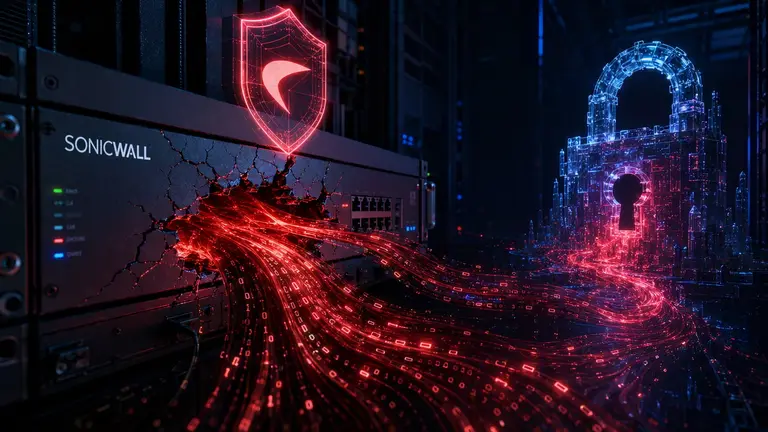
INC Ransomware has emerged as the dominant threat actor exploiting a chain of two zero-days in SonicWall SMA 1000 devices. Active pre-disclosure exploitation began on June 22, 2026. The attack enables unauthenticated root access, theft of credentials, sessions, and TOTP seeds, followed by lateral movement to domain controllers without an active VPN tunnel.
- CVE-2026-15409 (pre-auth SSRF, CVSS 10.0) and CVE-2026-15410 (code injection, CVSS 7.2) chained for unauthenticated root access on SonicWall SMA 1000
- Pre-disclosure exploitation began June 22, 2026; SonicWall patches released July 14, 2026, with CISA KEV listing and federal remediation deadline of July 17
- Attackers stole session databases and TOTP seeds, making full MFA re-enrollment mandatory regardless of password resets
- Rapid7 observed anomalous Active Directory authentications directly from the appliance's internal IP with client names 'kali', confirming lateral movement without VPN
885 — Total historical victims attributed to INC Ransomware per Ransomware.Live as of August 3, 2026. This figure is not specific to the SonicWall campaign.
The Chain That Turns an SSRF into Appliance Control
CVE-2026-15409 is a pre-authentication Server-Side Request Forgery in the /wsproxy component of the SMA Work Place interface, rated CVSS 10.0 per the NVD record with CISA-ADP assessment. Resecurity documents that this flaw opens a WebSocket tunnel to localhost-only services normally inaccessible from the outside.
From that position, the attacker reaches CVE-2026-15410, a code injection vulnerability in the remove_hotfix workflow of ctrl-service in the SMA 1000 Appliance Management Console, rated CVSS 7.2 per NVD. The chaining of the two flaws, documented by Volexity and Resecurity, escalates privileges remotely and without authentication to root.
The result is complete access to the VPN appliance, which Rapid7 observed acting as a bridge to the internal directory infrastructure.
Pre-Disclosure Exploitation: The Invisible Window
Volexity tracked the UTA0533 activity cluster with active exploitation from June 22, 2026. SonicWall released patches on July 14, the same day CISA added both CVEs to the KEV catalog with a remediation deadline of July 17 for federal agencies per BOD 26-04.
Brett Deroche, director of incident response at Rapid7, reported that attackers maintained persistence by "rolling the newly applied patch back to a vulnerable state to maintain access." This behavior, cited by Dark Reading, makes explicit that patching post-compromise does not equal full eviction.
The versions that remediate the vulnerabilities are 12.4.3-03453 and 12.5.0-02835 or later, per the SonicWall advisory reported by The Hacker News.
TOTP Seed Theft and the Failure of MFA as Remediation
Jacob Krell, senior director at Suzu Labs, told SC World that "the attackers stole session databases and the TOTP seeds that generate one-time codes. Password resets don't evict them. Any user who authenticated through a compromised appliance needs full MFA re-enrollment from scratch."
This detail shifts the operational paradigm: multi-factor authentication, typically invoked as a post-breach remediation control, instead requires complete reconstruction. Attackers with TOTP seeds can generate valid codes independently of reset credentials.
The practical consequence is that remediation is not a patch-and-password-reset cycle, but an identity project touching every user with sessions through the compromised appliance.
The Actor, the Victims, and Pressure Tactics
Douglas McKee stated that INC Ransomware is "the dominant threat actor actively weaponizing this vulnerability chain." According to Resecurity, victims have been observed in Australia, the United States, the United Arab Emirates, Colombia, Switzerland, and other countries.
The group accelerated activity in early August 2026, with new victims posted to the data leak site between July 17 and August 1. The figure of 885 total victims represents the group's historical count, not specific to this campaign.
Resecurity documented phone pressure tactics from an individual identifying as 'Andrew' at +1 (304) 384-0401, with email info@helprans[.]com. The domain was registered after the incident via a Chinese registrar that accepts cryptocurrency payments.
Malware observed in the original Resecurity report includes ROOTRUN, KNUCKLEBALL (a Python script for launching Suo5), Suo5 itself (an open-source HTTP proxy), and ORANGETAIL (a Java web shell with similarities to Behinder).
What to Do Now
Forensic eviction before patching. Per Brett Deroche of Rapid7, "a comprehensive forensic review of the firewall is required to ensure complete eviction." The appliance must be treated as compromised until verified, not simply updated.
Full MFA re-enrollment. Per Jacob Krell of Suzu Labs, every user with authentication through the compromised appliance requires "full MFA re-enrollment from scratch." Password resets alone do not remove attacker access.
Hunt for anomalous AD authentications from the appliance's internal IP. Per Rapid7, anomalous Active Directory authentications were observed directly from the appliance's internal IP with atypical client names such as 'kali', confirming lateral movement without an active VPN tunnel.
Monitor for patch rollback. Per Brett Deroche of Rapid7, attackers demonstrated the ability of "rolling the newly applied patch back to a vulnerable state to maintain access." Patching operations must be accompanied by verification of the installed version's integrity.
Analysis
The campaign signals a qualitative shift in how ransomware actors treat perimeter appliances: no longer just targets for initial access, but persistence platforms with direct visibility into internal directories. This architectural recalibration forces defenses to re-implement internal monitoring as if the perimeter is already compromised.
It is unclear whether UTA0533 and INC Ransomware are the same entity or if INC acquired initial access from a broker. The brief does not clarify this point.
Information verified against cited sources and current as of publication.
Sources
- https://www.scworld.com/news/inc-ransomware-chains-two-sonicwall-sma-1000-zero-days-in-attacks
- https://www.darkreading.com/vulnerabilities-threats/inc-ransomware-exploits-sonicwall-sma-zero-days
- https://thehackernews.com/2026/08/inc-ransomware-emerges-as-dominant.html
- https://thehackernews.com/2026/07/two-sonicwall-sma-1000-zero-days.html
- https://www.securityweek.com/recent-sonicwall-vulnerabilities-exploited-in-ransomware-attacks/
- https://www.resecurity.com/blog/article/from-wsproxy-to-root-inc-ransomware-and-sonicwall-sma-exploit-chain
- https://nvd.nist.gov/vuln/detail/CVE-2026-15409
- https://nvd.nist.gov/vuln/detail/CVE-2026-15410
- https://www.cisa.gov/news-events/alerts/2026/07/14/cisa-adds-four-known-exploited-vulnerabilities-catalog
- https://www.cisa.gov/known-exploited-vulnerabilities-catalog
Get DeafLetter
A weekly selection of signals, vulnerabilities and guides. Critical alerts remain optional.
You can unsubscribe at any time. Privacy policy.