Get DeafLetter
A weekly selection of signals, vulnerabilities and guides. Critical alerts remain optional.
You can unsubscribe at any time. Privacy policy.
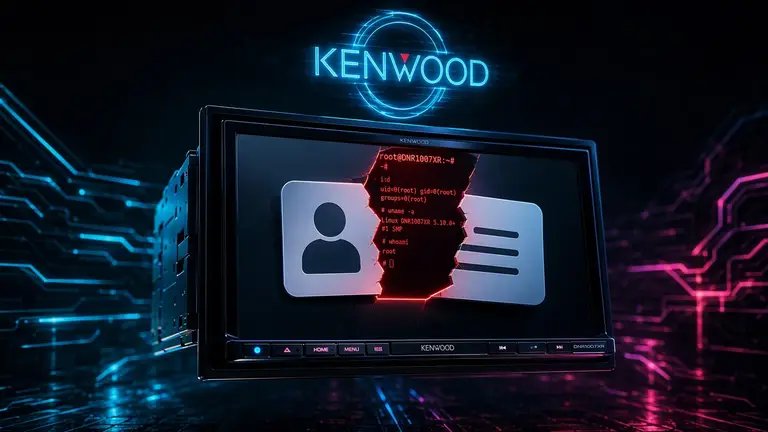
ZDI published advisory ZDI-26-488 on July 29, 2026, disclosing a vulnerability in the Kenwood DNR1007XR infotainment system discovered during Pwn2Own. The flaw, tracked as CVE-2026-18271, allows a physically present attacker to execute arbitrary code with root privileges. Kenwood has released a patch, but the coordinated disclosure spanned roughly six months: the initial vendor notification dates to February 3, 2026.
- Vulnerability ZDI-26-488 (CVE-2026-18271) affects the Kenwood DNR1007XR infotainment system and enables unauthenticated arbitrary code execution as root
- The mechanism is a heap-based buffer overflow in the vCardParser class, caused by missing length validation of a user-supplied string before copying it into a dynamically allocated heap buffer
- Kenwood issued a corrective update; coordinated release occurred July 29, 2026, approximately six months after initial reporting
- ZDI assigns the vulnerability a CVSS score of 6.8; the vector requires physical attacker presence, ruling out remote network exploitation
The vCard Weapon: How the Parser Overflow Works
The technical core resides in the vCard format parser, the RFC 6350 standard for contact exchange via Bluetooth or OBEX in automotive contexts. Advisory ZDI-26-488 describes the flaw precisely: the vCardParser class fails to validate the length of a user-supplied string before copying it into a dynamically allocated heap buffer. Overwriting heap metadata enables execution hijacking.
The vCard format is designed for portability: a contact file carries name, number, address, photo. In an infotainment system, the parser processes it to sync the smartphone's address book. ZDI documents that this ordinary processing becomes a full-compromise vector when the input is crafted. The attacker needs no credentials; physical presence suffices.
From Pwn2Own to Patch: The Timeline of a Coordinated Disclosure
The vulnerability surfaced in the Pwn2Own circuit, the contest that rewards zero-day exploits against industrial and consumer targets. The notification to Kenwood is dated February 3, 2026; public release, July 29, 2026. This roughly six-month interval falls within standard coordinated-disclosure windows, but raises operational questions: during this period, devices remained technically vulnerable.
Kenwood released an update, according to the advisory. However, ZDI does not specify the corrective firmware version number or the distribution mechanism. The DNR1007XR is an aftermarket device: the path that brings the patch from vendor to the user's dashboard runs through installers, dealerships, or manual updates. The dossier does not document the actual speed of this chain.
Infotainment as Attack Surface: Why the Risk Is Not Theoretical
Vehicle infotainment systems have grown in complexity into full-fledged computers, often connected to vehicle buses, CAN networks, and personal devices. Vulnerability ZDI-26-488 does not require remote access: a physically present attacker — in a parking, rental, car-sharing, or service scenario — compromises the system as root.
Root privilege on the infotainment opens pivoting scenarios toward other subsystems. The dossier does not document specific DNR1007XR architectures, but the automotive sector has recorded cases where the infotainment communicates with the vehicle gateway. The vulnerability raises questions about the boundary between consumer features and functional safety that the advisory does not resolve.
"The specific flaw exists within the vCardParser class. The issue results from the lack of proper validation of a user-supplied string before copying it to a heap-based buffer. An attacker can leverage this vulnerability to execute code in the context of root." — ZDI Advisory ZDI-26-488
Why It Matters
Advisory ZDI-26-488 does not specify the exact entry vector for the malicious vCard: Bluetooth, USB, or another channel remains undocumented. The dossier lacks details on the patch released by Kenwood, such as version number or fix mechanism. The identity of the researcher who discovered the vulnerability does not emerge from the sources. No detailed Pwn2Own demonstration is documented, nor the number of devices actually vulnerable or already patched.
The full CVSS vector is not available in the consulted sources: ZDI lists the aggregate score of 6.8 but not the calculation vector. The CVE-2026-18271 record on cve.org is in "reserved" status, confirming assignment but without technical details populated by the CNA. These limits reduce the ability to assess the specific exposure of a fleet or vehicle pool.
The gap between coordinated disclosure and actual end-user awareness remains the most significant blind spot. Aftermarket devices like the DNR1007XR do not integrate the same OTA update channels as OEM vehicles. The patch exists, but its dissemination depends on an opaque supply chain that the sources do not map.
FAQ
Which Kenwood devices are affected?
Advisory ZDI-26-488 explicitly identifies the Kenwood DNR1007XR model. Sources do not document extension of the vulnerability to other models in the range.
Can the flaw be exploited remotely?
No. The advisory specifies that the attacker must be physically present. No authentication is required, but the vector is local.
What severity score is assigned?
ZDI assigns a CVSS of 6.8 in the published list. The full calculation vector is not available in the sources.
Sources
Information is based on the cited source and current as of publication.
Sources
Get DeafLetter
A weekly selection of signals, vulnerabilities and guides. Critical alerts remain optional.
You can unsubscribe at any time. Privacy policy.