Get DeafLetter
A weekly selection of signals, vulnerabilities and guides. Critical alerts remain optional.
You can unsubscribe at any time. Privacy policy.
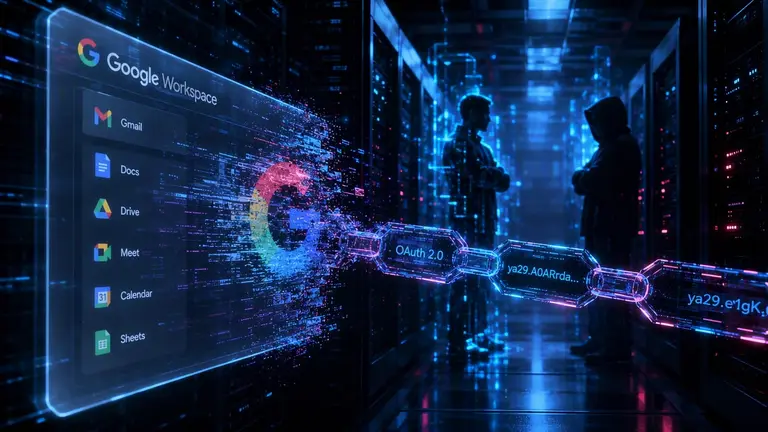
On September 16, 2026, an analysis by Material Security redefines the threat perimeter on Google Workspace: the attack chain has shifted from email-first to OAuth-first. The shift is not marginal. Stolen OAuth tokens survive password resets, do not expire, and are invisible to users. At the same time, legitimate AI agents with authorized OAuth grants structurally replicate the same compromise path, making it impossible to distinguish malicious threats from accidental productivity.
- The evolved attack chain on Google Workspace begins with a compromised OAuth token, often via supply chain attack, not email phishing.
- Stolen OAuth tokens persist beyond password changes, have no visible expiration, and often evade security teams.
- Legitimate AI agents with OAuth grants read email and Drive, operate on behalf of real users, and can access data outside the intended scope.
- The Google Threat Intelligence Group observed threat actors execute mass credential-harvesting campaigns with agent-enabled automation in under six hours in Q2 2026.
From Email Phishing to Invisible OAuth: How the Chain Changed
The traditional attack chain on Google Workspace followed a recognizable path: phishing email, credential theft, access to Gmail and Drive, lateral movement. This sequence had the advantage of visibility. Security teams could intercept the malicious email, detect anomalous logins, and react to password resets.
The evolved chain documented by Material Security eliminates these touchpoints. Entry occurs via a compromised OAuth token, often the result of a supply chain attack on a third-party vendor. The token provides direct access to Gmail and Drive data, bypassing the credential phase entirely. From there, the attacker proceeds to account takeover and lateral movement through the same infrastructure the organization uses for productivity.
Persistence is architectural, not tactical. Stolen OAuth tokens do not expire with a password change, generate no anomalous login alerts, and do not appear in traditional authentication dashboards. By design, they are invisible.
The Structural Paradox: The Legitimate AI Agent as Doppelgänger
The core of Material Security's analysis is not the attack technique itself, but its overlap with legitimate behavior. An authorized AI agent with an OAuth grant reads email, searches Drive, and operates on behalf of a real user. Its token has the same access as a human's token. When the permission scope exceeds the required task, the agent lacks the organizational "common sense" to recognize it.
According to the cited analyst, "OAuth tokens granted to an AI agent carry the same access as tokens granted to a person, but the agent won't understand that it's been overpermissioned before it acts. It will simply do what it needs to do in order to execute the task." The result is unintentional access to unintended inboxes or folders, reading of credentials in email threads, and downstream actions that replicate an attacker's lateral movement point by point.
The same analyst highlights the explicit convergence: "The pattern I'm describing, where an OAuth grant is used to access an account, read sensitive data from email and Drive, and use that access to move past the workspace, doesn't only describe what attackers do. It increasingly describes what AI agents do, by design, every day."
The Time Compression That Makes the Problem Urgent
Threat intelligence context corroborates the phenomenon as not just structural but accelerated. According to the Google Threat Intelligence Group, in Q2 2026 threat actors compromised a cloud resource, then planned, built, and executed an agent-enabled mass credential harvesting campaign in under six hours.
"In Q2 2026, GTIG observed threat actors compromise a cloud resource, then plan, build, and execute an agent-enabled mass credential harvesting campaign in under six hours." — Google Threat Intelligence Group
This time compression is not a marginal improvement in technique. It represents a paradigm shift: the planning and build phase, traditionally the longest and most detectable part of the kill chain, is now compressed into a single operational window. Defense based on temporal pattern detection fails.
The finding echoes broader industry research. According to a Filigran report cited by The Hacker News, 88% of security leaders say AI accelerates attacker speed post-infiltration. 93% report cyberattacks with negative business impact in the last 12 months despite validated defenses.
Why Traditional Controls Fail
Traditional defense rests on three pillars: email security for entry, strong authentication for credentials, endpoint detection for post-compromise behavior. The OAuth-first chain bypasses all three. There is no email to filter. No credentials to protect. No compromised endpoint to detect.
The distinguishing element is that the attacker and the legitimate AI agent share the same behavioral signature. Both traverse: OAuth grant, access to Gmail/Drive data, credential discovery in content, lateral movement via password resets or magic links, persistence. The difference lies solely in intent, which is not technically observable.
As the Material Security analyst underscores, "The same coverage that defends against the modern attack chain also defends against the modern agent risk. They're the same problem, wearing different hats." The implication is that security can no longer rely on distinguishing between malicious and legitimate actors, but must shift to environmental control: granular least-privilege, data classification, cross-layer visibility that integrates email, OAuth, Drive, and account behavior into a single analysis surface.
What to Do Now
- Audit active OAuth grants: identify AI agents and third-party applications with access to Gmail/Drive, verifying that scope matches the actual task required.
- Classify data in Drive and email: map where credentials, tokens, or sensitive information reside that could serve as pivots for lateral movement.
- Cross-layer visibility: integrate OAuth grant logs with data access and account actions to detect patterns that appear legitimate in isolation.
- Recalibrate access policies: design controls assuming any authorized agent can replicate an attacker's path, regardless of its nature.
An Architecture Problem, Not an Intent Problem
The novelty of this scenario is not technical but categorical. For decades, cybersecurity built controls presuming a sharp distinction between insider and outsider, legitimate software and malware, human error and malicious intent. The integration of AI agents into enterprise workflows dissolves these categories.
When an authorized OAuth token reads credentials in an email thread and uses them to access a third-party system, the boundary between automated productivity and compromise becomes operationally irrelevant. The question is no longer "who is attacking?" but "can any entity with these permissions cause this damage?" The answer, for over-permissioned AI agents as for attackers with stolen tokens, is yes. Workspace security must be rebuilt on this premise.
Frequently Asked Questions
Why do stolen OAuth tokens survive a password change?
OAuth tokens are decoupled from user credentials. Once issued, they authorize the application without requiring re-authentication. A password reset invalidates the password, not the tokens already distributed.
Can AI agents be configured to avoid accessing sensitive data?
The brief does not document automatic scoping mechanisms. The highlighted problem is that agents execute the task without understanding the business context of the data, making task-level configuration insufficient without environmental data controls.
Is CVE-2025-20393 linked to this threat?
Available data does not establish a link. The NVD page for the CVE is not resolved in specific detail in the extracted material.
Sources
- https://www.helpnetsecurity.com/2026/09/16/material-google-workspace-attack-chains/
- https://thehackernews.com/2026/09/attack-chains-not-just-attack-surfaces.html
- https://nvd.nist.gov/vuln/detail/cve-2025-20393
- https://cloud.google.com/blog/topics/threat-intelligence/from-prompting-to-autonomy-the-evolution-of-adversarial-ai/
- https://www.bleepingcomputer.com/news/security/reliaquest-confirms-failed-data-theft-attack-after-shinyhunters-breach/
- https://nvd.nist.gov/vuln
- https://img2.helpnetsecurity.com/posts2026/Material-Google_Workspace_security_2.png
Information verified against cited sources and current as of publication.
Sources
Get DeafLetter
A weekly selection of signals, vulnerabilities and guides. Critical alerts remain optional.
You can unsubscribe at any time. Privacy policy.