Get DeafLetter
A weekly selection of signals, vulnerabilities and guides. Critical alerts remain optional.
You can unsubscribe at any time. Privacy policy.
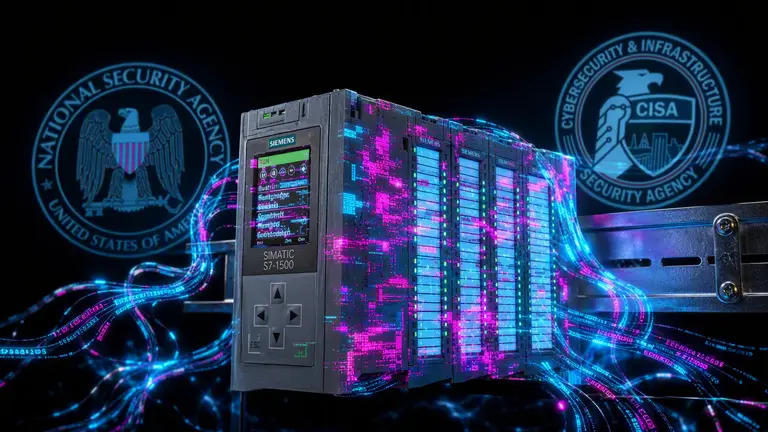
On August 19, 2026, the NSA, CISA, FBI, DOE, and EPA released a joint advisory formalizing a shift in attack methods against critical infrastructure: unidentified threat actors are using generative AI models to produce functional exploit scripts targeting Siemens S7 PLCs. The stakes are not a new vulnerability — the vulnerabilities are known and documented — but the velocity at which once-rarefied offensive capabilities become reproducible at scale.
- Five US federal agencies issued a joint advisory on August 19, 2026, on AI-assisted attacks against Siemens S7 Series PLCs.
- Actors combine open-source industrial libraries (snap7.dll, python-snap7) with AI-generated scripts to achieve read/write access to PLC memory, configuration, and ladder logic via the S7comm protocol.
- The activity is classified as an "active threat" with persistent reconnaissance underway, not a theoretical risk: Censys and ZoomEye scanning services are used to identify exposed targets.
- Siemens confirmed no unknown vulnerabilities exist in its products; the advisory describes new exploitation techniques against known vulnerabilities and potential misconfigurations.
- No official attribution, observed impact, or specific CVE has been publicly disclosed in the advisory.
The Mechanism: From Engineering Libraries to Offensive Weapons
CISA advisory AA26-231A, published June 23, 2026 but widely reported on August 19, details a precise technical pattern. Threat actors combine widely used open-source industrial automation libraries — snap7.dll and python-snap7 — with exploit scripts produced by generative AI models. The result is a toolset capable of natively interfacing with the S7comm protocol of Siemens S7-200, S7-300, S7-400, S7-1200, and S7-1500 PLCs.
The government document states verbatim that these scripts obtain "read/write access to Siemens S7 Series PLC memory, configuration data, and ladder logic programs via the S7comm protocol." This is not passive reconnaissance: write access to memory and ladder logic programs implies the ability to alter the physical behavior of controlled processes.
A distinguishing element is masquerading. The malicious tools are designed to mimic legitimate OT monitoring software, exploiting operators' familiarity with tools that use the same snap7 libraries for genuine diagnostic purposes. Signature-based detection becomes inadequate: the snap7.dll file present on a system can be either legitimate or malicious.
Internet-Scale Reconnaissance and Targeted Sectors
Beyond exploit development, the advisory documents the use of public scanning services — specifically Censys and ZoomEye — to map Siemens PLCs exposed on the internet. This reconnaissance phase is described as "persistent reconnaissance" and "pre-positioning," indicating preparation for future attacks rather than disruptive actions already executed.
The target sectors listed in the advisory span six critical areas: Critical Manufacturing, Energy, Water and Wastewater, Chemical, Food and Agriculture, Commercial Facilities. Editorial sources add the Defense Industrial Base as a potential target, though this sector does not appear explicitly in the primary government text. The absence of official attribution — no link to specific state actors is documented — and the indication that the campaign is in a preparation phase are important limitations of the dossier.
"Using AI to generate exploitation scripts represents an evolution in threat actor capabilities, dramatically reducing the technical expertise and time required to develop working ICS exploitation scripts and malicious tools."
— NSA/CISA/FBI/DOE/EPA joint advisory
Siemens Response: No New Vulnerabilities, But New Techniques
Siemens responded with a specific advisory, SSB-104599, published August 21, 2026. A spokesperson quoted by CyberScoop and Fox Business stated that "this advisory does not describe new vulnerabilities within the S7 Series programmable logic controllers (PLC). Instead, this reflects threat actors employing new techniques to exploit potential misconfigurations." The same source added: "At this point in time, we have not identified increased attack levels or unknown vulnerabilities in Siemens ICS products."
The Siemens bulletin confirms a timeline of multiple advisories: June 2025, April 2026, July 2026, and August 2026, suggesting consistent but growing attention to the threat. The distinction between new techniques and new vulnerabilities is critical for strategic reading: it shifts defensive focus from patching toward exposure reduction, network segmentation, and behavioral monitoring.
A Government Precedent: The First Formalization of AI as an OT Force Multiplier
Michael Garcia, former CISA official now VP at Monument Policy Advocacy, told CyberScoop: "It is the first alert I have seen where CISA is saying in a CSA that a malicious actor is using AI scripts to target OT systems." This quote identifies a turning point in public government communication: generative AI ceases to be treated as an abstract risk and becomes a documented component of real attack chains.
Brian Proctor, CEO of Frenos (an OT penetration testing firm), added: "Siemens S7 is the subject here, but the exposure pattern is not brand specific. An adversary who has mapped your data blocks understands your process. They know what normal looks like, which means they know what an operator would fail to notice."
According to our analysis, the evolution documented by the advisory lies in the learning curve: skills that once required years of experience in industrial control systems engineering are now compressible into hours of prompt engineering on generative models. The strategic implication is that the barrier to entry for developing OT-specific tools is lowering, though the brief does not provide direct citations on quantitative expansion of the attacker pool.
What to Do Now
The following recommendations are drawn from CISA advisory AA26-231A and Siemens bulletin SSB-104599, unless otherwise noted.
From the CISA document: organizations should review Siemens S7 PLC network configurations to eliminate direct internet exposure, apply the MITRE ATT&CK mitigations mapped in the advisory, and monitor S7comm traffic for anomalies. The advisory specifies detection tactics for the use of snap7.dll and python-snap7 in unauthorized contexts.
Derived implication: distinguishing between legitimate diagnostic operations and suspicious patterns requires behavioral baselines of OT systems, an investment many organizations have not completed.
From the Siemens bulletin: apply the SSB-104599 security recommendations, which include verifying PLC access settings and limiting network connectivity to authorized engineering systems only.
The advisory does not specify credential rotation, hardening checklists, or detailed operational procedures beyond the above. Primary sources do not document observed impacts, nor provide quantitative estimates of exposed or compromised PLCs.
Limitations and Context
The dossier presents significant constraints: no official attribution of actors, no observed and confirmed disruptive impact, no specific CVE listed in the advisory. The advisory mentions "various critical and high severity known vulnerabilities" without detailing them. Media coverage has placed the case in a broader context of July 2026 water sector attacks, but this connection is not documented in the primary government text.
The advisory's value lies in formalizing a technical pattern — generative AI + open-source OT libraries — that transforms the speed of offensive tool development without altering the nature of the vulnerabilities exploited. For defenders, this means the competition is no longer just about who finds the flaw first, but who adapts defenses to the speed at which AI can generate attack variants.
Sources: SecurityWeek, CISA AA26-231A, Siemens SSB-104599, CyberScoop, Fox Business, Quartz
Information has been verified against cited sources and is current as of publication.
Sources
- https://www.securityweek.com/hackers-using-ai-to-target-siemens-plcs-in-critical-us-sectors/
- https://www.foxbusiness.com/technology/siemens-plc-cyber-threat-critical-infrastructure
- https://www.hendryadrian.com/hackers-using-ai-to-target-siemens-plcs-in-critical-us-sectors/
- https://cyberscoop.com/hackers-use-ai-target-siemens-plcs-critical-infrastructure/
- https://qz.com/us-agencies-warn-ai-hackers-siemens-plcs-water-plants-082026
- https://www.cisa.gov/news-events/cybersecurity-advisories/aa26-231a?utm_source=SiemensS7SeriesPLC&utm_medium=GovDelivery
- https://cert-portal.siemens.com/productcert/html/ssb-104599.html
- https://podcast.securityweek.com/
Get DeafLetter
A weekly selection of signals, vulnerabilities and guides. Critical alerts remain optional.
You can unsubscribe at any time. Privacy policy.