Get DeafLetter
A weekly selection of signals, vulnerabilities and guides. Critical alerts remain optional.
You can unsubscribe at any time. Privacy policy.
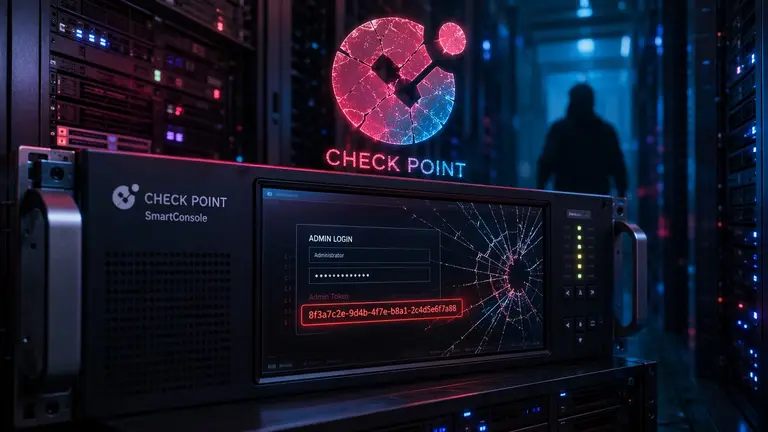
On July 22, 2026, Check Point issued a critical advisory for CVE-2026-16232, an authentication bypass vulnerability rated CVSS 9.3 that allows an unauthenticated remote attacker to obtain administrative login tokens on SmartConsole. CISA immediately added the flaw to its Known Exploited Vulnerabilities (KEV) catalog with a federal deadline of July 25 — three days to patch a system that, in certain operational configurations, exposes the management console directly to the internet.
The discovery came during a routine security review by Check Point's BLAST AI team, which detected in-the-wild exploitation against a limited number of customers. The necessary condition: a Management Server accessible from the internet without IP restrictions on Trusted Clients. A configuration that violates hardening principles but, according to the vendor, persists in real-world environments.
- CVE-2026-16232 allows an unauthenticated remote attacker to acquire administrative login tokens on SmartConsole and modify security policies.
- Check Point confirms active exploitation against "a handful of customers" with Management Servers exposed directly to the internet without IP restrictions.
- CISA added the vulnerability to the KEV catalog on July 22, 2026, with two operational dates: the notification date and a federal patch deadline of July 25, three days later.
- Affected versions include Quantum Security Management and Multi-Domain Security Management up to specific Jumbo Hotfix thresholds; the patch was released on July 22.
The Mechanism: From Auth Bypass to Full Perimeter Control
According to the official CVE record on NVD, the flaw resides in the SmartConsole login process. A remote attacker, without valid credentials and without user interaction, obtains an application authentication token that grants full administrative privileges. The attack vector is network-based (AV:N), complexity is low (AC:L), and no privileges or user interaction are required — a combination that defines maximum risk for an infrastructure management system.
From that token, the attacker gains the ability to modify security policies and configurations. The NVD record specifies impact on confidentiality and integrity (C:H, I:H) but not availability (A:N). This profile suggests an objective of persistence and control rather than immediate destruction: the attacker assumes the role of firewall administrator to alter traffic, exfiltrate data, or prepare lateral movement.
"This only affects a very specific configuration — when Management is exposed directly to the internet without IP restrictions. All affected customers have been notified. All Smart-1 Cloud customers are already protected." — Check Point, official advisory dated July 22, 2026
The Killer Configuration: Why Management Remains Exposed
Check Point has repeatedly emphasized that the flaw is configurational: it requires a Management Server accessible from the internet and an absence of restrictions on Trusted Client IPs. This combination, while contrary to hardening best practices, is not theoretical. In geographically distributed infrastructures, with remote security teams or in acquisition and consolidation scenarios, IP access constraints can be relaxed or forgotten during migrations.
The vendor advisory does not quantify the prevalence of this configuration, but its emphasis suggests the cases are not anecdotal. A comment from Lotem Finkelstein, Check Point's VP of Research, reported by The Hacker News, reinforces the point: "This only affects a very specific configuration." The repetition in official communications indicates an awareness that the problem is not only technical but operational: the attack surface exists because deployment practices have not kept pace with security policies.
The Response Chain: From BLAST AI to CISA's KEV
The vulnerability was identified during a security review of Check Point's BLAST AI system, which analyzes its own code for vulnerable patterns. The analysis revealed the flaw was already exploited in the wild: not a preventive discovery, but a detection during active offensive activity. This temporal element is critical: the July 22, 2026 patch day closed a zero-day already in use.
The institutional response was immediate. CISA added CVE-2026-16232 to the Known Exploited Vulnerabilities catalog with two key dates: added July 22, mandatory patch deadline for federal agencies July 25, 2026. This three-day window — formalized in Binding Operational Directive 26-04 — classifies the flaw at the highest urgency tier of the federal framework. The signal, even for non-government operators, is that the risk of mass exploitation exceeds standard patch management tolerance.
Concurrently, Check Point released updated Jumbo Hotfixes for supported branches: R82.10 with Take above 36, R82 with Take above 118, R81.20 with Take above 158. Earlier branches, from R81.10 through R77.30, are vulnerable with no fix indicated in the NVD record.
Immediate Actions
For organizations using Quantum Security Management or Multi-Domain Security Management, priority actions derive directly from the Check Point advisory and the CISA context:
- Immediately verify whether the Management Server interface is exposed to the internet and, if so, apply IP restrictions on Trusted Clients before patching, reducing the attack surface.
- Check SmartConsole logs for connections from the five published IoC IPs: 151.241.99.207, 151.241.99.233, 158.62.198.182, 192.142.10.99, 139.28.37.250, as reported by BleepingComputer.
- Apply the July 22, 2026 Jumbo Hotfix for the version branch in use, respecting the specific Take thresholds specified in the NVD record for each release.
- For Smart-1 Cloud customers: Check Point confirms protection is already active with no action required.
Two Unexploited Siblings: The Cumulative Patch Context
The July 22 release fixed three vulnerabilities, not one. CVE-2026-62144, with an identical CVSS 9.3 score, is also an authentication bypass with privilege escalation, but Check Point confirms it has not been exploited. CVE-2026-62145, rated CVSS 7.5, is a local privilege escalation. The concentration of critical flaws in the management plane — not the data plane or VPN gateway — suggests a structural focus area for Check Point security research and, potentially, for offensive actors targeting perimeter control through its administration.
Questions and Answers
Is my firewall vulnerable if I don't use SmartConsole remotely?
If the Management Server is not exposed to the internet and Trusted Clients have valid IP restrictions, the exploitation condition does not occur. The vulnerability is in the SmartConsole login process, not in the gateway or VPN.
Why did CISA impose only three days?
The KEV catalog with BOD 26-04 deadlines applies short windows when active exploitation is confirmed and the potential impact includes critical federal systems. The three days reflect the risk of complete administrative takeover, not the theoretical severity of the flaw.
What do we still not know?
The precise technical mechanism of the bypass is not public.
The lesson of CVE-2026-16232 is not only technical: it is operational. Perimeter management systems, when exposed beyond the boundaries of the trusted network, turn the control panel into a guaranteed high-value target. That the bypass was discovered by an automated review system like BLAST AI adds a methodological data point — the ability to detect zero-days in one's own code — but does not diminish the question of how many other Management servers, in other infrastructures, share that "very specific configuration" without their owners' awareness.
Information verified against cited sources and current as of publication.
Sources
- https://www.securityweek.com/new-check-point-zero-day-vulnerability-exploited-in-the-wild/
- https://thehackernews.com/2026/07/check-point-patches-exploited.html
- https://www.bleepingcomputer.com/news/security/check-point-patches-smartconsole-zero-day-exploited-in-attacks/
- https://nvd.nist.gov/vuln/detail/CVE-2026-16232
- https://blog.checkpoint.com/security/security-advisory-action-required-active-exploitation-of-check-point-smartconsole-authentication-bypass-cve-2026-16232
- https://www.rapid7.com/blog/post/etr-critical-check-point-vpn-zero-day-exploited-in-the-wild-cve-2026-50751/
- https://blog.checkpoint.com/security/check-point-releases-important-hotfix-for-vulnerabilities-in-deprecated-ikev1-vpn-protocol/
- https://www.infosecurity-magazine.com/news/check-point-critical-auth-bypass/
- https://nvd.nist.gov/vuln
- https://nvd.nist.gov/vuln/data-feeds
- https://nvd.nist.gov/vuln/vendor-comments
Get DeafLetter
A weekly selection of signals, vulnerabilities and guides. Critical alerts remain optional.
You can unsubscribe at any time. Privacy policy.