Get DeafLetter
A weekly selection of signals, vulnerabilities and guides. Critical alerts remain optional.
You can unsubscribe at any time. Privacy policy.
Editor's note: This article is based on a single editorial source (The Hacker News). The cited academic paper has not been independently verified and the researchers' website URL is not available.
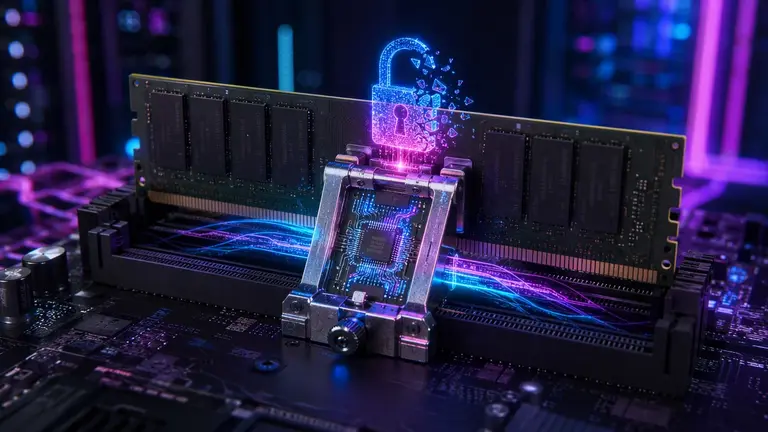
Researchers from KU Leuven and the University of Birmingham have demonstrated Battering RAM, a hardware attack requiring physical system access. Using a DDR4 interposer buildable for under $50, the attack bypasses Intel SGX and AMD SEV-SNP confidential computing protections. The research highlights a structural constraint: vendors have responded that physical attacks fall outside their threat models.
- A DDR4 bus interposer, buildable for under $50, behaves transparently during boot and is activated at runtime to redirect protected addresses.
- Battering RAM compromises Intel SGX and AMD SEV-SNP, enabling arbitrary read/write of encrypted memory and backdoor injection.
- Intel, AMD, and Arm have responded that physical attacks are out of scope for their threat models.
- Current designs omit cryptographic freshness checks in favor of larger protected memory sizes; defense would require a fundamental redesign of memory encryption.
- It is unclear whether the attack has been demonstrated on DDR5 systems.
Key Stat: under $50 — estimated cost to build the hardware interposer, per the researchers' statement as reported by the source.
How the Interposer Works
The attack inserts itself between the processor and memory. Per the researchers' direct quote as reported by the source: "We built a simple, $50 interposer that sits quietly in the memory path, behaving transparently during startup and passing all trust checks."
This initial invisibility defeats boot-time trust checks. The source reports that Battering RAM is "capable of introducing memory aliases dynamically at runtime. As a result, Battering RAM can circumvent Intel's and AMD's boot-time alias checks."
The quote continues: "Later, with just a flip of a switch, our interposer turns malicious and silently redirects protected addresses to attacker-controlled locations, allowing corruption or replay of encrypted memory." The source does not specify the technical mechanism of the "flip of a switch" beyond this description.
Impact on Intel and AMD
The source describes differentiated impacts by platform. On Intel systems, Battering RAM enables "arbitrary read access to the victim's plaintext or writing plaintext into SGX enclaves." On AMD systems, the attack allows "bypass of firmware mitigations against BadRAM (December 2024) and injection of arbitrary backdoors into the VM."
The source specifies the attack affects "all DDR4 systems, particularly confidential computing workloads in public clouds." It is unclear whether the attack has been demonstrated on DDR5 systems.
The Architectural Limit
Per the researchers' quote as reported by the source, "Battering RAM exposes the fundamental limits of the scalable memory encryption designs currently used by Intel and AMD, which omit cryptographic freshness checks in favor of larger protected memory sizes."
The source adds that "defending against Battering RAM would require a fundamental redesign of memory encryption itself." No partial software mitigations are documented.
Vendor Stance
The source reports that "Intel, AMD, and Arm have responded that physical attacks are currently considered out of scope of their product's threat model." This statement neither implies nor excludes contractual liability; the source does not mention contracts or service agreements.
On AMD systems, the source notes that Battering RAM "bypasses firmware mitigations against BadRAM, documented by the same group in December 2024." The source does not state that these mitigations "do not scale" nor does it offer judgment on the vendor response.
What Changes
For organizations using Intel SGX or AMD SEV-SNP, the source documents three relevant elements: the interposer costs under $50, vendors have classified physical attacks as out of scope, and the attack bypasses boot-time trust checks.
The source does not specify whether partial software mitigations exist. It is not documented whether the attack always requires physical hardware access, though the nature of the interposer implies it.
Frequently Asked Questions
Is Battering RAM a remote attack?
No. According to the source, the attack requires physical insertion of an interposer in the path between the processor and DDR4 memory.
Is there a patch?
According to the source, vendors have classified physical attacks as out of scope. No patch or immediate mitigation is documented.
Does the attack affect DDR5?
Unclear. The source explicitly mentions DDR4 systems; it does not specify whether the attack has been demonstrated on DDR5.
Is there a CVE for Battering RAM?
The source does not mention a CVE identifier.
Has the attack been exploited in the wild?
The source provides no information on in-the-wild exploitation. Battering RAM is presented as an academic demonstration.
Where to find the researchers' paper?
The source cites the researchers' "website" but does not provide the URL. The academic paper has not been independently verified for this article.
Sources
- The Hacker News, "Battering RAM Attack Breaks Intel SGX, AMD SEV-SNP with $50 Device", 2025 — https://thehackernews.com/2025/10/50-battering-ram-attack-breaks-intel.html
Note: This article is based on a single editorial source. Direct researcher quotes are reproduced as they appear in the source; the researchers' original website has not been independently verified.
Information is based on the cited source and current as of publication.
Fonti
- https://thehackernews.com/
- https://thehackernews.com/p/upcoming-hacker-news-webinars.html
- https://thehackernews.com/search/label/Threat%20Intelligence
- https://thehackernews.com/search/label/Vulnerability
- https://thehackernews.com/search/label/Cyber%20Attack
Get DeafLetter
A weekly selection of signals, vulnerabilities and guides. Critical alerts remain optional.
You can unsubscribe at any time. Privacy policy.