Get DeafLetter
A weekly selection of signals, vulnerabilities and guides. Critical alerts remain optional.
You can unsubscribe at any time. Privacy policy.
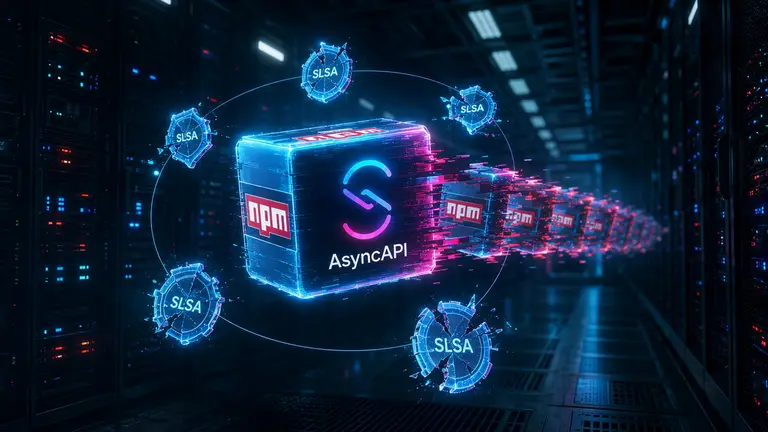
On July 14, 2026, between 07:10 and 11:18 UTC, five malicious versions of AsyncAPI npm packages remained available for download with perfectly valid SLSA provenance attestations. The attackers stole no npm tokens and breached no registry: they compromised two GitHub repositories by exploiting a misconfigured workflow, then used legitimate CI/CD pipelines with OIDC trusted publishing to cryptographically sign the malware. The result was a distribution that appeared technically flawless.
Execution occurs at module load (require()), not during npm install. This detail renders the standard --ignore-scripts mitigation useless and forces a rethink of JavaScript supply chain security assumptions.
- Five malicious versions published across four @asyncapi packages with over 2.25 million cumulative weekly downloads, according to BleepingComputer
- SLSA attestations on Sigstore/Fulcio were authentic: they certified that the authorized workflow produced the package, not that the triggering commit was legitimate
- Module-load execution bypasses --ignore-scripts; the malware activates when an application calls require(), not during installation
- The Miasma payload uses six independent C2 channels (HTTP, Nostr, IPFS, BitTorrent DHT, libp2p GossipSub, Ethereum smart contract) with cross-platform persistence
- The pull_request_target vulnerability was known since April 2026: a proof of concept had been submitted but the fix pull request remained open and unmerged
How the Repositories Were Compromised
The attack targeted two repositories: asyncapi/generator (next branch) and asyncapi/spec-json-schemas (master branch). The first malicious push, with commit SHA 3eab3ec9304aa26081358330491d3cfeb55cc245, landed on the next branch at 06:58:42 UTC, as documented by StepSecurity. Twelve seconds after the push, the GitHub Actions workflow executed the release.
The mechanism exploited no zero-day in GitHub Actions, but a known dangerous configuration. According to Wiz researchers Rami McCarthy and Merav Bar, the asyncapi/generator repository contained a workflow file that used pull_request_target to trigger on pull requests, but checked out the pull request's code instead of the base branch. This is critical because pull_request_target runs in the base repository's context with full access to secrets.
The git identity used for the commits was a placeholder: "Your Name" with email you@example.com and GitHub login "invalid-email-address".
The Provenance Paradox: When Cryptographic Signatures Mislead
The technical turning point of the attack is the production of valid SLSA attestations on malicious packages. StepSecurity analyzed the Sigstore Fulcio certificates: each package carried metadata recording repo:asyncapi/generator:ref:refs/heads/next, the exact workflow file, the commit SHA, and the run URL.
As StepSecurity researcher Rohan Prabhu observed: "Both attacks are CI/CD pipeline compromises, not stolen npm tokens or malicious maintainers". The distinction is substantial: the OIDC trusted publishing mechanism worked exactly as designed, conferring cryptographic authenticity on code injected from the outside. Provenance and code legitimacy have become disjoint categories.
"The resulting packages carry legitimate SLSA provenance attestations, proving only that the project's authorized workflow produced them, not that the triggering commits were legitimate. Provenance does not protect against a compromised push credential." — StepSecurity
require() Execution and the --ignore-scripts Bypass
Most npm supply chain defenses focus on lifecycle scripts (preinstall, postinstall). Experienced users run npm install --ignore-scripts to neutralize payloads that activate in that phase. This attack ignores that vector entirely.
The malicious code is an obfuscated JavaScript implant of approximately 7.7 KB injected into package files. When an application or CI/CD executes require() on the module, the dropper activates: it spawns a detached Node.js process that downloads a second stage. According to Microsoft: "Because the trigger is an import rather than an install script, the common npm install --ignore-scripts mitigation does not neutralize it". StepSecurity confirms: "This dropper fires when the poisoned module is require()d during normal use of the generator: the moment a build or CI job actually calls into the library, not at npm install time".
The second stage is an encrypted sync.js file of approximately 8.25 MB, downloaded from IPFS via two distinct CIDs for the two attacked repositories: QmQobZSp1wRPrpSEQ56qnyq7ecZh5Bg5k1fnjt4SUwwHb9 for generator and Qmet4fhsAaWMBUxNDfREHwgiyDeSWy4YSYs9wiKUW5jGyf for spec-json-schemas. Decryption uses HKDF-SHA256 and AES-256-GCM, producing a 3.09 MB Miasma payload.
Miasma: A Modular Framework with Six C2 Channels
The final payload is the Miasma framework, composed of 744 modules according to The Hacker News. Its C2 architecture is designed for resilience: six independent channels reduce reliance on a single point of control. Beyond classic HTTP, the framework uses Nostr relays, IPFS, BitTorrent DHT, libp2p GossipSub mesh P2P, and Ethereum smart contracts to receive commands and distribute updates.
Persistence mechanisms cover Linux (systemd, crontab), macOS (launchd), and Windows (Registry autostart). Anti-analysis includes sandbox and VM detection, Russian language verification, dead man's switch on stolen token, and evasion of eight security tools: CrowdStrike, SentinelOne, Microsoft Defender, CarbonBlack, Cylance, Osquery, Tanium, and Qualys.
Despite the Miasma branding, attribution remains uncertain. OX Security, via researcher Moshe Siman Tov Bustan, explicitly denies links to previous campaigns: "this malware isn't the same as [past Miasma/Shai-Hulud/TeamPCP campaigns], nor is it attributed to them". SafeDep suggests instead "either a private, parallel build by the same operators or a separate group that adopted the Miasma brand after the source was published". Aikido Security adds caution: "The Miasma branding may reflect code reuse, imitation, or deliberate mislabeling. No definitive attribution is made here".
Microsoft tracks the malware as MiasmStealer/Supychain.
What to Do Now
Priority actions for teams using AsyncAPI or managing similar pipelines:
- Audit pull_request_target workflows across all repositories: verify they check out the base branch, not the pull request code, and that they lack access to secrets unless strictly necessary
- Inspect build and CI/CD logs between 07:10 and 11:18 UTC on July 14, 2026 for require() calls to @asyncapi packages in compromised versions, not just install script executions
- Implement runtime network monitoring in CI/CD pipelines: StepSecurity confirmed C2 IP 85.137.53.71 via Harden-Runner telemetry that blocked connections to 85.137.53.71:8080, dht.transmissionbt.com, and router.bittorrent.com at 08:59:49-50 UTC
- Review SLSA attestation trust policy: the presence of a Sigstore attestation does not replace verification of the source code and workflow configuration that generated it
Why This Attack Changes Supply Chain Terms
The AsyncAPI incident is not a story of stolen tokens or a breached npm registry. It demonstrates that security infrastructure introduced to solve previous problems—provenance attestations, OIDC trusted publishing, SLSA—can become elements of the attack when the adversary moves the target upstream, to the pipeline itself. The cryptographic signature becomes a veil, not a shield.
Module-load execution demands a paradigm shift: defense can no longer stop at installation boundaries. And the proof of concept known since April 2026, with the fix unmerged at the time of the attack, raises a governance question: how many documented configuration vulnerabilities sit waiting in the pull request queues of critical open source projects?
Information verified against cited sources and current as of publication.
Sources
- https://thehackernews.com/2026/07/compromised-asyncapi-npm-packages.html
- https://thomasharris6.wordpress.com/2026/07/15/compromised-asyncapi-npm-packages-deliver-multi-stage-botnet-malware/
- https://www.bleepingcomputer.com/news/security/-asyncapi-npm-packages-infected-with-credential-stealing-malware/
- https://www.rescana.com/post/active-exploitation-alert-asyncapi-npm-supply-chain-attack-delivers-multi-stage-miasma-botnet-via-compromised-github-act
- https://www.stepsecurity.io/blog/compromised-next-branch-pushes-malicious-asyncapi-generator-generator-helpers-and-generator-components-to-npm
- http://www.stepsecurity.io/blog/compromised-next-branch-pushes-malicious-asyncapi-generator-generator-helpers-and-generator-components-to-npm
- https://docs.stepsecurity.io/github-actions/harden-runner#global-block-list
- https://app.stepsecurity.io/action-advisor
- https://app.stepsecurity.io/github/actions-security-demo/comp-packages/actions/runs/29320038189?tab=network-events
Get DeafLetter
A weekly selection of signals, vulnerabilities and guides. Critical alerts remain optional.
You can unsubscribe at any time. Privacy policy.