Get DeafLetter
A weekly selection of signals, vulnerabilities and guides. Critical alerts remain optional.
You can unsubscribe at any time. Privacy policy.
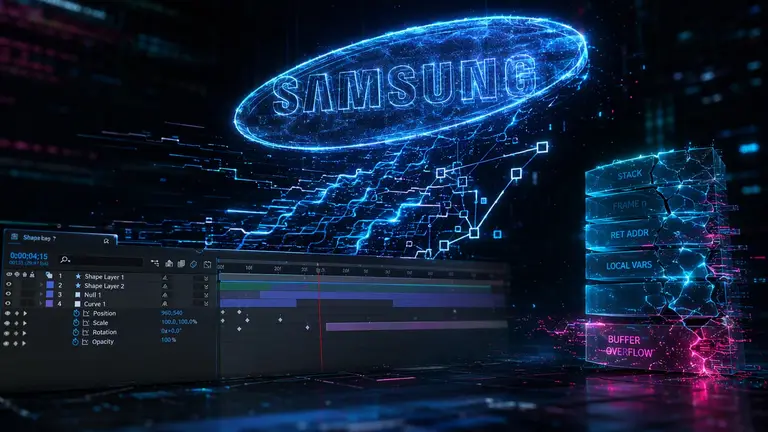
On September 17, 2026, the TrendAI Zero Day Initiative published advisory ZDI-26-714 detailing a stack-based buffer overflow in the Samsung rlottie library, tracked as CVE-2026-91826 with a CVSS score of 4.4 (MEDIUM). The flaw enables arbitrary remote code execution when a malicious vector animation is processed. The risk extends beyond Samsung's own products because rlottie is distributed as an open-source component integrated into third-party applications for rendering stickers and interactive content.
- CVE-2026-91826 is a stack-based buffer overflow in the Samsung rlottie library with RCE impact
- The CVSS score is 4.4 (MEDIUM) with vector AV:L/AC:L/PR:N/UI:R/S:U/C:N/I:L/A:L, per the official CVE record
- The affected commit is 480a2ad0c5d2e45458c545b8213279e9e8b71e39, as noted in the CVE record
- Coordinated disclosure occurred 23 days after vendor notification (August 25, 2026)
How the Flaw Works in Lottie Rendering
According to the ZDI advisory, the defect stems from "lack of validation of the length of user-supplied data prior to copying it to a stack-based buffer." The rlottie library, maintained by Samsung as an open-source project, processes vector animation files in the Lottie format (JSON derived from Adobe After Effects). During parsing, attacker-controlled data is copied into a stack-allocated buffer without size checks, allowing overwrite of the return address and subsequent code execution in the context of the current process.
Interaction with rlottie is a necessary condition for exploitation. As the source specifies, "attack vectors may vary depending on the implementation": a messaging app that renders incoming animated stickers, an email client displaying interactive previews, or a web platform processing user-generated content all represent potentially different attack surfaces.
Why the Risk Extends Beyond Samsung
The rlottie library is not a closed proprietary component. Samsung released it as an open-source project, and it has been adopted by independent developers and companies to integrate Lottie animations into mobile, desktop, and web applications. This reuse architecture amplifies the exposure surface: the flaw does not require the end user to own a Samsung device or use Samsung-branded software.
The Lottie format is widely used in UI design for its lightweight nature compared to video files. Animations travel as JSON and are rendered in real time. This bandwidth-efficient model assumes a robust parser—an assumption that CVE-2026-91826 invalidates for the indicated commit. The format's very nature—user-generated content, often without dedicated sandboxing—makes the attack vector realistic in social-engineering scenarios.
Severity Calibration: What the CVSS Says
The CVE-2026-91826 record assigns the vulnerability a score of 4.4, classified as MEDIUM. The vector string CVSS:3.1/AV:L/AC:L/PR:N/UI:R/S:U/C:N/I:L/A:L warrants close reading: the AV:L (Attack Vector: Local) parameter does not necessarily equate to physical machine access. In CVSS semantics, it can indicate that exploitation triggers via a local process action, such as opening a file or rendering content, rather than via a direct remote network connection. The UI:R (User Interaction: Required) parameter confirms that user interaction is necessary.
The Low integrity and availability scores with None for confidentiality reflect the impact profile: code execution in the current process context does not automatically expand privileges or exfiltrate data, but can still compromise application functionality and manipulate system behavior. The source does not clarify whether the exploit allows escalation beyond the initial security context.
"This vulnerability allows remote attackers to execute arbitrary code on affected installations of Samsung rlottie. Interaction with the rlottie library is required to exploit this vulnerability but attack vectors may vary depending on the implementation." — TrendAI Zero Day Initiative, advisory ZDI-26-714
Timeline and Disclosure Status
Vendor notification occurred on August 25, 2026; coordinated publication followed on September 17, 2026. This 23-day interval aligns with standard responsible disclosure, though the dossier does not specify whether a patch was developed or released in the interim. The researcher who identified the flaw chose to remain anonymous, collaborating through the TrendAI Zero Day Initiative program.
An element of incompleteness emerges from the source structure: the ZDI advisory does not report the CVE ID or CVSS score, while the CVE record does not detail the exploit mechanism. Only cross-referencing the two primary sources yields the complete picture. The CVE record identifies commit 480a2ad0c5d2e45458c545b8213279e9e8b71e39 as the affected version, providing a concrete reference point for developers maintaining forks or dependencies of the library.
Why It Matters
The dossier does not specify whether a patch is available at the time of publication, nor does it list applications or products confirmed vulnerable through rlottie integration. No in-the-wild exploitation has been documented. The significance of the AV:L parameter in the CVSS vector is not clarified in terms of attacker access requirements: the CVE record does not distinguish between local machine access and local process action.
The open-source nature of the library introduces a supply-chain dynamic that the brief does not fully quantify: rlottie can be embedded as a module, as a transitive dependency, or as a modified fork. The affected commit is indicated, but it is not specified whether later or earlier versions are affected. The source also does not detail which specific Lottie format construct triggers the vulnerable code path in the parser.
What Remains to Be Verified
For organizations using rlottie, the priority is determining whether commit 480a2ad0c5d2e45458c545b8213279e9e8b71e39 or its derivatives are present in their dependency chain. Verification requires auditing source code or binary libraries included in applications. The brief provides no automated tools for this identification nor documented vendor mitigation procedures.
The broader issue concerns the security model of user-content rendering libraries. Lottie, animated GIFs, animated SVG, WebGL—all these formats assume a parser as an implicit security boundary. The history of CVE-2026-91826 suggests that this boundary, at least for rlottie, has structural weaknesses in buffer handling. The burden of verification falls on integrators, absent specific advisories on downstream products.
Information verified against cited sources and current as of publication.
Sources
- http://www.zerodayinitiative.com/advisories/ZDI-26-714/
- https://www.cve.org/CVERecord?id=CVE-2026-91826
- https://www.trendmicro.com/
- https://www.trendmicro.com/en_us/business/products/one-platform.html
Get DeafLetter
A weekly selection of signals, vulnerabilities and guides. Critical alerts remain optional.
You can unsubscribe at any time. Privacy policy.