Get DeafLetter
A weekly selection of signals, vulnerabilities and guides. Critical alerts remain optional.
You can unsubscribe at any time. Privacy policy.
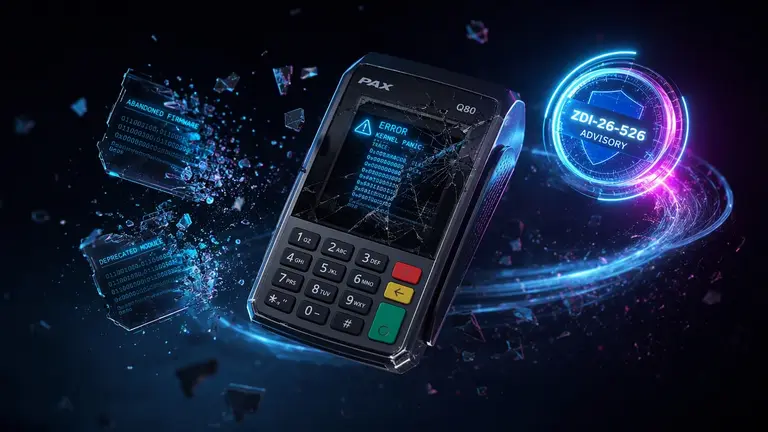
On August 5, 2026, Trend Micro's Zero Day Initiative published advisory ZDI-26-526, revealing a 0-day vulnerability in PAX Technology Q80 payment terminals. The flaw allows an attacker with local network access to execute arbitrary code as root, bypassing cryptographic application signature verification. The vendor confirmed the firmware as end-of-life on April 23, 2026, closing the door on any official patch.
The disclosure now forces retailers, banks, and financial service providers to manage a hardware risk they cannot eliminate with an update. ZDI's decision to force disclosure — after the vendor requested an extension until April 2027 — reignites the debate over the responsibility of manufacturers of embedded devices critical to the payment ecosystem.
- Vulnerability ZDI-26-526 carries a CVSS 7.5 score and enables unauthenticated RCE as root on PAX Q80, according to data published on the official ZDI list.
- The attack mechanism exploits a bypass of cryptographic signature verification in the application installer, allowing installation of malicious applications.
- PAX Technology declared the firmware end-of-life on April 23, 2026: no patches exist and none are planned.
- ZDI proceeded with 0-day publication on August 5, 2026, rejecting the vendor's request for an extension until April 2027.
The Mechanism: How the Signature Bypass Works
The flaw resides in the PAX Q80's application installer, the component that manages software installation on the terminal. The problem, explained in the ZDI advisory, stems from "improper verification of a cryptographic signature prior to installing an application." This gap allows a network-adjacent attacker to load and install a specially crafted application without the system validating its origin.
The advisory's technical statement is unequivocal: "This vulnerability allows network-adjacent attackers to execute arbitrary code on affected installations of PAX Technology Q80. Authentication is not required to exploit this vulnerability." The network-adjacent position — meaning access to the local network where the device is connected — reduces the attack surface compared to an internet-based exploit, but does not neutralize it in retail environments where the POS network often coexists with other infrastructure.
It is not yet direct RCE as root. The advisory specifies that the attacker must "leverage this vulnerability in conjunction with other vulnerabilities" to achieve root execution context. The dossier does not identify what these "other vulnerabilities" are, nor whether they are known or already published. This chaining introduces operational uncertainty: the complexity of the full exploit depends on the availability and accessibility of the complementary flaws.
The Timeline: Three Months of Stalemate and the End-of-Life Declaration
The ZDI-documented timeline shows a path marked by the vendor's refusal to maintain the firmware. The report was submitted on April 22, 2026. The following day, April 23, PAX Technology responded that the reported firmware was "end-of-life and no longer supported." The dossier does not show a distinction between specific firmware versions or Q80 sub-models: the declaration appears to refer to the firmware subject to the report, but the exact boundary of the vulnerable surface remains undefined.
The vendor subsequently requested a disclosure timeline extension until April 2027. ZDI rejected the extension and, on July 27, 2026, notified its intention to publish the advisory as a 0-day. The coordinated release occurred on August 5, 2026. The advisory does not report an assigned CVE, an absence that complicates formal tracking of the vulnerability in risk management systems and security databases.
The CVSS 7.5, derived from the published ZDI list and corroborated by the secondary reference source, classifies severity as "high." The lack of a complete CVSS vector in the advisory text prevents reconstruction of the exact metric combination, but the score places the flaw above the threshold that typically triggers rapid response protocols in financial organizations.
"An attacker can leverage this in conjunction with other vulnerabilities to execute code in the context of root." — ZDI Advisory ZDI-26-526
Immediate Mitigation Steps
The situation demands containment measures because the definitive mitigation — the patch — does not exist. The four priority actions derive directly from the threat structure and the advisory's documented characteristics.
POS Network Isolation. The attacker's network-adjacent requirement makes network segmentation the most effective barrier. Q80 terminals must reside in a dedicated VLAN, with no direct routing to general corporate networks or internet access. Every flow to the device must pass through strict interposition controls.
Traffic Monitoring to Terminals. The potential attack signature includes uploading unsigned applications to the Q80 installer. Network infrastructure serving the terminals must log and alert on anomalous connections, file transfers to installer ports, and repeated installation patterns.
Inventory and Identification of Exposed Devices. Organizations must verify the presence of PAX Q80 terminals in their installed base, map their network connectivity, and classify them as "priority replacement" in lifecycle planning. The dossier does not specify how many devices are active in production, but the Q80 model is known in retail and financial distribution.
Hardware Transition Plan Assessment. With the firmware declared end-of-life and no patch coming, definitive remediation requires physical replacement. Service contracts with terminal providers must be revised to exclude extended maintenance clauses on vendor-abandoned firmware, and to plan upgrades to models with active support lifecycles.
Why Vendor Responsibility Is the Policy Flashpoint
The ZDI-26-526 episode highlights a systemic tension: payment terminals remain in operational service for years, often beyond the formal end of firmware support. PAX Technology chose not to extend maintenance, but the market has yet to digest the transition. The result is a population of devices critical to financial data security, orphaned by a vendor that decided to close the cycle.
ZDI's decision to publish the 0-day, rejecting the requested extension, inserts a conflict of interest into the public debate. On one hand, forced disclosure exposes users who cannot protect themselves; on the other, indefinite secrecy benefits a vendor that has already declared product abandonment. ZDI's choice reflects a consolidated program position: without a prospect of a fix, information has more public value if made available for active mitigation.
The case has no exact precedent in the dossier, but falls into a growing category of events: connected embedded devices, declared obsolete by the manufacturer, that continue to process sensitive data. The difference here is the criticality of the domain — payments — where compromise of a terminal is not a malfunction but a potential violation of PCI-DSS and transaction data regulations.
Unanswered Questions in the Dossier
The advisory leaves open questions that affect risk management. It is not specified whether the end-of-life applies to all Q80 firmware or a particular version: organizations with updated terminals cannot automatically rule out the vulnerability. It is not documented whether in-the-wild exploits exist, nor whether PAX Technology has communicated directly with customers. The absence of a CVE complicates dialogue with managed service providers and vulnerability management platforms.
The nature of the "other vulnerabilities" required for root context is another concrete limitation. Without knowing them, it is impossible to estimate the complexity of the full exploit and, consequently, the likelihood of a successful attack. The certainty concerns only the first chain: the signature bypass allows installation of unauthorized code, and that alone is sufficient to classify the device as non-compliant in regulated environments.
The overall reading is of a hardware market that has not yet internalized support duration as a procurement parameter equivalent to functionality. The PAX Q80, now a 0-day with CVSS 7.5 and no way out, is a use case for contracts that mandate minimum patching obligations and replacement clauses in case of premature end-of-support.
Information has been verified against cited sources and updated at time of publication.
Sources
- http://www.zerodayinitiative.com/advisories/ZDI-26-526/
- https://www.zerodayinitiative.com/advisories/published/
Get DeafLetter
A weekly selection of signals, vulnerabilities and guides. Critical alerts remain optional.
You can unsubscribe at any time. Privacy policy.