Get DeafLetter
A weekly selection of signals, vulnerabilities and guides. Critical alerts remain optional.
You can unsubscribe at any time. Privacy policy.
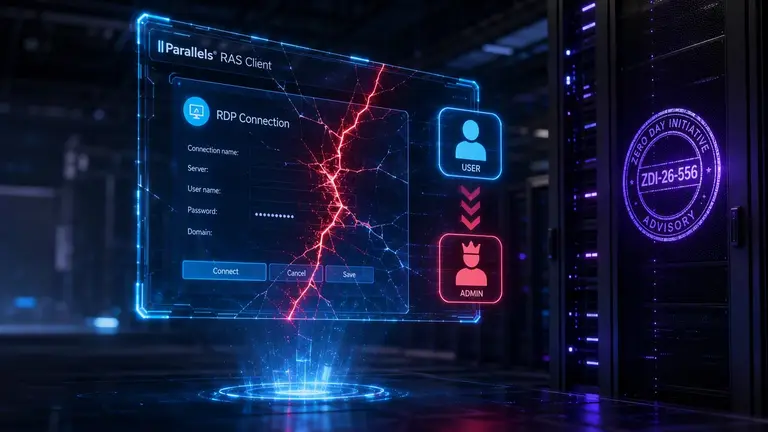
ZDI advisory ZDI-26-556, published August 11, 2026 by Trend Micro's Zero Day Initiative, documents a local privilege escalation vulnerability in the Parallels RAS Client RAS RDP Backend Service. The flaw, classified as an "exposed dangerous function," allows an attacker with low-privileged code execution to elevate rights to SYSTEM and achieve arbitrary code execution. The severity carries a CVSS score of 7.8, making the flaw significant for organizations running Parallels RAS in VDI and terminal server architectures.
The vendor notification dates to February 25, 2026: the roughly 168-day interval between report and coordinated disclosure falls within the standard responsible-disclosure window, but leaves installations exposed to a documented, measurable risk during the interim. The assigned CVE is CVE-2026-18263, whose record shows a "reserved" status on cve.org at time of publication.
- ZDI-26-556 was published August 11, 2026 with CVE-2026-18263 and CVSS 7.8.
- The flaw resides in the RAS RDP Backend Service and stems from an "exposed dangerous function."
- Impact is local privilege escalation to SYSTEM with arbitrary code execution.
- Attack prerequisite is the ability to execute low-privileged code on the target system.
How the Exposed Dangerous Function Works
The RAS RDP Backend Service, a critical component of the Parallels desktop virtualization infrastructure, exposes a function whose access is not adequately protected by the Windows authorization model. According to the ZDI advisory, "the specific flaw exists within the RAS RDP Backend Service. The issue results from an exposed dangerous function." The technical phrasing points to a service interface design error: a routine that should be invocable only by elevated processes is instead accessible from limited execution contexts.
The defect is architectural rather than implementation-level. It is not a buffer overflow or parsing error, but a violation of the least-privilege principle in the service boundary definition. An attacker who has already gained code execution on the system — via malware, compromised account, or insider — can call this function directly to modify their security context to SYSTEM, the highest level in the Windows protection model.
The mechanism is particularly insidious because it requires no memory exploits or sophisticated bypass techniques: the exposed API works as documented, but who may invoke it is defined incorrectly. This reduces attack complexity and increases exploitation reliability, traits typically associated with high operational severity.
"This vulnerability allows local attackers to escalate privileges on affected installations of Parallels RAS Client. An attacker must first obtain the ability to execute low-privileged code on the target system in order to exploit this vulnerability." — ZDI Advisory ZDI-26-556
Why VDI Architectures Are in the Crosshairs
Parallels RAS is a consolidated remote access and desktop virtualization platform in enterprise environments where many users share the same server infrastructure. In these architectures, the local attack surface is often underestimated: focus centers on remote vectors, while OS-level access control is assumed sufficient.
This vulnerability shatters that assumption. A single design error in a backend service turns limited user access — the kind routinely obtained by first-stage malware or a low-privileged insider — into total machine compromise. In a VDI environment, where multiple user sessions coexist on the same physical host, SYSTEM escalation from a single session can compromise the entire node and, potentially, connected sessions.
The brief does not specify whether Parallels had resolved the vulnerability at the time of ZDI publication, nor does it list affected or patched versions. This information gap matters for organizations that must determine their exposure without a vendor advisory containing patch-management guidance.
The Dossier's Unknowns
Several technical elements remain undocumented in the advisory. The specific name of the exposed function, its call parameters, and the exact mechanism of security-context escalation are not detailed. The identity of the researcher who discovered and reported the vulnerability is not mentioned. The full CVSS vector is not explicit: the 7.8 score appears in the ZDI published list, but the base-metric breakdown is unavailable.
Specific affected versions of Parallels RAS Client are not declared. The brief does not document specific vendor remediation measures, nor the nature of any data exposed beyond the privileged execution context. The presence of in-the-wild exploits is neither mentioned nor confirmed.
Why It Matters
The dossier does not specify corrective actions or operational mitigations from the source. The ZDI advisory lists no released patches, temporary workarounds, or recommended countermeasures. Organizations using Parallels RAS Client must independently verify the update status of their deployments and await any vendor communications.
The source does not clarify whether the vulnerability affects all product versions or only specific configurations. No infrastructure overlap emerges linking this advisory to known attack campaigns or specific threat actors at present.
The case study's value lies in illustrating a recurring vulnerability pattern in desktop virtualization software: the exposure of powerful primitives to unprivileged contexts. This defect class, documented here with metric precision, demands systematic review of service interfaces in analogous products.
Information is based on the cited source and current as of publication.
Sources
- http://www.zerodayinitiative.com/advisories/ZDI-26-556/
- http://www.zerodayinitiative.com/advisories/published/
- https://www.cve.org/CVERecord?id=CVE-2026-18263
- http://www.zerodayinitiative.com/advisories/upcoming/
- https://www.trendmicro.com/
- https://www.trendmicro.com/en_us/business/products/one-platform.html
Get DeafLetter
A weekly selection of signals, vulnerabilities and guides. Critical alerts remain optional.
You can unsubscribe at any time. Privacy policy.