Get DeafLetter
A weekly selection of signals, vulnerabilities and guides. Critical alerts remain optional.
You can unsubscribe at any time. Privacy policy.
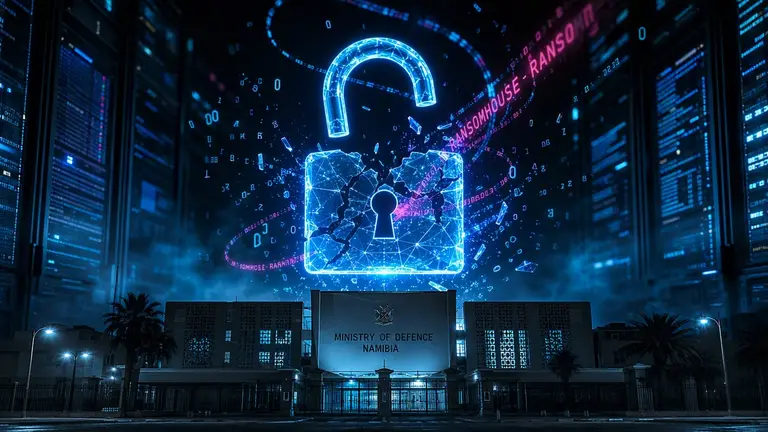
On September 19, 2026, the Communications Regulatory Authority of Namibia confirmed via Nam-CSIRT that the Ministry of Defence and Veterans Affairs was attacked by the RansomHouse ransomware group. The listing on the criminal leak site had appeared three days earlier, on September 16 at 15:32 UTC, showing the domain www.mod.gov.na and the label "Namibian Defence Force." The confirmation comes from a newly established institution — Nam-CSIRT launched on April 16, 2025 — now managing an unprecedented crisis for the country.
- On September 16, 2026, RansomHouse published a listing naming "Namibian Defence Force" with the domain www.mod.gov.na; Nam-CSIRT confirmed the substance of the attack on September 19.
- Nam-CSIRT attributed the incident to RansomHouse, describing the method as double extortion, combining encryption with the threat of publishing stolen data.
- A monitoring service estimates the intrusion date as September 12, 2026, four days before the listing.
- No verified figure on data volume, no file count, no confirmed initial access vector: the technical dossier remains incomplete.
The RansomHouse Method: From Affiliate Platform to Institutional Target
RansomHouse operates as a platform with core operators and affiliates who conduct intrusions independently. According to Halcyon, cited in the primary source, the group typically gains initial access by exploiting unpatched edge appliances: Citrix NetScaler, Palo Alto GlobalProtect, Check Point. This pattern — edge network as entry point, credential harvesting, lateral movement, massive exfiltration to cloud storage — is documented on other victims. Its specific application to the Namibian incident remains inferential, however: no source has verified which appliance, if present, was compromised at the Ministry of Defence.
The double-extortion model signals operational maturity. RansomHouse does not merely encrypt systems; it threatens publication of stolen data to pressure the victim. Notably, the group has a history of "theft-only" operations without encryption. The dossier does not specify whether the Namibian incident included an encryption phase or was limited to exfiltration.
The Leaked Folders: Sensitive Names, Unverified Content
The source reports that Xinhua, citing the Namibian Broadcasting Corporation, described files with folders named Commander, Defence, Military, Financials, and Personal. These names suggest a hierarchical organizational structure and potentially sensitive data. However, the original article explicitly warns that the folder names "describe the containers rather than the contents" and have not been independently verified. The dossier provides no information on the actual file contents, their security classification, or their operational use.
No investigative confirmation emerges on the line of inquiry pointing to a captain in Okahandja as the entry vector via a malicious link click. This lead remains unverified.
"Cybersecurity incidents of this nature serve as a reminder that no organisation, regardless of size or mandate, is immune to the evolving threat landscape." — Emilia Nghikembua, head of Nam-CSIRT and CEO of CRAN
The Institutional Context: Nam-CSIRT Newborn, No Cybercrime Law
Namibia has no specific cybercrime law at the time of the incident. Nam-CSIRT, hosted at the Communications Regulatory Authority of Namibia, has been operational for less than eighteen months. This configuration — a nascent CERT, absence of a legal framework, a defence ministry target — makes the incident a case study in the structural fragility of African response institutions facing mature threat groups.
The shift from commercial targets — in December 2024, Telecom Namibia suffered an attack with 626.3 gigabytes of data exfiltrated, according to the source — to national intelligence targets marks an escalation in continental cybercrime. As of September 2026, monitoring services listed 209 RansomHouse victims. The inclusion of a defence ministry in this list is anomalous for the region.
Why It Matters
The dossier does not specify remedial measures taken by the Ministry of Defence or technical containment interventions. The source does not document whether systems were isolated, whether forensic analysis of network logs is underway, or whether national or international judicial authorities were notified. No infrastructure overlaps emerge linking the operators of this specific attack to previous campaigns attributed to RansomHouse: attribution to the group is operational, not technical.
The brief lists no available patches, verified indicators of compromise, or vendor-specific recommendations for the incident. The absence of primary technical sources — CERT advisories, vendor reports, public forensic analysis — limits the dossier to journalistic reconstruction without an independent technical evidence map.
For African and public institutions, the case highlights the systemic vulnerability of unmaintained edge network infrastructure. For the cybersecurity sector, it marks an evolution from commercial data breach to an event with potential counterintelligence implications. For Namibian policymakers, it makes visible the interdependence between the absence of a cybercrime law and effective response capability.
Analysis: The Qualitative Leap of African Ransomware
The attack on the Namibian Defence Ministry is not an isolated incident but a signal of saturation. Ransomware groups have exhausted easy commercial targets in mature markets and are shifting aim toward public institutions in regions with weak technological governance. Namibia offers optimal conditions: a recent CERT, no cybercrime law, presumably unpatched edge networks. RansomHouse calculated the risk-reward and bet on Vote 8 — the ministry's budget designation — as a target of strategic value.
The Mt Kenya Times editorial captures the distinction: "A breach at a telecommunications operator is a data protection failure. A breach at a defence ministry is a counterintelligence event." This distinction is not rhetoric. Data exfiltrated from a defence ministry has a different value than that of a commercial operator: it can feed state intelligence, influence regional balances, compromise military partnerships. The final destination of the data — black market, national intelligence, both — is not documented in the brief.
The immediate danger is not technical but systemic. If Nam-CSIRT fails to manage this incident, the signal to other ransomware groups is clear: African defence ministries are open targets, with slow response and no foreseeable legal consequence. Competition among affiliates for initial intrusions in this segment could intensify in the coming months.
Frequently Asked Questions
- Have Namibian military data been compromised?
- The dossier does not verify the content of the files. The leaked folder names (Commander, Defence, Military, Financials, Personal) do not prove the nature of the documents contained.
- Who confirmed the attack?
- Nam-CSIRT, Namibia's Computer Security Incident Response Team hosted at the Communications Regulatory Authority of Namibia, in a statement by Emilia Nghikembua in her capacity as head of the team and CEO of CRAN.
- Is the access vector known?
- No. The source reports an unconfirmed hypothesis (captain in Okahandja, malicious link) and a general RansomHouse pattern targeting unpatched edge appliances, without a verified link to this incident.
Sources
- https://mountkenyatimes.co.ke/breach-at-vote-8-what-the-attack-on-the-namibian-defence-establishment-means-for-national-security/
- https://nvd.nist.gov/vuln
- https://nvd.nist.gov/vuln/vulnerability-detail-pages
- https://nvd.nist.gov/developers/vulnerabilities
- https://nvd.nist.gov/vuln/search
- https://nvd.nist.gov/vuln/weaknesses
- https://nvd.nist.gov/vuln/data-feeds
- https://nvd.nist.gov/vuln/vendor-comments
- https://nvd.nist.gov/vuln/cvmap
Information verified against cited sources and current as of publication.
Sources
Get DeafLetter
A weekly selection of signals, vulnerabilities and guides. Critical alerts remain optional.
You can unsubscribe at any time. Privacy policy.