Get DeafLetter
A weekly selection of signals, vulnerabilities and guides. Critical alerts remain optional.
You can unsubscribe at any time. Privacy policy.
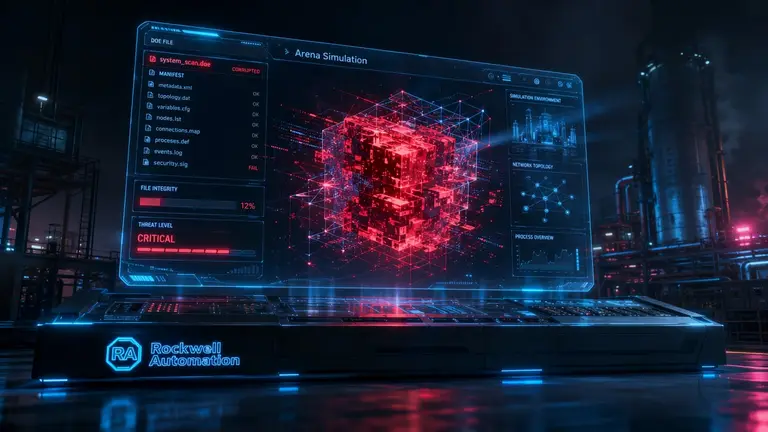
On July 15, 2026, the Zero Day Initiative published advisory ZDI-26-438, a vulnerability in Rockwell Automation Arena Simulation that allows remote arbitrary code execution through the parsing of crafted DOE files. The flaw, reported to the vendor on May 2, 2025, requires user interaction but carries critical impact in the industrial simulation context, where model sharing among engineers and operators is daily practice. Rockwell Automation has already released a corrective update, making immediate and measurable patching action possible.
- ZDI-26-438 enables RCE on Rockwell Automation Arena Simulation installations via malformed parsing of DOE files
- The mechanism is an out-of-bounds write caused by missing validation of attacker-controlled data during parsing
- Exploitation requires explicit user interaction: opening a malicious file or visiting a compromised page
- Rockwell Automation published a corrective update on July 15, 2026, closing a coordinated disclosure window of approximately 14 months
The Mechanism: Out-of-Bounds Write in the DOE Parser
The flaw resides specifically in the parser for DOE (Design of Experiments) files, the format Arena Simulation uses to import experimental configurations and simulation parameters. According to the ZDI advisory, "the specific flaw exists within the parsing of DOE files" and stems from "the lack of proper validation of user-supplied data, which can result in a write past the end of an allocated object."
This technical description identifies a classic out-of-bounds write: the parser allocates a buffer to hold DOE file data, then writes beyond the boundary of that memory region. In native parsing contexts, this pattern is typically exploitable to overwrite heap metadata, function pointers, or vtables, resulting in execution flow control within the Arena process context.
The absence of details on the exact offset or corrupted DOE structure does not weaken the assessment: ZDI classifies the vulnerability as RCE, and its coordinated disclosure structure implies verified reproducibility by both the researcher and the vendor.
The Vector: Social Engineering and Model Sharing
"This vulnerability allows remote attackers to execute arbitrary code on affected installations of Rockwell Automation Arena Simulation. User interaction is required to exploit this vulnerability in that the target must visit a malicious page or open a malicious file."
The quote from advisory ZDI-26-438 precisely defines the attack perimeter. This is not a zero-click vulnerability: the attacker must induce the user to take explicit action. The file vector is particularly relevant for Arena Simulation because the software is a shared work tool: models, scenarios, and DOE configurations circulate via email, cloud storage, and project repositories among process engineers, consultants, and plant operators.
The attack surface extends beyond the single workstation. In typical OT/ICS architectures, the simulation PC may have connectivity to the factory network, MES systems, or historical databases. A compromise in the context of the Arena process — typically with engineer-level user privileges — offers pivoting toward industrial segments that the simulation itself models and represents.
Timeline and Disclosure: 14 Months of Vendor-Researcher Coordination
The disclosure of ZDI-26-438 follows the classic Zero Day Initiative program timeline. The initial report is dated May 2, 2025; coordinated public release occurred on July 15, 2026. This interval of approximately 14 months reflects the time for Rockwell Automation to develop and test the update, subsequently verified by the original researcher.
The advisory states verbatim: "Rockwell Automation has issued an update to correct this vulnerability." The patch URL is not specified in the advisory detail but points to the Rockwell support portal, consistent with ZDI practice of not publishing direct vendor links unless verified.
No infrastructure overlaps or indicators of compromise emerge linking ZDI-26-438 to known active campaigns at this time. ZDI does not declare in-the-wild exploitation, and the nature of the vector — user interaction on specialized software — makes massive, indiscriminate deployment unlikely.
What to Do Now
- Apply the corrective update released by Rockwell Automation for Arena Simulation, verifying availability on the vendor's official support portal
- Review DOE file sharing policies: restrict automatic execution of attachments from external emails and implement antimalware scanning on shared model repositories
- Isolate Arena Simulation workstations from industrial network segments not strictly necessary, containing the blast radius of a potential compromise
- Document all Arena Simulation installations in the OT inventory, with version tracking to verify patch coverage
The brief does not specify additional corrective measures beyond the vendor update. The nature of data exposed in case of exploit — simulation projects, process parameters, or credentials for access to other systems — is not detailed in the advisory.
Why Industrial Simulation Is a New Frontier
Arena Simulation is not a PLC or an HMI: it is software that runs on Windows, used to design and optimize processes before their physical deployment. This apparent distance from the real production line is illusory. Simulation models contain cycle parameters, control logic, and sometimes interfaces to execution systems. Compromising the simulation PC means compromising trust in the project that will then guide the plant.
The DOE format, in particular, is a structured data vehicle that engineers exchange as a work document. Its perceived harmlessness — "it's just a configuration file" — makes it an ideal vector for targeted attacks. The lesson of ZDI-26-438 is that parsing of specialized formats, even far from traditional ICS protocols, deserves the same security attention reserved for control systems.
The ZDI program published this advisory after more than a year of coordination. The delay between report and disclosure is not anomalous for industrial software, where test cycles are extended. The side effect, however, is a potentially long exposure window for those who do not promptly apply patches at the moment of coordinated release.
Frequently Asked Questions
Is there a CVE identifier for this vulnerability?
No. Advisory ZDI-26-438 does not report an assigned CVE-ID, nor a CVSS score. The ZDI identifier structure is authoritative but not mapped on CVE.org at this time.
Which versions of Arena Simulation are affected?
The advisory does not list specific affected versions. The brief does not provide this detail, which remains to be verified through the Rockwell Automation support portal.
Is a public exploit necessary to be at risk?
No. The vulnerability is RCE with a crafted DOE file vector: the technical barrier to build the payload is relatively low for an attacker with knowledge of the format. The primary protection remains the corrective update.
Sources
- http://www.zerodayinitiative.com/advisories/ZDI-26-438/
- https://www.zerodayinitiative.com/advisories/published/
Information has been verified against cited sources and updated at time of publication.
Sources
Get DeafLetter
A weekly selection of signals, vulnerabilities and guides. Critical alerts remain optional.
You can unsubscribe at any time. Privacy policy.