Get DeafLetter
A weekly selection of signals, vulnerabilities and guides. Critical alerts remain optional.
You can unsubscribe at any time. Privacy policy.
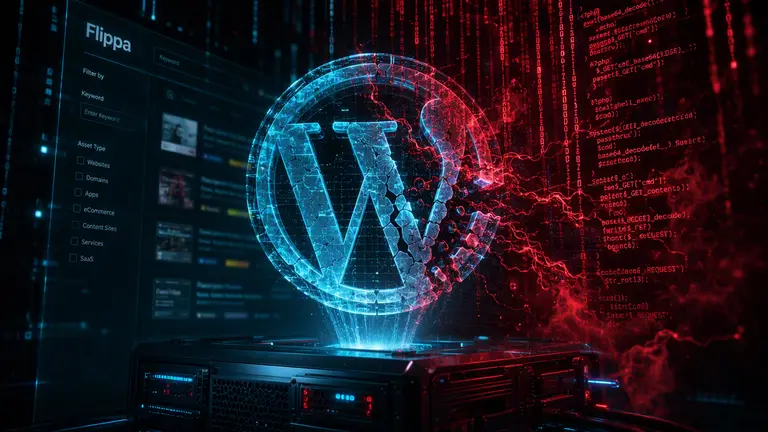
On April 7, 2026, WordPress.org permanently shut down 31 plugins from the Essential Plugin portfolio after a buyer acquired them on Flippa for a six-figure sum, injected PHP backdoors in the August 8, 2025 version 2.6.7 release, and triggered the payload two days prior to serve invisible SEO spam to site owners. The attack exploited no technical zero-day vulnerability but a governance void: the complete absence of any notification or review for ownership transfers in the official plugin repository.
- The buyer, identified only by the alias "Kris" with a background in SEO, cryptocurrency, and online gambling, purchased the Essential Plugin portfolio on Flippa for a six-figure sum
- The backdoor, hidden in 191 lines of PHP added to version 2.6.7, lay dormant for eight months before activating on April 5-6, 2026
- Command and control resolved via an Ethereum smart contract, rendering traditional domain seizure ineffective
- WordPress.org closed all 31 plugins on April 7, 2026; the 2.6.9.1 update only neutralized the phone-home mechanism without removing code injected into wp-config.php
How the Attack Mechanism Worked
The compromise followed a precise sequence. In July 2025, Flippa published a case study of the sale. On August 8, 2025, version 2.6.7 was released with a changelog reading "Check compatibility with WordPress version 6.8.2" — a note that concealed 191 additional lines of PHP, including a deserialization-based backdoor for remote code execution. Eight months of dormancy allowed the new version to propagate through WordPress's automatic update mechanism, normally protective but in this case converted into a distribution vector.
On April 5-6, 2026, the payload activated. According to forensic reconstruction, the concrete injection window lasted 6 hours and 44 minutes: from 04:22 to 11:06 UTC on April 6. The malicious wpos-analytics module downloaded the wp-comments-posts.php file and injected code into wp-config.php, ensuring persistence even beyond the plugin update itself. The payload served spam links, redirects, and fake pages exclusively to Googlebot, using a cloaking technique that rendered the anomaly invisible to site administrators.
The Blockchain C2 Infrastructure
Command and control bypassed traditional takedown countermeasures. Instead of a conventional domain, vulnerable to seizure or blacklisting, the payload resolved the command server via an Ethereum smart contract, querying public blockchain RPC endpoints. This architecture makes domain seizure ineffective: there is no registrar to contact or DNS record to block, only a smart contract address distributed on an immutable ledger.
The technical choice reveals familiarity with the cryptocurrency ecosystem consistent with the buyer's profile, documented by sources as active in SEO, cryptocurrency, and online gambling marketing. The real name of "Kris" has not emerged; it remains unknown whether they acted on their own behalf or for third parties.
Discovery and WordPress.org Response
The attack was discovered by Austin Ginder of Anchor Hosting starting from an alert by a digital marketing agency, as reported by TechRepublic citing the researcher directly. Ginder conducted the security audit, published the list of 31 affected plugins, and released patching guides. TechRepublic reports that Countdown Timer Ultimate, one of the portfolio plugins, had over 20,000 active installations at the time of discovery.
WordPress.org reacted on April 7, 2026 by permanently closing all plugins in the Essential Plugin portfolio. However, the emergency update to version 2.6.9.1 merely neutralized the phone-home mechanism: the code previously injected into wp-config.php remained intact on compromised servers, leaving the need for manual cleanup.
The Regulatory Gap: Commercial Trust Without Verification
The case exposes a structural flaw in the WordPress ecosystem. The legal buyer inherits commit access, the plugin's historical reputation, and the automatic update channel without any code review or user notification. WordPress.org lacks a registry of control changes: a gap that, as TechRepublic notes citing Ginder, "makes it easier for any attacker to silently take control of plugins and push malware without users knowing."
The contrast with other ecosystems is stark. npm and PyPI have introduced supply chain controls that the WordPress repository, despite powering roughly 43% of the web, has not adopted. Trust has become a tradable commodity transferable on legitimate marketplaces: Flippa handled the transaction under its own rules, without any due diligence mechanism on the security of the code the buyer would then distribute to millions of sites.
"Someone bought more than 30 WordPress plugins on the open market, quietly injected backdoors into all of them, waited eight months, and then activated a payload that served hidden SEO spam to Google while the websites' owners saw nothing wrong."
What to Do Now
- Check for suspicious code in wp-config.php on sites that used plugins from the Essential Plugin portfolio, even after updating to version 2.6.9.1
- Consult the patching guides published by Austin Ginder for manual removal of injected code
- Review the provenance and ownership change history of installed third-party plugins, verifying any recent developer transitions
- Monitor access logs to identify suspicious requests to analytics.essentialplugin.com or patterns of queries to Ethereum RPC endpoints from site servers
Why the Ecosystem Remains Exposed
The Essential Plugin case is not a technical compromise in the strict sense: it is a compromise of commercial governance. The backdoor worked because WordPress.org's trust architecture assumes a plugin maintainer remains identical over time, without anticipating that identity could be purchased. The result is that a legitimate marketplace, Flippa, became the preferential entry point for a supply chain attack.
Sources do not indicate whether WordPress.org is developing notification mechanisms for ownership transfers. The precise total number of compromised sites remains unknown: sources speak of "thousands" without a definitive figure. No CVE has been assigned for this vulnerability, nor is a CVSS score available.
For enterprises that depend on WordPress, the message is that plugin due diligence can no longer be limited to code: it must extend to ownership structure, maintainer stability, and traceability of the commercial transactions that determine control. The automatic update mechanism, designed to protect, now requires a verification context that the ecosystem still does not provide.
Sources
- https://thenextweb.com/news/wordpress-plugins-backdoor-supply-chain-essential-plugin-flippa-2
- https://www.techrepublic.com/article/news-malicious-wordpress-plugins-backdoor-april-2026/
- https://support.techrepublic.com/
- https://thenextweb.com/news/why-2026-will-be-the-year-of-governed-cybersecurity-ai
- https://thenextweb.com/news/every-saas-company-is-building-ai-features-right-now
- https://thenextweb.com/news/ai-analytics-agents-need-guardrails-not-more-model-size
Information has been verified against cited sources and updated at time of publication.
Sources
Get DeafLetter
A weekly selection of signals, vulnerabilities and guides. Critical alerts remain optional.
You can unsubscribe at any time. Privacy policy.