Get DeafLetter
A weekly selection of signals, vulnerabilities and guides. Critical alerts remain optional.
You can unsubscribe at any time. Privacy policy.
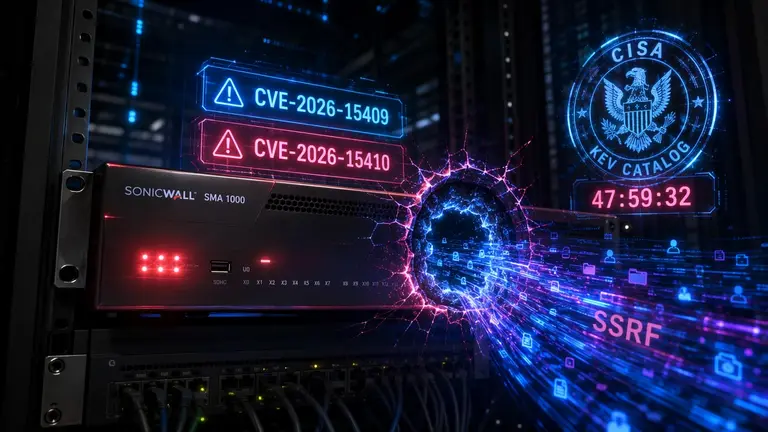
SonicWall disclosed two critical zero-days for the SMA 1000 series on July 14, 2026. CVE-2026-15409, rated CVSS 10.0, is a pre-authentication SSRF; CVE-2026-15410, rated CVSS 7.2, enables post-authentication code injection. CISA added both to the Known Exploited Vulnerabilities catalog with a patch deadline of July 17 for federal agencies. Active exploitation is documented from June 22, 2026, per Volexity, with a proof-of-concept published by Rapid7 the day after disclosure.
- CVE-2026-15409 (CVSS 10.0): Pre-authentication SSRF in the SMA 1000 Appliance Work Place interface, remotely exploitable without credentials.
- CVE-2026-15410 (CVSS 7.2): Post-authentication code injection in the AMC (Appliance Management Console), enabling arbitrary OS command execution with root privileges.
- Volexity attributes pre-disclosure exploitation to threat actor UTA0533 from June 22, 2026, using custom malware KNUCKLEBALL and ORANGETAIL.
- Rapid7 documented lateral movement via anomalous Active Directory authentications, with no active VPN tunnel, confirming full appliance compromise.
The Exploit Chain: From SSRF to WebSocket Tunnel to Root
CVE-2026-15409 resides in the SMA 1000 Appliance Work Place interface. An unauthenticated remote attacker can force the server to send HTTP requests to internal endpoints, bypassing input validation checks. According to eSentire's technical analysis, this SSRF is chained with the creation of a WebSocket tunnel to services listening on localhost, notably CouchDB.
From that foothold, an authenticated attacker exploits CVE-2026-15410: a code injection in the AMC module that allows arbitrary OS command execution with root privileges. The full chain transforms the perimeter device — designed to secure remote access — into a backdoor with total control over the underlying infrastructure.
The custom malware identified by Volexity includes the ELF binary /usr/bin/xzfind, timestamped June 22, 2026, confirming pre-disclosure zero-day exploitation. UTA0533 established persistence through NGINX Unit configuration modifications and deployed proxying tools and a web shell: Suo5 proxy and a behavioral variant of Behinder.
Lateral Movement That Evades VPN Monitoring
The most insidious element of the incident documented by Rapid7 is not the initial compromise, but the subsequent lateral movement. The compromised appliance was used for direct Active Directory authentications, without corresponding VPN tunnel creation. Anomalous authentications originated from the appliance's internal IP address with non-corporate workstation names, including instances labeled kali, executed under LDAP service accounts.
"This unique behavior of direct, machine-level lateral movement with no corresponding active VPN tunnel confirmed that the appliance itself had been fully compromised and was acting as an unmonitored backdoor into the corporate directory infrastructure" — Rapid7
This pattern breaks the fundamental assumption of perimeter monitoring: that legitimate traffic traverses controllable, logged channels. The compromised appliance operates as a trusted entity inside the network, with authentication capabilities that do not trigger alerts in traditional detection systems.
A Timeline That Compresses the Response Window
The incident chronology highlights extreme compression of response time. UTA0533 operated for roughly three weeks under zero-day conditions, from June 22 to July 14. SonicWall's public disclosure occurred July 14. Rapid7 published the proof-of-concept on July 15. eSentire observed in-the-wild exploitation from July 16. CISA mandated federal agency patching by July 17 via Binding Operational Directive 26-04.
Per the official NVD record, CVE-2026-15409 has a network attack vector, low complexity, no privileges required, no user interaction, and changed scope: the ideal configuration for mass, automated exploitation. The CVSS 10.0 score is the maximum assignable.
Why It Matters
The source does not clarify whether NGINX Unit modifications can be detected via standard configuration file integrity verification, or whether they require specific tools.
The source does not specify the nature of data exposed in compromised organizations. No infrastructure overlaps link UTA0533 to known threat actors at this time.
The absence of detailed operational recommendations in the primary source leaves a gap on reimaging procedures, LDAP service credential rotation, or verification of authentication directory integrity in environments potentially compromised since June 22.
The Lesson of the Inverted Perimeter
The SonicWall SMA 1000 case inverts traditional network security logic. The device meant to filter and control remote access becomes, once compromised, the privileged access vehicle that evades the very filtering it provides. The capacity for machine-to-machine authentication to Active Directory — a legitimate appliance function — is repurposed as an invisible lateral movement channel to VPN monitors.
This dynamic raises an architectural question: the implicit trust granted to perimeter security devices requires runtime integrity controls that go beyond periodic firmware verification. The absence of active VPN tunnels as a correlate of legitimate authentications is no longer a safe assumption when the appliance itself is the attacker.
Sources
- https://www.esentire.com/security-advisories/sonicwall-discloses-two-zero-day-vulnerabilities-cve-2026-15409-cve-2026-15410
- https://thehackernews.com/2026/07/two-sonicwall-sma-1000-zero-days.html
- https://thehackernews.com/2026/07/sonicwall-sma-zero-days-exploited.html
- https://www.helpnetsecurity.com/2026/07/14/sonicwall-sma-attacks-via-cve-2026-15409-cve-2026-15410/
- https://nvd.nist.gov/vuln/detail/CVE-2026-15409
- https://nvd.nist.gov/vuln/detail/CVE-2026-15410
- https://www.cisa.gov/news-events/alerts/2026/07/14/cisa-adds-four-known-exploited-vulnerabilities-catalog
- https://www.cisa.gov/known-exploited-vulnerabilities-catalog
Get DeafLetter
A weekly selection of signals, vulnerabilities and guides. Critical alerts remain optional.
You can unsubscribe at any time. Privacy policy.