Get DeafLetter
A weekly selection of signals, vulnerabilities and guides. Critical alerts remain optional.
You can unsubscribe at any time. Privacy policy.
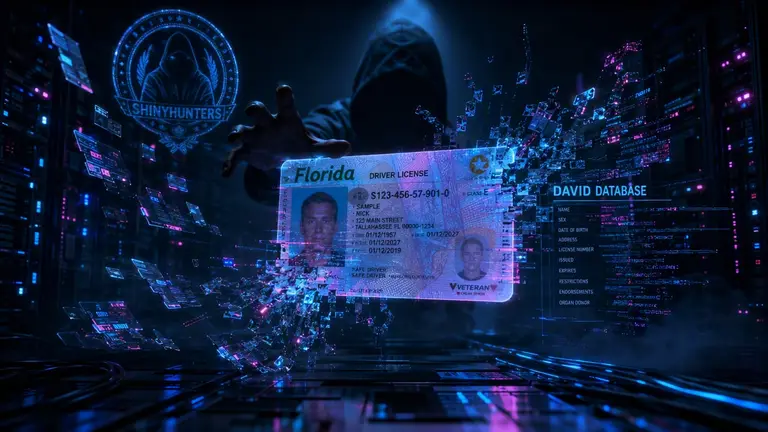
On the night of September 7, 2026, ShinyHunters added the Florida Department of Highway Safety and Motor Vehicles to its data leak site, claiming access to over 200,000 driver records from the DAVID platform. According to the group's statement, the operation began on September 3 via a password reset vulnerability. No government agency had confirmed the breach at the time of publication, and the only "proof" distributed is a screenshot of the DMV record of Jeffrey Epstein, who died in 2019.
- ShinyHunters claims to have breached DAVID, Florida's driver and vehicle data management platform, exfiltrating over 200,000 records starting September 3, 2026.
- The declared intrusion method is a logical vulnerability in the password reset mechanism, with escalation to multiple accounts including that of an alleged FBI agent.
- The published proof-of-breach is a screenshot of Jeffrey Epstein's DMV record, containing address, SSN, date of birth, license ID, and registered vehicles; its authenticity is not verifiable.
- The extortion deadline is set for September 11, 2026; the group claims to have lost access and that the vulnerability is being patched.
The Epstein "Proof" Paradox: A Dead Man as Credibility Guarantor
ShinyHunters published a screenshot showing Jeffrey Epstein's DMV record, with detailed information: address, Social Security number, date of birth, license identifier, issue and expiration dates, and registered vehicles. The choice of a high-profile public figure who died in 2019 as a "proof-of-breach" introduces a logical anomaly: a historical record of this type could have been obtained from prior breaches, reconstructed from already-exposed data, or genuinely extracted from a fresh intrusion. CyberInsider explicitly stated it could not independently verify the claims, the authenticity of the displayed record, or its direct origin from the FLHSMV platform.
The group's communication strategy is readable: a high-profile media target guarantees visibility for the claim and amplifies psychological pressure on institutional counterparts. But epistemologically, the proof is circular. If the record is authentic and sourced from DAVID, it confirms access but not the declared volume of 200,000 records. If it is inauthentic or pre-existing, it invalidates the entire credibility chain. The uncertainty interval is total, and sources provide no elements to resolve it.
The Declared Method: Password Reset and Privileged Accounts
According to ShinyHunters' statement to BleepingComputer, the entry point was a "password-reset flaw" that allowed compromise of multiple accounts within DAVID. The group asserts that among the accounts were those of DMV employees and an FBI agent. From this foothold, the operation allegedly proceeded with iterative enumeration of records by ID, downloading associated HTML and images.
The DAVID platform — short for Driver and Vehicle Information Database — is an operational system of the Florida Department of Highway Safety and Motor Vehicles, accessible via web to law enforcement and authorized officials. Its criticality is twofold: it holds sensitive personally identifiable information (PII) of millions of residents, and serves as interconnected infrastructure between state and federal agencies. A vulnerability in the password recovery mechanism, if confirmed, indicates a failure of basic security hygiene in a system managing privileged access to government data.
The group claims to have lost access to the platform and that the vulnerability is being patched. If true, this suggests defenders detected the anomalous activity and initiated containment, but it does not clarify whether the investigation has mapped the full extent of exfiltration or identified compromised accounts with forensic precision.
Timeline and Extortion Mechanism
The leak site listing appeared on September 7, 2026, with a "final warning" and a contact deadline set for September 11, 2026. The declared breach start date — September 3, 2026 — leaves a four-day window between compromise and publication, consistent with a reconnaissance and threat-packaging phase. ShinyHunters stated it is not negotiating with the victim.
The operational model is data leak extortion without encryption: no ransomware deployed, only the threat of public data release. This mode, now dominant in the 2024-2026 threat landscape, reduces forensic visibility compared to classic ransomware and complicates damage quantification. The September 11 deadline acts as a temporal lever, but the lack of official confirmation from FLHSMV or the FBI leaves open the possibility that the victim is evaluating a legal response rather than a technical one.
Systemic Pattern: Targeting DMV Platforms
BleepingComputer reports that a source indicates ShinyHunters is actively targeting other states' DMV platforms using social engineering techniques. The group declared it expects to announce further DMV breaches in the coming weeks. If materialized, this sequence would outline a structured campaign against a specific government vertical: driver and vehicle management databases, which concentrate verified identity data and are often accessible through web interfaces with legacy authentication.
The DMV platform is a high-value target for identity theft: SSNs, addresses, license photos, vehicle histories are all verified inputs for financial fraud, synthetic identities, and fraudulent service access. The criticality lies not in the single record, but in the scalability of access and the verifiability of the data: a driver's license is a trust document that traverses many authentication systems.
"CyberInsider could not independently verify ShinyHunters' claims, the authenticity of the displayed record, or whether the data came from a direct compromise of the Florida Department of Highway Safety and Motor Vehicles (FLHSMV)." — CyberInsider
Why It Matters
The source does not specify whether the DAVID platform implemented multi-factor authentication, rate limiting on password reset, or access logging sufficient to detect iterative enumeration.
The case exemplifies a structural limit of threat intelligence: extortion groups' claims become news before any independent verification is possible, and the "proofs" distributed are designed to be media-effective but technically unverifiable. The choice of the Epstein record is symptomatic: a sensationalistic datum that obscures the lack of a public audit trail. Until official confirmation or independent forensic analysis, the incident status remains claim-based, not evidence-based.
The danger to Florida residents is concrete but unquantifiable: if the breach is real, the exposed data enables long-term identity fraud; if fabricated, the reputational damage to trust in government systems is real regardless.
The source does not specify the nature of exposed data beyond driver records, nor whether transactions, insurance data, or complete vehicle histories were involved. No infrastructure overlaps emerge linking this incident to the previous IDScan.net exposure of approximately 153 million license scans, explicitly denied as correlated by sources.
Frequently Asked Questions
Is the Florida DMV breach confirmed?
No. At the time of publication, neither FLHSMV nor the FBI have publicly confirmed the breach. The claim is exclusively from ShinyHunters, and editorial sources have not been able to verify it independently.
Why isn't the Jeffrey Epstein screenshot definitive proof?
The record belongs to an individual who died in 2019. It could originate from a prior breach, public data, or have been reconstructed. Authenticity and provenance from DAVID are not verifiable without forensic access to the platform or victim confirmation.
What do we know about the attack method?
Only what ShinyHunters declared: a vulnerability in password reset, compromise of multiple accounts, iterative record enumeration. The exact nature of the flaw has not been technically analyzed by independent sources.
Sources
- https://www.bleepingcomputer.com/news/security/shinyhunters-hackers-claim-breach-of-florida-david-dmv-database/
- https://cyberinsider.com/shinyhunters-claims-breach-of-florida-dmv-threatens-data-leak/
- https://blog.netmanageit.com/shinyhunters-hackers-claim-breach-of-florida-david-dmv-database/
- https://radar.offseq.com/threat/shinyhunters-hackers-claim-breach-of-florida-david-dmv-database-f7ff711b0e84c4fc
- https://blog.rankiteo.com/flo1788871160-florida-department-of-highway-safety-and-motor-vehicles-breach-september-2026/
- https://www.bleepingcomputer.com/vpn/
Get DeafLetter
A weekly selection of signals, vulnerabilities and guides. Critical alerts remain optional.
You can unsubscribe at any time. Privacy policy.