Get DeafLetter
A weekly selection of signals, vulnerabilities and guides. Critical alerts remain optional.
You can unsubscribe at any time. Privacy policy.
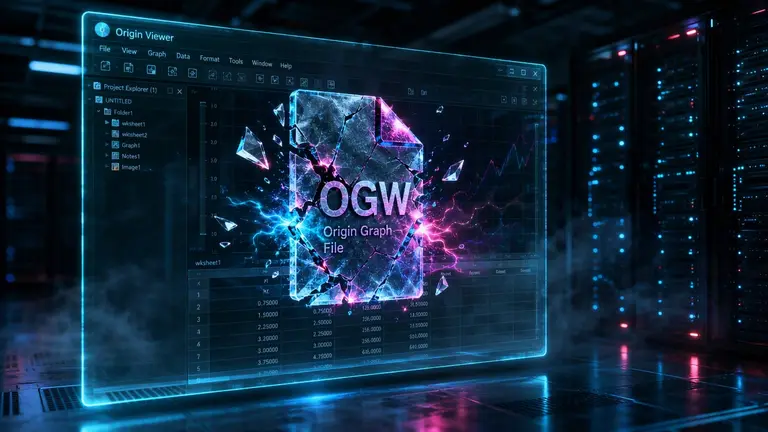
The scientific data visualization program OriginLab Origin Viewer contains a security flaw in its OGW file parser that allows remote code execution. The Trend Micro Zero Day Initiative (ZDI) published advisory ZDI-26-553 on August 11, 2026, confirming that OriginLab released a corrective update after nearly four months of coordinated disclosure. The risk directly affects research workstations, laboratories, and industrial environments where the OGW format routinely circulates among colleagues and collaborators.
- Vulnerability ZDI-26-553, assigned CVE-2026-18294, allows arbitrary code execution in the context of the current process via a malicious OGW file.
- The flaw resides in the lack of validation of user-supplied data during the parsing of Origin workbook files, resulting in memory corruption.
- Exploitation requires user interaction: opening a compromised OGW file or visiting a malicious web page that delivers one.
- OriginLab has released a patch; the initial report was submitted on April 8, 2026, and public disclosure occurred on August 11, 2026.
How the OGW Parser Attack Works
The OGW format is a native workbook of the Origin platform, used to store scientific data, graphs, and analysis metadata. According to the ZDI advisory, the specific flaw exists in the parsing of these files: the lack of validation of user-supplied data generates a memory corruption condition. An attacker can leverage this condition to execute code in the context of the process in which Origin Viewer operates.
ZDI explicitly documents the mechanism as file-based, not a network service. The user must take a deliberate action: open an email attachment, download a file from a shared repository, or visit a web page that forces the download and automatic opening of the OGW file. This vector makes social engineering a necessary component of the attack chain, but does not reduce the danger in environments where dataset sharing is daily practice.
ZDI Coordinated Disclosure Timeline
The vulnerability was reported to OriginLab on April 8, 2026. After approximately four months, on August 11, 2026, ZDI published the public advisory according to the coordinated timeline. CVE-2026-18294 is reserved in the MITRE registry but the record remains in a reserved state, with no additional technical details beyond the ZDI advisory.
ZDI does not specify the exact affected version of Origin Viewer nor the identity of the researcher who discovered the flaw. The dossier does not reveal details on the trigger OGW file size, memory corruption offsets, or involved format variants. These omissions are typical of ZDI disclosures that protect the researcher's intellectual property until coordinated publication.
"The specific flaw exists within the parsing of OGW files. The issue results from the lack of proper validation of user-supplied data, which can result in a memory corruption condition. An attacker can leverage this vulnerability to execute code in the context of the current process." — Advisory ZDI-26-553
Why Labs Are Atypical Attack Surfaces
Origin Viewer is widely deployed in universities, research centers, the pharmaceutical industry, and advanced manufacturing. Unlike production servers, scientific workstations receive less attention from automated patching and often run specialized software with elevated privileges to access instrumentation or internal databases. An OGW file shared via institutional email, collaboration platform, or academic repository raises no alarms: it is the standard format of the trade.
ZDI does not document in-the-wild exploits or active campaigns leveraging this specific flaw. However, the vector's structure — a file shared in trusted environments — makes the vulnerability particularly suited for targeted spear-phishing scenarios against high-value targets, where dataset sharing is credible and expected.
Immediate Actions
The primary source indicates four priority actions:
- Verify the presence of OriginLab Origin Viewer in the fleet and confirm the installation is updated to the corrected version released by OriginLab.
- Block or filter automatic execution of OGW files downloaded from email or sharing platforms until source verification.
- Isolate scientific data analysis workstations from network segments with direct access to critical systems or instrumentation.
- Review file-sharing policies between research units to require out-of-band confirmation before opening workbooks from unverified senders.
Who Should Worry (and Who Shouldn't)
The ZDI advisory does not specify whether the flaw affects only Origin Viewer — the free viewer — or also OriginPro, the full analysis suite. This distinction matters: Origin Viewer is often installed on unmanaged machines, such as student laptops or external collaborator devices, while OriginPro tends to reside on enterprise workstations with more structured update procedures. ZDI does not clarify this scope, so prudence suggests treating both products as potentially exposed until vendor confirmation.
The specific CVSS score is not reported in the available advisory text. CVE-2026-18294, reserved but not yet populated with metrics in the MITRE registry, offers no objective priority scale. Absent these numbers, the classification of impact as RCE in the context of the current process — with required user interaction — places the vulnerability in a high but not critical severity band, where patching timeliness remains decisive but not existential.
Frequently Asked Questions
Can OGG files or other Origin formats be attacked?
The dossier does not document vulnerabilities in OGG or other Origin formats. Flaw ZDI-26-553 explicitly concerns the parsing of OGW files.
Is it necessary to uninstall Origin Viewer if the patch cannot be found?
The source does not indicate uninstallation as a corrective measure. OriginLab has released an update; patch availability is the confirmed datum, not product removal.
Is CVE-2026-18294 already public with full details?
No. The CVE-2026-18294 record remains in a reserved state at cve.org at the time of this article's publication; technical details come exclusively from advisory ZDI-26-553.
Data science requires trust in the provenance of analyzed samples. That same trust, automatically transferred to the files containing them, is what makes this flaw insidious: the daily work format becomes a compromise vector without the user perceiving any anomaly. The patch exists, but its efficacy will depend on the speed with which scientific system administrators — often under-resourced and invisible in the corporate security chain — deploy it across their technological niches.
Information has been verified against cited sources and updated at the time of publication.
Sources
- http://www.zerodayinitiative.com/advisories/ZDI-26-553/
- https://www.cve.org/CVERecord?id=CVE-2026-18294
- http://www.zerodayinitiative.com/advisories/upcoming/
- https://www.trendmicro.com/
- https://www.trendmicro.com/en_us/business/products/one-platform.html
Get DeafLetter
A weekly selection of signals, vulnerabilities and guides. Critical alerts remain optional.
You can unsubscribe at any time. Privacy policy.