Get DeafLetter
A weekly selection of signals, vulnerabilities and guides. Critical alerts remain optional.
You can unsubscribe at any time. Privacy policy.
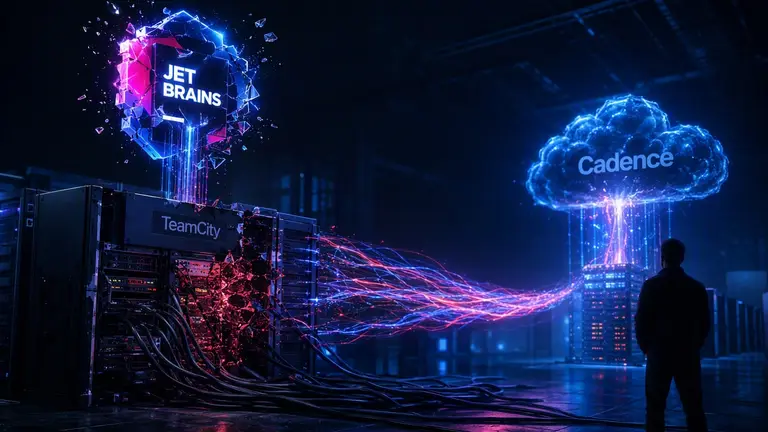
JetBrains confirmed on August 23, 2026, the breach of its Cadence cloud service, orchestrated through a critical vulnerability in its own TeamCity product that the vendor failed to patch internally. The malicious activity persisted for 16 days, from August 8 to 24, before the api.cadence.jetbrains.com server was taken offline. The case stands as an emblematic demonstration of how fragmentation between the security of a sold product and the security of the cloud-hosted service running it can produce systemic failures even at companies that build the defensive tools.
- JetBrains explicitly admitted the internal TeamCity server used for Cadence "should have been patched" but was not, despite available patches and inclusion in the CISA KEV catalog
- Vulnerability CVE-2026-63077, with a CVSS score of 9.8 per the official NVD record, allows unauthenticated remote code execution via the TeamCity agent polling protocol
- Attackers compromised a full backup of the Cadence server from 2024 containing multiple AWS IAM credentials, including users belonging to JetBrains employees
- Confirmed exfiltrated personal data: usernames, real names, email addresses, last login timestamps, and last access IP addresses
The Mechanism: Unauthenticated Deserialization in Agent Polling
The CVE-2026-63077 record in the NVD database identifies the flaw as an untrusted data deserialization vulnerability in the TeamCity agent polling protocol. The attack vector is classified as AV:N/AC:L/PR:N/UI:N/S:U/C:H/I:H/A:H, which translates to: network access, low complexity, no privileges required, no user interaction, with maximum impact on confidentiality, integrity, and availability. It is a configuration that makes exploitation trivial and automatable in practice.
The agent polling protocol is the channel through which TeamCity build agents register with the server to receive compilation jobs. The unsafe deserialization allows an attacker to inject malicious serialized objects that execute with the server process privileges, immediately gaining control of the instance. According to JetBrains' official advisory, the compromised server was the one managing the Cadence service, the cloud workflow orchestration platform integrated with PyCharm.
The Timeline: 16 Days of Persistence Between KEV and Discovery
The timeline reveals a critical gap between public exposure and internal response. CVE-2026-63077 was added to CISA's Known Exploited Vulnerabilities (KEV) catalog on August 5, 2026, with a two-day deadline for patching. The api.cadence.jetbrains.com server remained vulnerable nonetheless. Malicious activity was identified on August 8, with official discovery by JetBrains on August 23 and server takedown the following day.
The patched versions of TeamCity, per the official release notes cited in the JetBrains advisory, were available as 2025.11.7 and 2026.1.3. The company did not disclose the specific version running on the Cadence server nor explain the reasons for the missed update. This element remains among the dossier's gaps: the why behind such a glaring omission was not clarified in the vendor's controlled disclosure.
"The server should have been patched as part of our response to the vulnerability, but it was not. We sincerely apologize for this failure and the impact it may have on you." — JetBrains, official advisory
The Exposed Data: From 2024 Backup to Current Storage
The compromise primarily affected a full backup of the Cadence server dating to 2024. Per JetBrains' official advisory, this archive contained "credentials, configurations, artifacts, and logs." Specifically, "multiple AWS IAM users and associated credentials/secrets used with Cadence, including IAM users belonging to JetBrains employees" were compromised. The vendor's phrasing implies the exposed credentials were not limited to a single account or service.
Confirmed exfiltrated personal data of Cadence users includes: usernames, real names, email addresses, last login timestamps, and last access IP addresses. While not strictly classified as sensitive data under GDPR, this information constitutes a detailed behavioral profile useful for future spear-phishing attacks.
An element of uncertainty persists regarding the current environment. JetBrains stated in an update that "the threat actor obtained access that could have allowed them to reach storage containing data associated with current Cadence users, including email addresses, project source code, and credentials." However, the vendor specifies it has no evidence of actual exfiltration from this storage. The same uncertainty applies to potential S3 buckets in customer accounts: "We do not currently know if threat actors have access to storage buckets in customer accounts," the advisory reads.
Immediate Actions
JetBrains issued specific operational recommendations that Cadence users must enact immediately:
- Mass credential rotation: revoke or rotate all credentials and secrets used to run Cadence workflows, without assuming they remain valid
- Treat executions as untrusted: consider all inputs and outputs of Cadence workflows potentially compromised, including historical ones
- Token invalidation: JetBrains has already disabled all PyCharm plugin access tokens for Cadence; users must regenerate them with new credentials
- AWS account verification: check IAM activity and S3 access logs for anomalies, given that exposed AWS credentials could have permitted lateral movement or access to resources outside the JetBrains perimeter
The Supply Chain Paradox: Who Patches the Patcher?
The incident raises a structural question that transcends the single vendor. JetBrains sells TeamCity as a secure CI/CD platform, with advisories, timely patches, and enterprise workflow integration. The internal failure demonstrates that the security guarantee of the product does not automatically translate to the security of the cloud service that employs it. The responsibility for patching, when distributed between product teams and cloud operations teams, can create gray zones where no one holds complete visibility.
For companies entrusting critical pipelines to cloud-hosted services, the case serves as a warning: the promise of "out of the box" security does not eliminate the need to independently verify the patching status of the underlying infrastructure. Trust in the vendor as the sole guardian of one's supply chain reveals a model with systemic blind spots, especially when the vendor is simultaneously the weapon supplier and the victim of the assault.
Daniel Gallo, JetBrains Solutions Engineering Lead, clarified that new analyses "have not identified additional affected users beyond those already contacted directly," but that "as a precaution we are treating the data stored there as potentially exposed." Linguistic caution does not erase the gravity of the case: 16 days of persistent access to a cloud server with AWS credentials in the clear represents a time window more than sufficient for lateral movements not yet detected.
Questions and Answers
- Why wasn't the server patched if fixes were available?
- JetBrains provided no technical or organizational explanations for the missed patching. The advisory limits itself to admitting the error without detailing whether the issue stemmed from change management processes, misclassification of the system, or other operational causes.
- Are TeamCity Cloud customers at risk?
- Per JetBrains' official advisory, TeamCity Cloud customers were not exposed to the risk related to this specific compromise. The affected service was Cadence, with separate infrastructure.
- What does "treat executions as untrusted" mean in practice?
- It means build outputs, generated artifacts, environment variables, and any secrets injected into Cadence workflows could have been altered or exfiltrated. The recommendation implies integrity audits and, where possible, reconstruction of pipelines from verified sources.
Information verified against cited sources and current as of publication.
Sources
- https://thehackernews.com/2026/09/attackers-breached-jetbrains-cadence.html
- https://adtmag.com/articles/2026/08/31/jetbrains-breach.aspx
- https://beyondmachines.net/event_details/jetbrains-cadence-service-breached-via-unpatched-teamcity-rce-flaw-s-9-2-o-x
- https://securityonline.info/jetbrains-cadence-server-hacked/
- https://blog.jetbrains.com/pycharm/2026/08/cadence-security-incident-august-2026/
- https://nvd.nist.gov/vuln/detail/cve-2026-63077
- https://adtmag.com/pages/topic-pages/security.aspx
- https://adtmag.com/articles/2026/08/27/microsoft-agent-framework-adds-support.aspx
Get DeafLetter
A weekly selection of signals, vulnerabilities and guides. Critical alerts remain optional.
You can unsubscribe at any time. Privacy policy.