Get DeafLetter
A weekly selection of signals, vulnerabilities and guides. Critical alerts remain optional.
You can unsubscribe at any time. Privacy policy.
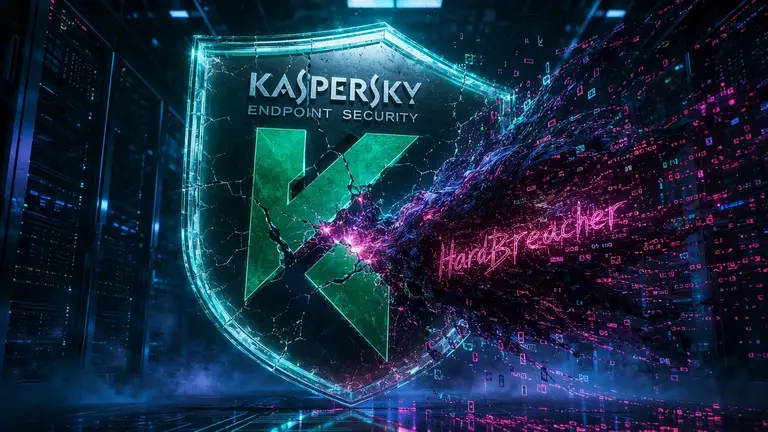
Nightmare Eclipse, also operating under the alias Chaotic Eclipse, released a proof-of-concept exploit dubbed HardBreacher on August 31, 2026, targeting a privilege escalation vulnerability in Kaspersky Endpoint Security. The researcher, previously known for Windows and Microsoft Defender zero-day exploits later operationalized in the wild, describes the code as "improvised but functional." Kaspersky told SecurityWeek that the fix is available via automatic or manual database update, a response mode that distinguishes it from a structural product patch.
- Nightmare Eclipse releases HardBreacher, a privilege escalation PoC against Kaspersky Endpoint Security, continuing a pattern of systematically targeting endpoint defense tools.
- The exploit compromises the Kaspersky UI process, manipulating internal access-control decisions and causing product malfunctions that grant or block unauthorized file access.
- Kaspersky states the vulnerability was resolved via a database update, not a software patch: the distinction matters for those monitoring security perimeter consistency.
- Nightmare Eclipse has a documented history of exploits against Windows Defender later abused by malicious actors, raising the alert profile for this release.
The Mechanism: Hijacking the UI to Bend the Kernel-Adjacent
According to the researcher's description reported by SecurityWeek, HardBreacher operates by taking control of the Kaspersky Endpoint Security UI process. This component, which runs with elevated privileges to interface with system security decisions, becomes the leverage point to manipulate product behavior. Nightmare Eclipse stated that "Kaspersky completely loses it when you take control over the UI process": the product stops functioning correctly, allowing the granting or blocking of unauthorized file access.
The technique exemplifies a growing class of attacks against security products themselves: endpoint software, designed to operate with kernel-adjacent privileges, presents a privileged attack surface that, when compromised, inverts defensive logic. The protector becomes a manipulable gatekeeper, with cascading impact across the operating system.
HardBreacher: Duct Tape That Works
"The PoC is not in the best shape at all, it is basically duct taped, I just managed to make it work and that's all" — Nightmare Eclipse, via SecurityWeek
The researcher's self-assessment does not diminish the technical relevance. The code, released on a public repository under an MIT license, includes a component named SolidSnake described as a companion payload or shellcode stager. According to Malwaretips, the PoC drops a DLL file to C:\Windows\System32\MY_SNAKE_IS_SOLID.dll with full permissions for the current user, demonstrating arbitrary write capability in protected system paths.
Source 5 specifies the presumed affected version as Kaspersky Antivirus for Endpoint v14.0.0.504 on Windows 11 25H2, and that the exploit requires no network access, social engineering, or prior administrative privileges: a standard account suffices. These technical details are not independently verified by the primary sources from SecurityWeek or Kaspersky.
Kaspersky Responds: Database Update, Not Product Patch
Kaspersky's statement to SecurityWeek, quoted verbatim, is explicit: "The corresponding fix is delivered via an automatic update, or users can trigger a database update manually." Taken literally, this wording indicates a correction distributed through the product's signature or rule database, not through a modification of executable code.
The distinction is operationally significant. A database update intercepts known patterns or regulates behaviors, but does not necessarily remove the structural vulnerability enabling the UI process takeover. If the root cause lies in the interaction logic between UI and kernel components, the signature may mitigate the public exploit without closing the vulnerability class. Kaspersky has not issued a structured advisory with CVE, CVSS, or technical detail on the fix.
The Nightmare Eclipse Pattern: Systematic Subversion of Defenders
The researcher's track record, documented by SecurityWeek, includes zero-day exploits for Windows and Microsoft Defender, some of which "ended up being exploited in the wild by malicious actors." Previous releases include ShieldBreak (spawning a System-privileged shell) and LegacyHive (privilege escalation). Source 5 additionally cites, without independent verification, tools such as BlueHammer, RedSun, and UnDefend associated with Huntress.
The sequence — first Microsoft Defender, now Kaspersky — indicates a deliberate focus on subverting endpoint defense tools, not user applications. This strategy maximizes impact: compromising the defender renders subsequent attacks invisible, evading the very monitoring the product should provide.
Why It Matters
No infrastructure overlaps link the actor to known campaigns at this time.
The non-primary source Malwaretips claims "no patch was available at the time the PoC was published," contradicting Kaspersky's statement to SecurityWeek. This discrepancy cannot be resolved with available sources and constitutes a limitation of the dossier. Independent third-party validation of the PoC is not documented in the provided sources.
Attribution of the exploit to Nightmare Eclipse is stated by the sources; the motive — research, demonstration, or staging for future campaigns — is not documented.
Questions and Answers
Does HardBreacher allow remote code execution?
The source does not classify the vulnerability as RCE.
Why does a database update differ from a patch?
A database update modifies signatures, rules, or detected behaviors, while a structural patch alters the product's executable code. Kaspersky explicitly declared the former; the latter is not documented.
What is the residual risk if the update is applied?
The dossier lacks sufficient data: without a technical advisory with CVE or fix detail, it is not verifiable whether the root cause is eliminated or only the public exploit intercepted.
Sources
- https://www.securityweek.com/nightmare-eclipse-drops-hardbreacher-kaspersky-product-exploit/
- https://www.hendryadrian.com/nightmare-eclipse-drops-hardbreacher-kaspersky-product-exploit/
- https://radar.offseq.com/threat/nightmare-eclipse-drops-hardbreacher-kaspersky-product-exploit-2761cce57a3b1047
- https://www.itsecuritynews.info/nightmare-eclipse-drops-hardbreacher-kaspersky-product-exploit/
- https://malwaretips.com/threads/big-breaking-guardian-turned-gatekeeper-zero-day-eop-in-kaspersky-endpoint-security-lets-attackers-own-the-protector.142998/
- https://radar.offseq.com/console
- https://radar.offseq.com/threats?sortBy=createdAt&sortOrder=desc
Get DeafLetter
A weekly selection of signals, vulnerabilities and guides. Critical alerts remain optional.
You can unsubscribe at any time. Privacy policy.