Get DeafLetter
A weekly selection of signals, vulnerabilities and guides. Critical alerts remain optional.
You can unsubscribe at any time. Privacy policy.
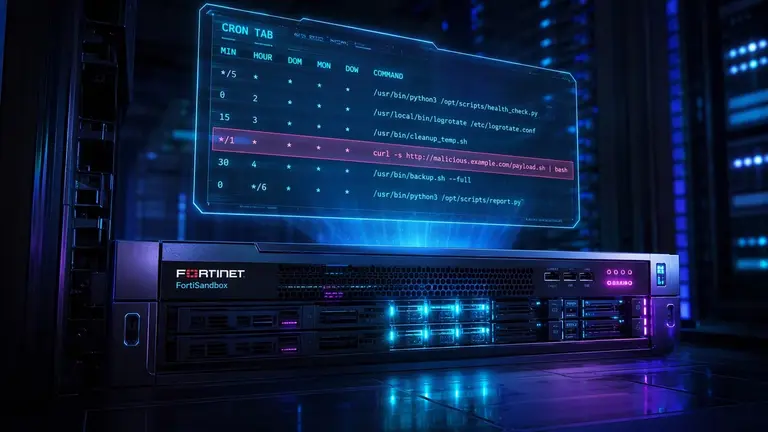
On the afternoon of September 9, 2026, Trend Micro's Zero Day Initiative published advisory ZDI-26-645 covering a command injection vulnerability in Fortinet FortiSandbox. A seemingly minor maintenance endpoint, write_remote_backup_to_crontab, allows an authenticated attacker to execute arbitrary code with root privileges. The assigned CVSS 3.1 score of 6.7 (MEDIUM) for CVE-2026-84387 does not reflect the actual risk for a security appliance that serves as a critical malware analysis node in enterprise networks.
- The
cronValueparameter of thewrite_remote_backup_to_crontabendpoint in FortiSandbox is vulnerable to command injection due to missing input validation before a system call - Exploitation requires authentication and enables arbitrary remote code execution in the context of root
- Affected versions are FortiSandbox 5.2.0, 5.0.0 through 5.0.6, and 4.4.0 through 4.4.9, per the official CVE-2026-84387 record
- The CVSS 3.1 score is 6.7 (MEDIUM) with vector AV:N/AC:L/PR:H/UI:N/S:U/C:H/I:H/A:H, but the high-privilege requirement masks the catastrophic impact on a security appliance
How the Attack Works: The Backup Endpoint That Executes Commands
The flaw lies in how FortiSandbox handles the cronValue parameter passed to the write_remote_backup_to_crontab endpoint. According to the ZDI analysis, the application "does not properly validate a user-supplied string before using it to execute a system call." This gap allows arbitrary command concatenation in the cronValue field.
The impact is total. The ZDI advisory states clearly that "an attacker can leverage this vulnerability to execute code in the context of root." This is not a privilege escalation: execution occurs directly with the highest privileges of the underlying operating system. The only requirement is authentication, which narrows the attack surface but does not mitigate severity in environments where compromised credentials or accounts with administrative access are not uncommon.
The CVSS 6.7 and the Problem of Context-Free Scoring
The CVE-2026-84387 record assigns a score of 6.7, classified as MEDIUM. The full vector is AV:N/AC:L/PR:H/UI:N/S:U/C:H/I:H/A:H: network access, low attack complexity, high privileges required, high impact on confidentiality, integrity, and availability. The PR:H (Privileges Required: High) requirement is what depresses the score.
This is the implicit critique at the heart of the analysis. FortiSandbox is not a generic application: it is a network security appliance designed to perform dynamic analysis on suspicious files and malware. Its compromise as root is not an isolated incident but a structural failure of the defense perimeter. An attacker with root control over the sandbox can manipulate analysis results, inject backdoors into examined samples, or use the device as a bridge for lateral movement within the internal network.
CVSS calculates in the abstract; enterprise infrastructure operators must calculate in the concrete. The CVSS 3.1 framework, in its current architecture, does not account for the functional role of the compromised system. A print server with root RCE and a malware analysis sandbox with identical capability receive identical scores if the technical vectors match. But the second case has cascading effects on the entire enterprise security trust chain: if the sandbox lies, every downstream tool that relies on its verdict becomes unreliable.
"This vulnerability allows remote attackers to execute arbitrary code on affected installations of Fortinet FortiSandbox. Authentication is required to exploit this vulnerability." — ZDI Advisory ZDI-26-645
The Coordinated Disclosure Timeline
Trend Micro managed disclosure through its Zero Day Initiative program. The vendor was notified on March 24, 2026; public release occurred on September 9, 2026. A span of 169 days separates the report and disclosure, an interval consistent with standard coordinated disclosure timelines for medium-to-high complexity vulnerabilities.
Immediate Actions
For operators running FortiSandbox in their infrastructure, priority actions follow directly from the documented facts:
- Identify any FortiSandbox installations running versions 5.2.0, 5.0.0-5.0.6, or 4.4.0-4.4.9 and schedule application of the Fortinet update
- Review access logs for the
write_remote_backup_to_crontabendpoint to detect anomalous calls to thecronValueparameter - Assess network segmentation of the FortiSandbox appliance to limit its attack surface from untrusted segments, given its root RCE capability
- Inspect active cron jobs on the underlying OS for suspicious tasks inserted via the remote backup vector
The Limits of the Metric and the Real Risk
The ZDI-26-645 case raises a methodological issue that cuts across the security industry. The ZDI advisory does not document whether the vulnerability has been exploited in the wild, nor does it identify the discovering researcher. These gaps leave open questions about the maturity of risk assessment processes in enterprise contexts.
The discrepancy between the CVSS score and operational impact remains the most critical data point for decision-makers. An organization relying on FortiSandbox as a central analysis node cannot treat this vulnerability as a generic MEDIUM. Root compromise of an active security system voids the assurance that all analyzed samples were evaluated correctly, with consequences that propagate unpredictably through the entire dependent infrastructure.
Risk management therefore demands a dual layer of assessment: the standardized CVSS score, useful for initial prioritization, and a contextual evaluation based on the system's functional role in the organization's trust chain. Only the integration of both approaches prevents a numerical metric from masking a structural threat to the security perimeter.
Information verified against cited sources and current as of publication.
Sources
Get DeafLetter
A weekly selection of signals, vulnerabilities and guides. Critical alerts remain optional.
You can unsubscribe at any time. Privacy policy.