Get DeafLetter
A weekly selection of signals, vulnerabilities and guides. Critical alerts remain optional.
You can unsubscribe at any time. Privacy policy.
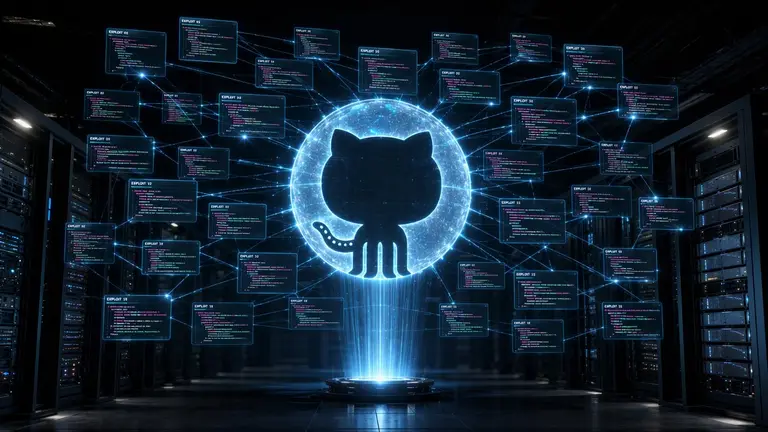
On June 27, 2026, an anonymous researcher known as "bikini" published the Exploitarium repository on GitHub with roughly 15 proof-of-concept exploits for zero-day vulnerabilities. By July 2 the count exceeded 30; as of July 22, LevelBlue SpiderLabs documented 204 files spread across 35 project folders, expanding at a pace of two to three new projects per week. No vendors were contacted in advance.
- The researcher "bikini" published dozens of zero-day exploits for widely deployed open-source components—including libssh2, Gitea, PostgreSQL, Redis, Nextcloud, RustDesk, Nmap, and OpenVPN—without prior coordination.
- CVE-2026-55200 is a pre-authentication RCE in libssh2 with transitive impact on curl, Git, and PHP; the National Vulnerability Database rates it CVSS 8.1 HIGH.
- CVE-2026-20896, an authentication bypass in self-hosted Gitea rated CVSS 9.8 CRITICAL by NVD, is among the vulnerabilities independent sources have verified as actively exploited.
- The repository has evolved from a personal archive into a collaborative clearinghouse, accepting external pull requests and pairing with a code-obfuscation toolkit.
The Mechanics of CVE-2026-55200 and Transitive Risk
The most documented vulnerability in the dossier resides in libssh2's ssh2_transport_read() function, where a malformed packet_length triggers an out-of-bounds write and subsequent heap corruption. The National Vulnerability Database confirms authentication is not a prerequisite for exploitation: a malicious SSH server can execute remote code on vulnerable clients before any credential exchange occurs.
The blast radius extends well beyond libssh2 itself. System Two Security verified the library is a transitive dependency of curl, Git, and PHP—components present in CI/CD pipelines, development environments, and production systems often missed by attack-surface scans. The NVD records the fix commit in mainline, though the dossier notes an unresolved conflict between two partially overlapping hashes (7acf3df and 97acf3d).
From Personal Archive to Collaborative Infrastructure
The timeline is measurable. The initial June 27 release contained roughly 15 exploits, according to Infosecurity Magazine, which interviewed bikini on Discord. By July 2 the researcher confirmed "over 30" proof-of-concepts. LevelBlue SpiderLabs, analyzing the repository as of July 22, counted 204 files across 35 project folders with a growth rate of two to three new folders per week in the first half of July.
The qualitative shift is equally significant. The repository began accepting external contributions: pull request #4 from a user "Unrealisedd" introduced new vulnerabilities in Windows kernel drivers. The maintainer also retroactively credited external work on objdump. In parallel, LevelBlue detected coupling with a general-purpose code-obfuscation toolkit, an element that complicates triage for defenders.
AI-Assisted Fuzzing and the Compression of the Research Cycle
Bikini states the fuzzing process was automated using OpenAI models, referencing GPT-5.5 Codex and a subsequent revision to GPT-5.3. The operational distinction is precise: the AI generated fuzzing inputs, while the proof-of-concepts were written manually by the researcher. The barrier to entry lowers not because of automatic generation of working exploits, but because the crash-identification phase accelerates.
The methodology produced, according to Infosecurity Magazine, 12 additional CVEs beyond CVE-2026-55200 and CVE-2026-20896. The source does not list all identifiers but confirms assignment occurred after public publication. The coordinated vulnerability disclosure model—based on private notification and coordinated embargo—was not applied in any case documented by the dossier.
"I just came to the understanding that open disclosure is better for everyone in 99% of circumstances" — bikini, via Discord to Infosecurity Magazine
The Absence of CVD and the Disclosure Debate
The repository README explicitly states that none of the vulnerabilities were reported to vendors before publication. Bikini justified the choice as educational: "I think it's the best way for people to learn and become allured into the field. It's a lot less interesting and informative if someone has to read a write up that's not applicable by today's security standards." An anti-misuse disclaimer ("Cybercrime is cringe") is present, but the researcher responded skeptically to questions about its effectiveness: "Of course not. The disclaimer might help, but at the end of the day, they have the free will to make their own choices."
Ethan Andrews, an analyst at Federal Signal Corporation, created 44 KQL rules for Microsoft Sentinel and Defender XDR. His assessment captures the tension: "shows a meaningfully different intent than a coordinated offensive toolkit release, but a risky decision at the same time, especially with no vendor coordination." LevelBlue SpiderLabs characterized Exploitarium as "not a discrete incident with a start and end date but an ongoing infrastructure likely to keep generating both genuine findings and triage overhead."
What to Do Now
The cited sources suggest priority actions for security teams:
- Verify the reachability of libssh2 in your transitive dependencies, with specific attention to CI/CD pipelines, versioning tools, and development environments that incorporate curl, Git, or PHP.
- Monitor the expansion of the Exploitarium repository and external contributions, given the documented growth rate and acceptance of unverified pull requests.
- Prioritize triage on CVE-2026-55200 and CVE-2026-20896 based on transitive blast radius rather than media visibility, given that both vulnerabilities are actively exploited according to independent sources.
- Evaluate adoption of the detection rules published by Ethan Andrews for Microsoft platforms, available for Sentinel and Defender XDR.
The dossier does not specify generalizable remediation measures for the other vulnerabilities in the repository, nor does it document the existence of patches for all 35 listed projects. The uncoordinated nature of the disclosure prevents construction of a reliable fix-release timeline.
Why the Disclosure Model No Longer Holds
Exploitarium is not an isolated leak nor a threat-actor campaign. It is infrastructure that turns vulnerability research into a continuous supply-chain phenomenon, where the speed of flaw generation outpaces the patching capacity of open-source maintainers. The use of AI for fuzzing further compresses the cycle, while the repository's collaborative structure distributes editorial responsibility among multiple unidentified contributors.
For CISOs, the case demands a methodological shift: triage can no longer rest on isolated CVSS severity but must map the blast radius of transitive dependencies. For the industry, the CVD-versus-full-disclosure debate moves out of the ethical sphere and becomes an operational problem. When a single researcher can overwhelm dozens of projects with working exploits before any coordination is technically feasible, the coordinated disclosure model as we have known it ceases to scale.
Sources
- https://www.scworld.com/brief/anonymous-researcher-dumps-zero-day-exploits-for-multiple-software-products
- https://www.infosecurity-magazine.com/news/researcher-exploitarium-exploits/
- https://cybersecuritynews.com/researcher-dumps-0-day-exploit-files/
- https://www.darkreading.com/vulnerabilities-threats/microsoft-rogueplanet-zero-day-threat
- https://nvd.nist.gov/vuln/detail/CVE-2026-55200
- https://systemtwosecurity.com/share/inspiration/VNJMKFVM
- https://msrc.microsoft.com/update-guide/vulnerability/CVE-2026-50656
- https://www.scworld.com/topic/vulnerability-management
Information verified against cited sources and current as of publication.
Sources
Get DeafLetter
A weekly selection of signals, vulnerabilities and guides. Critical alerts remain optional.
You can unsubscribe at any time. Privacy policy.