Get DeafLetter
A weekly selection of signals, vulnerabilities and guides. Critical alerts remain optional.
You can unsubscribe at any time. Privacy policy.
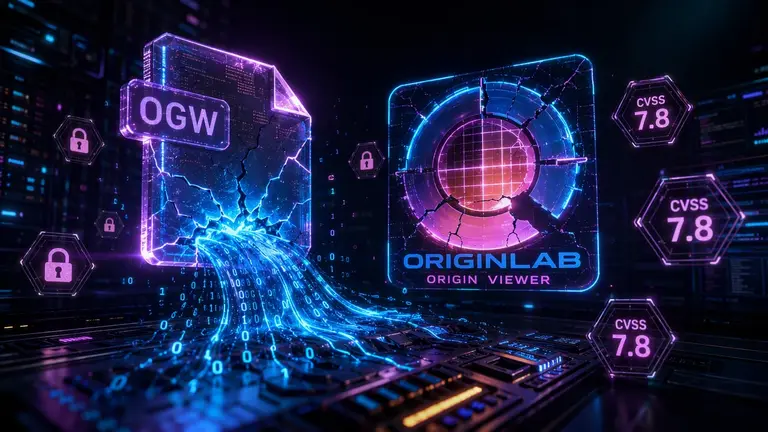
Trend Micro's Zero Day Initiative coordinated disclosure program published advisory ZDI-26-553 on August 11, 2026, documenting a remote code execution vulnerability in OriginLab Origin Viewer. The flaw resides in the OGW file parser, where a lack of user-supplied data validation leads to memory corruption. OriginLab has released a corrective update; the interval between initial report and coordinated disclosure was approximately 125 days.
- The vulnerability carries identifier CVE-2026-18294, rated CVSS 7.8 HIGH per the official CVE.org record
- Memory corruption occurs during OGW (Origin workbook) file parsing due to missing validation of user-supplied data
- Exploitation requires user interaction: opening a crafted file or visiting a malicious webpage that triggers its opening
- OriginLab has distributed a corrective update; specific affected versions are not identified in available sources
The Flaw Mechanism: OGW Parsing Without Boundary Checks
The specific flaw lies in the OGW file parsing module, OriginLab's proprietary workbook format. According to the ZDI advisory, "the specific flaw exists within the parsing of OGW files. The issue results from the lack of proper validation of user-supplied data, which can result in a memory corruption condition." The assigned CWE-119 — Improper Restriction of Operations within the Bounds of a Memory Buffer — confirms the classic nature of the defect: absence of buffer boundary checks during processing of attacker-controlled input.
The impact is arbitrary code execution in the context of the Origin Viewer process. The CVSS vector CVSS:3.0/AV:L/AC:L/PR:N/UI:R/S:U/C:H/I:H/A:H encodes a local attack vector (AV:L) that nonetheless requires user interaction (UI:R), with no prior privileges needed (PR:N). The combination yields high severity across all three CIA axes: confidentiality, integrity, and availability are all rated "High."
Timeline and Coordinated Disclosure: 125 Days Vendor-to-Fix
The initial vendor report is dated April 8, 2026. Coordinated advisory publication occurred on August 11, 2026, as documented in the ZDI advisory's structured fields. This roughly four-month interval aligns with standard coordinated disclosure patterns, where the researcher and managing organization grant the vendor a window to develop and release a patch.
The prior internal ZDI identifier was ZDI-CAN-29338, as reported in the official CVE Record. The transition from internal identifier to public CVE underscores process traceability: the vulnerability moved through verification, MITRE identifier assignment, fix development, and coordinated release. The discoverer's identity does not appear in available sources.
"This vulnerability allows remote attackers to execute arbitrary code on affected installations of OriginLab Origin Viewer. User interaction is required to exploit this vulnerability in that the target must visit a malicious page or open a malicious file." — ZDI Advisory ZDI-26-553
Scientific Software as an Overlooked Attack Surface
Origin Viewer is widely deployed in academic and industrial environments for visualizing scientific data and graphs. Its role as a viewer — often installed on research workstations with access to sensitive datasets — places it in a software category that traditionally receives less security scrutiny than browsers or mainstream office suites. The OGW format, specific to the OriginLab ecosystem, represents a niche parser that accumulates technical debt: fewer independent testers, less automated fuzzing, mature codebases not necessarily subjected to continuous scrutiny.
CVE-2026-18294 fits a broader pattern: programs like ZDI are systematically mapping these lateral surfaces. A dedicated advisory for a scientific viewer — rather than an office suite or browser — signals that security researchers' perimeter of attention has expanded beyond conventional targets. For organizations operating in R&D, materials science, chemistry, and data-intensive disciplines, this implies specialized software is no longer exempt from the patch management lifecycle.
Immediate Actions
- Verify OriginLab Origin Viewer installations on research workstations and apply the vendor-released update
- Inspect inbound OGW files via email, cloud storage, or research group sharing channels before opening
- Evaluate execution policies for niche proprietary formats on systems with access to sensitive or proprietary data
- Monitor official OriginLab channels for detailed patch changelogs and confirmed fixed versions
When the Viewer Becomes a Vector
The transition from "simple viewer" to "attack surface with RCE" is the core of this case. The CVSS 7.8 without need for prior privileges means a standard user, tricked into opening an OGW file, grants the attacker full control of the process. In environments where researchers handle pre-publication data, patents in development, or confidential industrial results, the process context becomes critical: the viewer has access to the filesystem, recently opened data, and potentially mapped network resources.
The sources do not document in-the-wild exploitation or detected attacks. However, the vector structure — a crafted file delivered via targeted phishing to scientific communities — requires no complex infrastructure. The barrier remains social engineering, not technical. For CISOs at research institutes and university departments, the lesson is methodological: patching can no longer stop at operating systems and general-purpose suites but must extend to the chain of specialized tools that constitute the scientific workflow.
Sources
- http://www.zerodayinitiative.com/advisories/ZDI-26-553/
- https://www.cve.org/CVERecord?id=CVE-2026-18294
- http://www.zerodayinitiative.com/advisories/upcoming/
- https://www.trendmicro.com/
- https://www.trendmicro.com/en_us/business/products/one-platform.html
Information verified against cited sources and current as of publication.
Sources
Get DeafLetter
A weekly selection of signals, vulnerabilities and guides. Critical alerts remain optional.
You can unsubscribe at any time. Privacy policy.