Get DeafLetter
A weekly selection of signals, vulnerabilities and guides. Critical alerts remain optional.
You can unsubscribe at any time. Privacy policy.
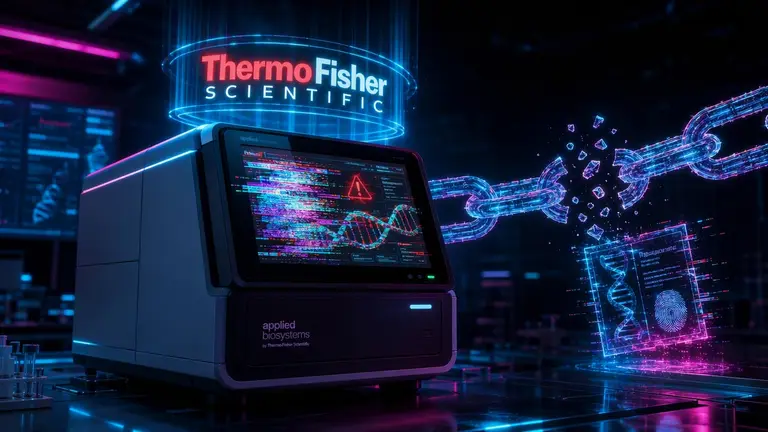
On July 31, 2026, Thermo Fisher Scientific released patches for CVE-2026-17583, a high-severity vulnerability in Applied Biosystems software used in forensic and clinical laboratories worldwide. Researchers Nathan Adams, Kevin Dyer, and Laura Gaydosh-Combs — with CISA coordination — demonstrated that .fsa and .hid output files could be modified without triggering alarms, compromising the integrity of seemingly authentic genetic profiles. The patch introduces digital signatures, but no method exists to retroactively validate files produced since 1995.
- CVE-2026-17583 carries CVSS v4.0 8.2 and CVSS v3.1 8.4, both rated HIGH; CISA assigns CWE-353 (Missing Support for Integrity Check)
- .fsa and .hid files can be altered before loading into analysis software without the system detecting tampering
- Nathan Adams demonstrated the vulnerability using Anthropic's Claude AI to combine two DNA profiles into an apparently unaltered file from 2015, with a first successful modification in roughly 45 minutes
- Three end-of-life product lines receive no patch: 3130 Series, ABI PRISM 3100/3100-Avant, and ABI PRISM 310
The Mechanism: Absence of Integrity Across Three Decades of Genetic Files
The vulnerability lies in the lack of integrity verification for DNA sequencer output files. According to the CVE-2026-17583 record and CISA advisory ICSMA-26-216-01, Applied Biosystems software loads .fsa and .hid files without validating digital signatures or cryptographic hashes. An actor with access to laboratory systems can alter genetic profiles before the software processes them, generating seemingly authentic results.
The CVSS v4.0 vector string confirms the risk profile: local access (AV:L), low attack complexity (AC:L), no privileges required (PR:N), no user interaction (UI:N), high impact on data integrity and availability (VI:H, VA:H). CISA explicitly states the vulnerability "is not exploitable remotely" — it requires physical or credentialed remote access to laboratory servers and knowledge of DNA testing workflows.
Using Claude AI to Build the Proof of Concept
Adams, a systems engineer at Forensic Bioinformatics, used Anthropic's Claude AI to accelerate construction of the technical demonstration. As reported by The Hacker News citing the Wall Street Journal, "his first successful file modification using Anthropic's Claude took about 45 minutes." The demonstration produced a file that combined two distinct DNA profiles while preserving metadata that appeared unaltered since 2015.
"nearly undetectable changes to .fsa and .hid outputs could occur if laboratory controls are circumvented" — Thermo Fisher security bulletin
The demonstration remains in a controlled context: there is no indication it constitutes a public proof of concept or that the technique has been independently replicated. The source does not specify whether the modification with Claude AI required multiple iterations before success, nor details on target system protections during the test.
Five Patches, Three Abandoned Products, Zero Historical Validation
Thermo Fisher released updates with digital signatures for five supported product lines: 3500/3500xL, 3730/3730xL, SeqStudio, SeqStudio Flex, and GeneMapper ID-X. The fixed versions are identified in the official release notes and the CISA advisory.
Three end-of-life platforms receive no updates: 3130 Series, ABI PRISM 3100/3100-Avant, and ABI PRISM 310. These systems remain vulnerable to permanent tampering of output files. The documents do not indicate how many forensic or clinical laboratories still operate these platforms.
The most significant gap concerns the absence of retroactive validation. According to the Rescana advisory, "no known method to retroactively validate files generated before the patch, leaving historical data potentially at risk." The researchers, cited by WSJ/The Hacker News, state that "the vulnerability likely existed in digital files produced by crime-lab machines since 1995 and that they had not found a way to detect prior tampering if it occurred." The dossier does not specify whether this start date represents an internal Thermo Fisher confirmation or a researcher inference based on software version analysis.
What to Do Now
For laboratories operating Thermo Fisher Applied Biosystems systems, the actions documented in the sources are as follows:
- Immediately apply the digitally signed patches for the five supported product lines, following the versions indicated in the official release notes and CISA advisory ICSMA-26-216-01
- Evaluate decommissioning or isolating the three unpatched end-of-life platforms, given that no fix exists for the integrity vulnerability
- Review laboratory system access controls: CISA confirms the exploit requires local or credentialed remote access, making network segmentation and physical access control primary mitigating factors
- Document the chain of custody for .fsa and .hid files generated before the patch, acknowledging that no technical method exists to retroactively validate their authenticity
Why Digital Forensics Was Never Truly Forensically Verified
The vulnerability exposes an implicit assumption that lasted three decades: that the digital representation of DNA was equivalent to the biological sample. In reality, the forensic chain of custody has always broken at the handoff from sequencer to file system, without integrity mechanisms guaranteeing identity between the two. Tampering does not touch physical DNA — that remains in the domain of laboratory contamination — but it alters the digital trace in an indistinguishable manner.
For the cybersecurity sector, the case documents a growing pattern: generative AI reduces proof-of-concept construction time for vulnerabilities in non-traditional critical infrastructure. Roughly 45 minutes of interaction with an LLM produced a functional file modification that would have required weeks of manual reverse engineering. The impact is not on the speed of exploits in the wild — no exploitation is confirmed — but on the democratization of vulnerability discovery in legacy systems.
The real open question remains judicial: how many historical cases relied on unverifiable .fsa or .hid files? The dossier provides no figures or methodologies for retroactive audit. The technical fix — digital signatures — solves the problem from July 31, 2026 onward, leaving everything prior unresolved.
Does the vulnerability allow alteration of physical DNA?
No. CVE-2026-17583 affects only the digital representation in .fsa and .hid files: the modification does not extend to biological samples, but it can produce seemingly authentic analysis results that do not correspond to the real genetic profile.
Why can't historical files be validated after the patch?
The patch introduces digital signatures calculated at the moment of file generation. Files produced before the update do not contain these signatures, and no cryptographic method exists to reconstruct them ex post without access to the original content verified independently.
What is the concrete risk for a forensic laboratory today?
The documented risk is one of integrity: altered files loaded into analysis software generate inauthentic genetic profiles. CISA confirms the exploit requires non-remote access and workflow knowledge, limiting the attack surface but not eliminating the insider or post-compromise vector.
Sources
- https://www.rescana.com/post/cve-2026-17583-critical-dna-data-tampering-vulnerability-in-thermo-fisher-applied-biosystems-software
- https://thehackernews.com/2026/08/thermo-fisher-patches-flaw-that-could.html
- https://www.cisa.gov/news-events/ics-medical-advisories/icsma-26-216-01
- https://nvd.nist.gov/vuln/detail/CVE-2026-17583
- https://nvd.nist.gov/vuln/search
- https://www.cve.org/CVERecord?id=CVE-2026-17583
- https://www.cisa.gov/known-exploited-vulnerabilities-catalog
- https://thehackernews.com/
Information verified against cited sources and current as of publication.
Sources
Get DeafLetter
A weekly selection of signals, vulnerabilities and guides. Critical alerts remain optional.
You can unsubscribe at any time. Privacy policy.