Get DeafLetter
A weekly selection of signals, vulnerabilities and guides. Critical alerts remain optional.
You can unsubscribe at any time. Privacy policy.
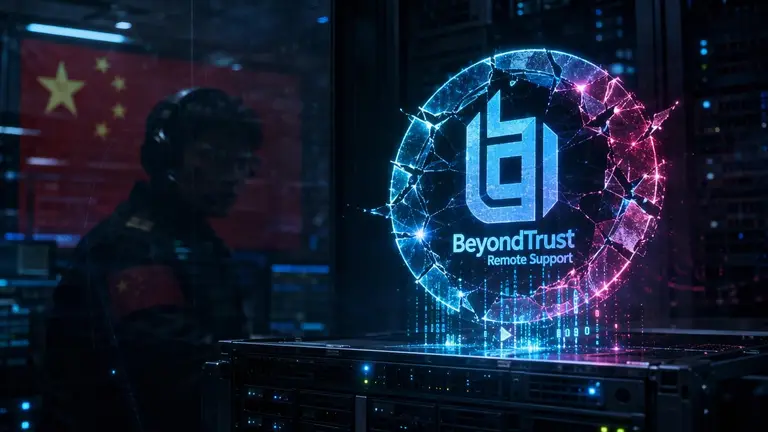
BeyondTrust disclosed a critical flaw in its Remote Support platform on Oct. 15, 2026, after a Chinese espionage actor identified as Armory Castle (also UNC5221 and Warp Panda) exploited it for nearly seven weeks undetected. The exposure window, from Aug. 29 to Oct. 15, enabled root access and lateral movement across enterprise networks through custom-built tools: the Sawfly web shell and the Bareclaw SOCKS5 tunnel. CISA added CVE-2026-102764 to the KEV catalog on Oct. 16, setting a patch deadline of Oct. 19 for federal agencies.
- The vulnerability CVE-2026-102764 carries a CVSS 9.3 score in version 4.0 and affects BeyondTrust Remote Support releases 24.3.1 through 26.2.3.
- In-the-wild exploitation is confirmed from Aug. 29, 2026: two appliances, one hosted and one self-hosted, were compromised on the same date.
- Armory Castle used a structured chain: authentication bypass, arbitrary file operations, upload of the Sawfly PHP web shell, Bareclaw proxy for SOCKS5 tunneling, and root escalation via SUID manipulation.
- The attacker systematically wiped system, web server, and application logs, rendering forensic verification based solely on appliance logs insufficient.
The Mechanism: When Trust Concentrates in a Single Broker
The defect lies in improper origin validation in the platform's internal messaging components, classified as CWE-290: Authentication Bypass by Spoofing. According to the official description cited by The Hacker News, "The components did not adequately validate the origin of the messages it received. Under the right conditions, this could be used to perform file operations on the appliance." This missing check allows a remote actor to send messages the appliance processes as legitimate, opening the door to arbitrary filesystem operations.
From there the chain unfolds with surgical precision. Upload of the Sawfly web shell — lightweight and featuring encrypted bidirectional communication with its command-and-control server — establishes the initial foothold. The Bareclaw tunnel, written in C and configured as a SOCKS5 proxy, routes further traffic through the compromised appliance. Root escalation occurs by copying /bin/sh to /usr/bin/dbus-authd with SUID permissions and root ownership, turning an apparently innocuous binary into a privileged backdoor.
The next target is the appliance's internal credential vault. Mandiant and Google Threat Intelligence Group researchers documented the use of the proprietary /ns/sbin/bt-secrets CLI utility to extract passwords, API keys, and endpoint credentials. This is where a single breach transcends the compromised system: BeyondTrust Remote Support acts as a privileged access broker, so stealing its vault equals obtaining the keys to every session and downstream target it manages.
"Any appliance that was reachable from the internet on a vulnerable version during the exploitation window should be treated as potentially compromised until it has been reviewed."
— Mandiant/GTIG (Jayson Frost, Bryce Greathouse, Brian Meyer, John Palmisano, Rajesh Rajeshirke, Steve Rasch, John Wolfram)
The 47-Day Window and the Visibility Problem
Aug. 29, 2026 marks the start of a campaign that remained invisible for nearly seven weeks. BeyondTrust released patch BT26-05-RS on Oct. 8; SaaS instances were automatically updated by Oct. 9. Public disclosure followed on Oct. 15. In that span, the attacker operated methodically: log deletion was not random but systematic, covering tracks at the system, web server, and application levels.
This cleanup operation has a paradoxical effect. Affected appliances cannot be declared clean simply because no suspicious activity appears in their own logs: absence of evidence becomes evidence of manipulation, not of innocence. Per BeyondTrust and Mandiant/GTIG recommendations, any self-hosted system exposed to the internet during that period must be considered potentially compromised until a dedicated review is completed.
Privileged Remote Access (PRA), a related product that shares the vulnerable code, has no confirmed exploits at this time. BeyondTrust drew this distinction, avoiding an alarmist expansion of the risk perimeter beyond what is documented.
Attribution and the Pattern of Access as the Objective
Attribution to Armory Castle, UNC5221, or Warp Panda — all labels referring to the same Chinese espionage cluster — rests on Mandiant and Google Threat Intelligence Group analysis with moderate-to-high confidence. No infrastructure overlaps formally linking the actor to Chinese government operations have emerged, nor does the source provide evidence of a state mandate.
A strategically significant element emerges from BeyondTrust's reconstruction, cited by The Hacker News: "Our working assessment is that this actor selects high-value software targets in advance and keeps a working model of the products the actor targets in an AI context that it uses on an ongoing basis to develop exploit chains." This is an operational assessment, not technical proof of actual AI use in the weaponization process. It remains a hypothesis that qualifies the actor's preparation level, not a forensic finding.
The case fits a systematic 2026 pattern of Chinese actors focusing not on terminal data but on the access infrastructures that reach it: Ivanti Connect Secure early in the year, Citrix ADC, Fortinet FortiManager, and now BeyondTrust Remote Support. The angle is constant — the concentration of trust these appliances embody — and the logic is cold: why attack a thousand endpoints when you can breach the single broker that administers them all?
What to Do Now
Priority actions derive directly from documented recommendations by BeyondTrust, CISA, and Mandiant/GTIG research.
Apply BT26-05-RS immediately. The patch has been available since Oct. 9, 2026 for SaaS instances and since Oct. 8 for self-hosted deployments. For U.S. federal systems, CISA imposed a binding deadline of Oct. 19.
Rotate all credentials managed by the appliance. Theft from the internal vault via the bt-secrets CLI exposes passwords, API keys, and endpoint credentials. Rotation is not precautionary but a direct consequence of the documented compromise mechanism.
Rebuild from a clean image if compromise is confirmed or cannot be ruled out. Systematic log deletion makes verification based on residual log forensics insufficient. In the absence of integrity evidence, a full rebuild remains the only guarantee of restoration.
Review administrative sessions and downstream Jump Items. Use of the appliance's native lateral movement mechanisms — Jump Client and Jump Item — must be inspected to identify suspicious sessions or anomalous access during the exposure window.
Why This Case Changes the Defense Perimeter
The legacy of CVE-2026-102764 is not only technical but architectural. When a vendor positions its product as a central node for privileged access, it implicitly assumes an attack surface that multiplies the impact of every single vulnerability. The CVSS 9.3 measures the software defect, but does not account for the network effect: once inside the appliance, the attacker automatically inherits the trust topology it governs.
2026 is drawing a new geography of risk, where Chinese APTs do not climb networks endpoint by endpoint but seek consolidation points. BeyondTrust Remote Support is the latest example of this logic. The question that remains open, and that the current dossier does not resolve, is how many other trust brokers are being modeled right now in contexts the industry has not yet mapped.
FAQ
- Is Privileged Remote Access (PRA) at risk?
- BeyondTrust confirmed that PRA shares the vulnerable code but has not identified in-the-wild exploits for this product. The official recommendation is to apply the patch regardless, but the documented perimeter is limited to Remote Support.
- Why do deleted logs make verification impossible?
- The attacker systematically removed system, web server, and application logs. Without intact records, it is impossible to reconstruct access history or rule out residual activity. A clean-image rebuild therefore replaces forensic verification as the only reliable guarantee.
- Is the attacker's use of AI proven?
- No. The BeyondTrust quote describes a "working assessment" of Armory Castle's operational model, not technical proof. The dossier contains no evidence of automated exploit generation or LLM use in the documented attack chain.
Sources
- shattered.io
- rapid7.com
- techbytes.app
- thehackernews.com
- securityweek.com
- thehackernews.com
- rapid7.com
- cisa.gov
Get DeafLetter
A weekly selection of signals, vulnerabilities and guides. Critical alerts remain optional.
You can unsubscribe at any time. Privacy policy.